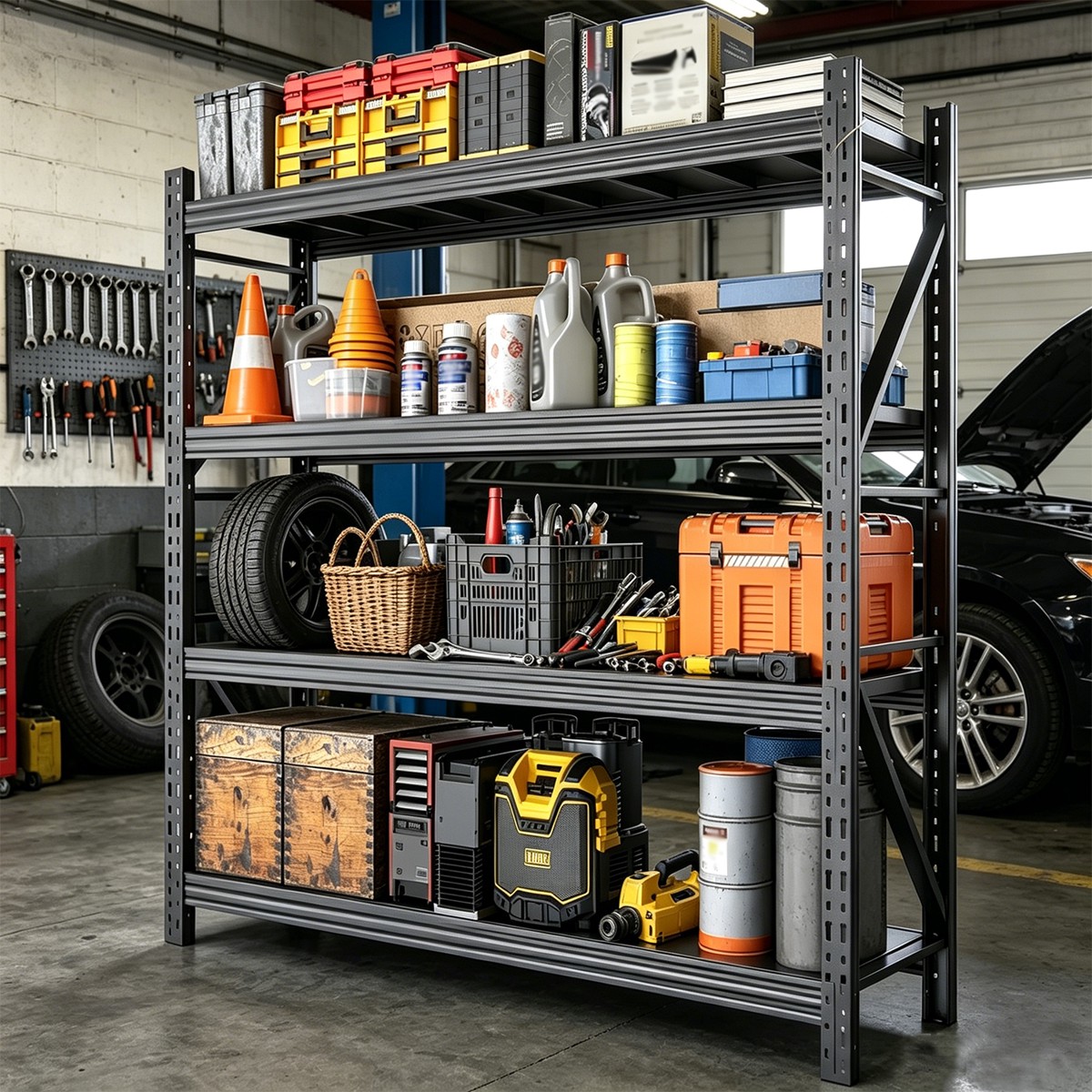

Photos from current listings. Actual item, color, and included accessories may vary.
Industrial Shelf Wall Buying Guide
Industrial wall shelves are heavy-gauge steel or wire rack systems that mount to wall studs or freestanding uprights to carry dense loads of tools, parts, and equipment. The primary trade-off is between static load rating and wall-fastener/construction quality: high capacities demand thicker steel, deeper beams, and proper stud anchoring, while lighter consumer units often use thinner gauge and plastic connectors that creep under sustained load. The clear decision rule is to match the shelf's per-tier capacity and mounting method to your actual wall substrate and load profile, not to chase a headline total weight figure.


At a glance
- Category
- Garage Storage
- Data updated
- Nov 20, 2026
Current offers
Highlights
- Load capacity is rated per tier or per pair of beams, not as a single total; a 2500 lb unit across 4 tiers typically means roughly 625 lb per shelf when evenly distributed and properly anchored.
- Steel gauge drives durability: 14–16 gauge uprights and beams resist bending and bolt-hole elongation, while 18–20 gauge consumer racks are prone to flex and connector fatigue under sustained loads.
- Wall-mounted industrial shelves transfer load into studs or masonry; freestanding boltless racking carries load through upright posts to the floor, so wall condition is irrelevant but floor levelness matters.
- Post-and-beam boltless racking with rivet or keyhole connectors assembles without tools and allows tier height adjustment in 1–2 inch increments; welded or bolted units are stiffer but fixed or require wrenches.
Best use cases
- Best fit for a garage with exposed studs and a concrete floor: choose freestanding boltless steel racking rated at least 600–800 lb per tier for engine blocks, tires, and stacked totes; skip thin wire shelving.
- Best fit for a finished wall with 16-inch on-center studs: choose wall-mounted industrial shelf brackets rated to the load and fasten with 5/16-inch lag screws into stud centers; skip drywall anchors for anything over 50 lb per bracket.
- Best fit for a workshop needing frequent reconfiguration: pick adjustable boltless beams with 1.5-inch height increments and a powder-coated finish; skip welded fixed-tier units if you plan to change shelf spacing.
- Wrong fit for damp basements or coastal garages: standard powder-coated or zinc-plated steel rusts; choose galvanized or stainless construction, or accept reduced service life.
Buying tips
- Measure your wall stud spacing first: standard is 16 inches on center, but older garages may be 24 inches; wall shelf brackets must land on studs, so choose a unit whose mounting holes align or plan a plywood ledger board.
- Use the per-tier rating, not the total: divide the headline capacity by the number of tiers to get even-load per shelf, then derate 20–30% for concentrated point loads like a single heavy tool box.
- Match fastener grade to load: 1/4-inch lag screws into studs are adequate for light-to-medium wall shelves, but 5/16-inch or 3/8-inch lag screws or through-bolts are required for heavy industrial wall racks; masonry walls need sleeve anchors.
- For freestanding racking, confirm upright gauge and beam style: 14-gauge uprights with rivet-lock beams handle warehouse-grade loads, while 16-gauge is the practical minimum for a home garage; plastic foot caps and mallet-assembled units are lighter duty.
Specs
| Material | Powder-coated steel / galvanized |
|---|---|
| Steel Gauge | 14–16 ga heavy; 18–20 ga light |
| Mount Type | Wall bracket vs freestanding rack |
| Per-Tier Load | 200–800 lb typical; 600+ heavy-duty |
Related searches
What to check before buying
- Verify wall substrate: locate studs with a stud finder, confirm 16- or 24-inch spacing, and check for plumbing or wiring before drilling; masonry walls require a hammer drill and sleeve anchors.
- Measure floor-to-ceiling height and shelf depth clearance: a 73-inch-tall unit needs at least 80 inches of clear height for loading, and 14–18 inch depth fits standard garage walkways while 24-inch depth suits bulky bins.
- Check floor level and condition for freestanding racks: uneven or cracked concrete causes racking; use shims under uprights and confirm the unit has adjustable foot levelers.
- Confirm the load path: wall-mounted shelves need a continuous load path from bracket to stud to foundation; freestanding racks need a level floor and, for tall units, optional wall tie-back brackets for tip-over resistance.
FAQ
Data sources: eBay / Amazon listings and product attribute feeds Data updated Nov 20, 2026.
Some links on this page are affiliate links. If you buy after clicking one, we may earn a commission at no extra cost to you. This does not change which products appear here or their order. Affiliate disclosure.