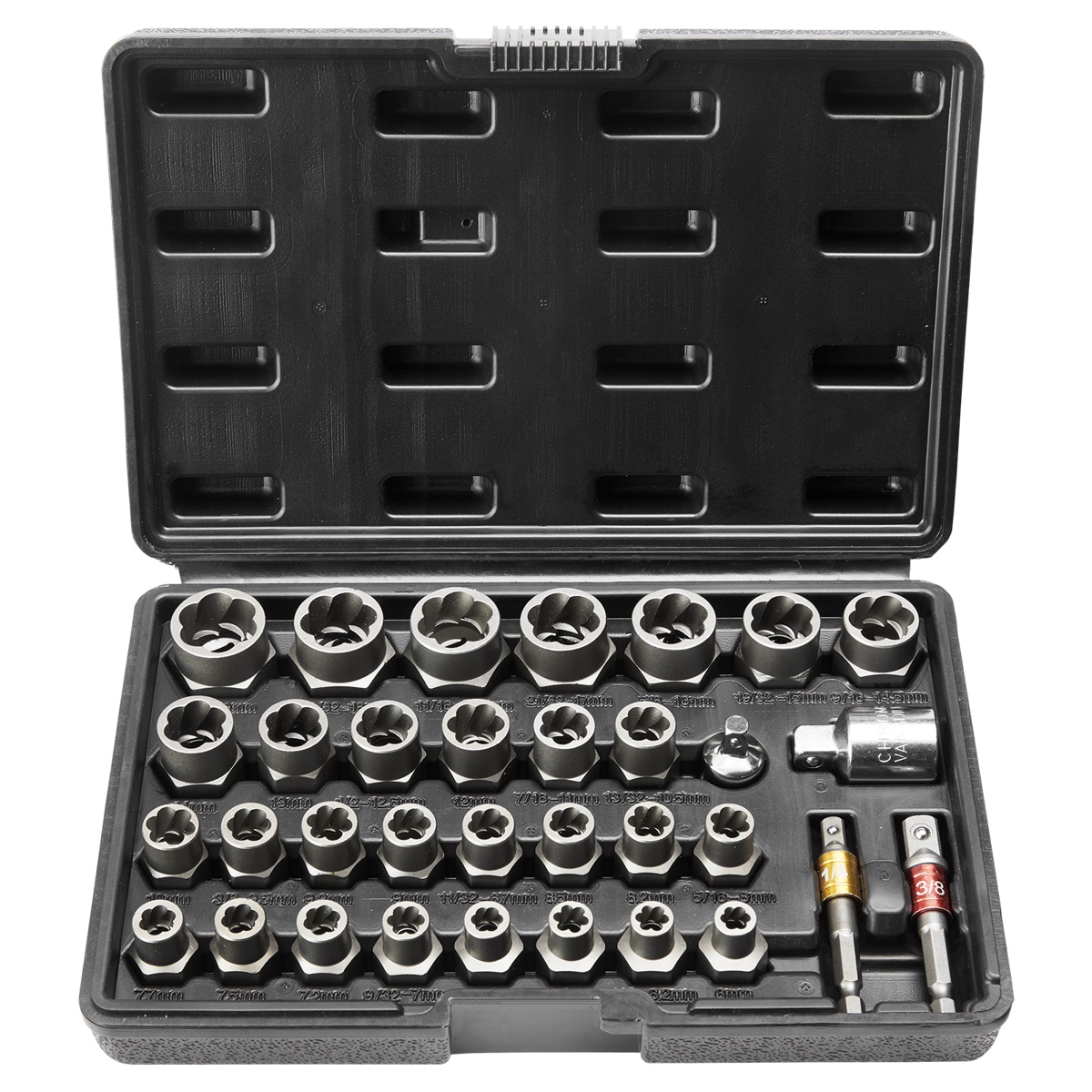

Photos from current listings. Actual item, color, and included accessories may vary.
Bolt Extractor Socket Set Buying Guide
A bolt extractor socket set is a damaged-fastener removal system that bites into rounded or rusted bolt heads using reverse-fluted sockets. The core trade-off is steel grade and flute geometry: Cr-Mo (chromium-molybdenum) sockets survive high torque without cracking, while cheaper carbon-steel or thin-wall versions deform or strip the head further. Buy Cr-Mo or S2 tool-steel extractors with a deep reverse-flute pattern for any bolt you cannot sacrifice; skip low-cost carbon-steel kits for seized automotive or structural fasteners.


At a glance
- Category
- Hand Tools
- Data updated
- Nov 20, 2026
Current offers
Highlights
- Cr-Mo steel (chromium-molybdenum) extractor sockets resist cracking and mushrooming under breaker-bar torque better than carbon steel or Cr-V alternatives.
- Reverse spiral flutes cut deeper as torque increases, so left-hand extraction force tightens the bite instead of spreading the socket walls.
- Two families exist: spline/star-style extractors for rounded hex heads, and nut-remover sockets with straight flutes for fully stripped nuts and studs.
- Deep-well extractor sockets (typically 1.5–2 in deep) clear protruding studs and recessed bolt heads that shallow sockets cannot reach.
Best use cases
- Choose a Cr-Mo spline-flute socket set with 3/8 in drive for rounded brake caliper, exhaust, and suspension bolts on daily-driven vehicles.
- Choose a nut-remover socket set with 1/2 in drive and straight flutes for fully stripped lug nuts and rusted exhaust flange nuts under high torque.
- Skip 12-point chrome sockets and any carbon-steel 'extractor' kit for seized head bolts or structural fasteners — they round the head further or crack.
- Choose a compact 1/4 in drive extractor set for small rusted screws, hose clamps, and interior fasteners where a 3/8 in body will not fit.
Buying tips
- Match drive size to torque: 1/4 in for fasteners under ~15 ft-lb, 3/8 in for 15–80 ft-lb, and 1/2 in for lug nuts and suspension bolts above 80 ft-lb.
- Pick Cr-Mo or S2 steel over Cr-V; Cr-V extractor sockets are harder and more brittle and can shatter under breaker-bar load.
- Confirm the socket's hex size covers the damaged head, not the original size — a 13 mm rounded head often needs a 12 mm or 12.5 mm extractor.
- Choose a set with left-hand reverse flutes and a matching storage case that indexes sizes, so you grab the right extractor without trial fitting.
Specs
| Material Grade | Cr-Mo vs S2 vs carbon steel |
|---|---|
| Drive Size | 1/4, 3/8, 1/2 in |
| Flute Style | Spline vs straight nut-remover |
| Socket Depth | Standard vs deep-well |
Related searches
What to check before buying
- Measure the damaged bolt head across flats with calipers; select an extractor 0.5–1 mm smaller than the rounded head for a bite.
- Check clearance around the fastener: deep-well extractor sockets need 2–3 in of axial room and a straight approach for the breaker bar.
- Confirm your ratchet/breaker bar drive (1/4, 3/8, or 1/2 in) matches the set's drive, or budget for an adapter.
- For rusted or seized fasteners, have penetrating oil and a wire brush on hand — extractors bite best on clean, burr-free heads.
FAQ
Data sources: eBay / Amazon listings and product attribute feeds Data updated Nov 20, 2026.
Some links on this page are affiliate links. If you buy after clicking one, we may earn a commission at no extra cost to you. This does not change which products appear here or their order. Affiliate disclosure.