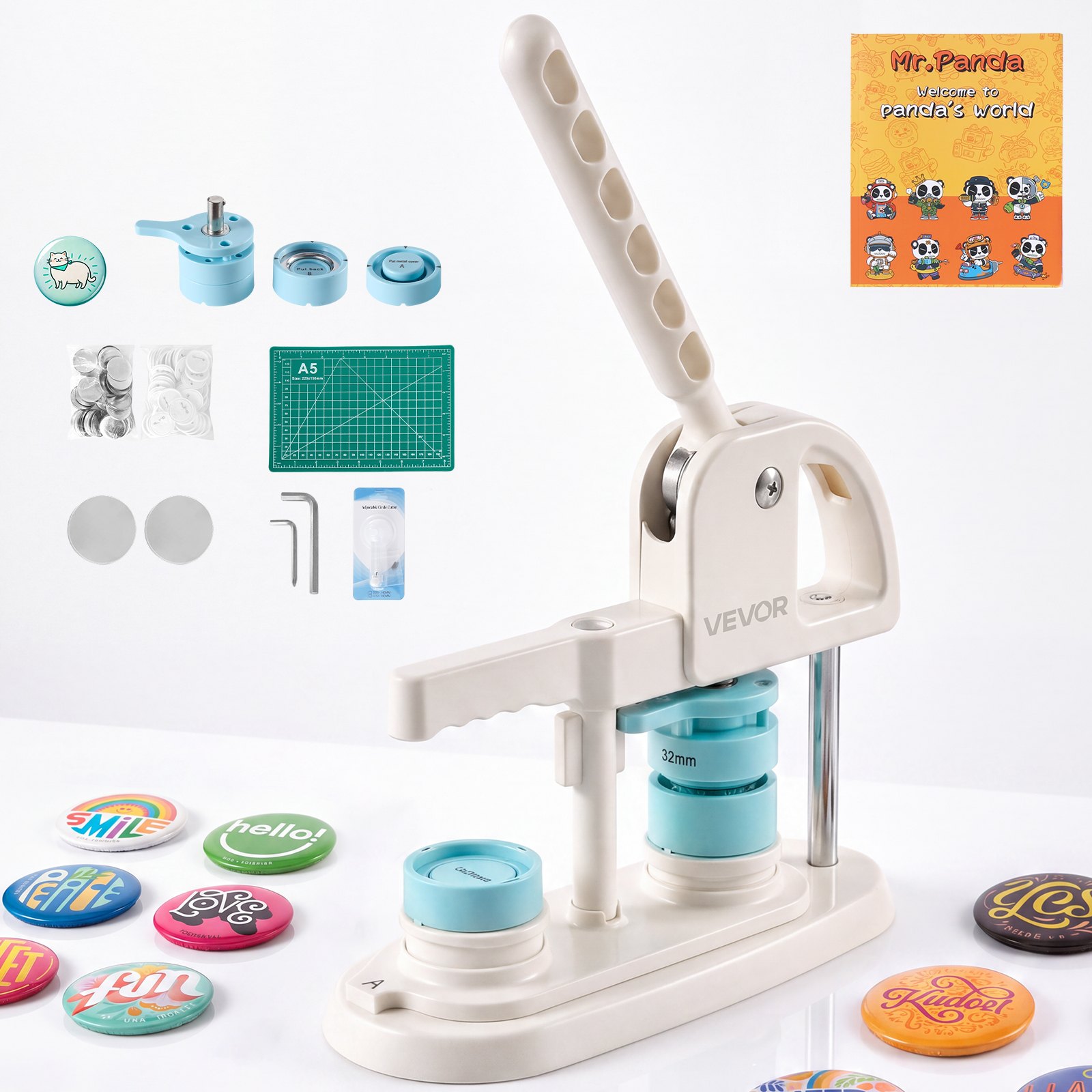

Photos from current listings. Actual item, color, and included accessories may vary.
Button Maker Buying Guide
A button maker is a manual or motorized press that crimps a metal shell, graphic, and pin-back (or keychain/magnet) into a finished badge. The core trade-off is die-cast metal frames with interchangeable hardened steel dies versus stamped or plastic frames with fixed, soft dies that wear out and misalign. Buy a metal-frame press with replaceable dies sized to your standard graphic; skip plastic-body kits with glued dies if you intend to make more than a few hundred buttons.


At a glance
- Category
- Hand Tools
- Data updated
- Nov 20, 2026
Current offers
Highlights
- Frame material splits durability: die-cast aluminum or cast iron holds die alignment under repeated cycling; stamped steel and ABS plastic flex and cause off-center crimps.
- Die sizing drives everything—common pin-back standards are 1", 1.25", 1.5", 2.25", and 3" (25/32/38/58/75 mm); each size needs its own matched die set and graphic cutter.
- Interchangeable die systems (bayonet or screw-in) let one press run multiple sizes; fixed-die presses lock you to a single diameter for the machine's life.
- Handle and leverage determine force: reinforced ergonomic handles and compound linkage reduce operator fatigue on 2.25"+ shells where crimping force rises sharply.
Best use cases
- Best fit for high-volume crafters or small shops: a cast-metal press with quick-change dies in 1.25" and 2.25"—these two cover the most common pin-back and keychain blanks.
- Best fit for occasional DIY and school projects: a 1" or 1.25" metal-frame kit with 100-count parts; skip motorized units, which add cost without benefit below a few hundred pieces per session.
- Wrong fit: plastic-frame or fixed-die kits for anyone selling buttons—soft dies deform after a few hundred cycles and produce rejected shells. Also skip 3" presses unless you specifically need large badges; blanks and graphics cost more per unit.
Buying tips
- Match the die to the blank, not the graphic: a 1.25" (32 mm) pin-back needs a 32 mm die and a graphic cut about 2-4 mm smaller than the shell diameter for clean wrap.
- Choose a press whose die system is explicitly interchangeable and sold as separate modules; confirm the same brand stocks 1", 1.25", 1.5", and 2.25" dies for that frame.
- For 2.25" (58 mm) and 3" (75 mm) shells, prioritize compound-lever or reinforced-handle metal presses—single-pivot plastic handles require excessive force and crack.
- Parts count in kits is consumables, not capability: 100 sets of shells/pins is a starter quantity; verify the kit includes matching clear film and a circle cutter for your die size.
Specs
| Frame Material | Die-cast aluminum / cast iron vs plastic |
|---|---|
| Die System | Interchangeable vs fixed single-size |
| Common Sizes | 1" / 1.25" / 1.5" / 2.25" / 3" (25-75 mm) |
| Drive Type | Manual lever vs motorized/pneumatic |
Related searches
What to check before buying
- Measure your intended graphic: the cutter diameter must match the die size or slightly undershoot it (typically 2-4 mm less than shell OD) for a flat, wrinkle-free face.
- Confirm bench space and mounting: cast-metal presses are heavy and should be clamped or bolted to a stable surface; measure the press footprint before buying.
- Check the blank standard you will restock: pin-back, keychain, magnet, and bottle-opener backs each use different shell depths—buy a press whose dies support the back types you need.
- Verify die availability and spare parts (springs, cutting mats) from the same maker; a press with discontinued dies becomes a single-size machine.
FAQ
Data sources: eBay / Amazon listings and product attribute feeds Data updated Nov 20, 2026.
Some links on this page are affiliate links. If you buy after clicking one, we may earn a commission at no extra cost to you. This does not change which products appear here or their order. Affiliate disclosure.