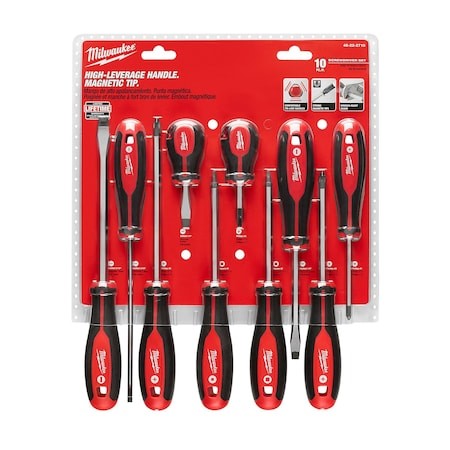

Photos from current listings. Actual item, color, and included accessories may vary.
Milwaukee Screwdriver Set Buying Guide
A Milwaukee screwdriver set is a hand tool kit built around chrome-plated steel blades and either acetate or dual-material handles, with the main trade-off being grip comfort and tip durability versus count and stubby/insulated coverage. The clear decision rule: buy a set with forged or hardened tips, a defined handle material (acetate or dual-material rubber overmold), and the exact tip mix you use daily; skip generic no-name driver sets even if the red color mimics pro brands.


At a glance
- Category
- Hand Tools
- Data updated
- Nov 20, 2026
Current offers
Highlights
- Milwaukee sets typically use hardened steel blades with chrome plating for corrosion resistance and forged tips on premium lines; entry sets may use stamped or less-hardened tips that round out faster.
- Handle architecture splits into classic acetate (fluted, solvent-resistant, thinner) and dual-material rubber-overmold grips (larger, cushioned, better torque transfer but bulkier in tight spaces).
- 10-piece kits like the 48-22-2710 pattern cover Phillips #1/#2, slotted, and square-drive tips; larger 20+ piece kits add Torx, hex, and precision sizes for electronics and specialty fasteners.
- Stubby and insulated (1000V-rated) variants are separate models — a standard set will not substitute for VDE-insulated work or low-clearance stubby tasks.
Best use cases
- Best fit: general home/auto repair and cabinet work — pick a 10–14 piece dual-material set with Phillips #1/#2, slotted, and square tips; skip precision electronics kits for this.
- Best fit: electrician or panel work — choose a VDE 1000V-insulated set with individually tested blades; a standard set's acetate handles are not rated for live voltage.
- Wrong fit: tight cabinet hinges and recessed fasteners — a standard long-shaft set will not reach; add a stubby set or a bit-holder with short bits instead of forcing a long driver.
- Wrong fit: precision eyeglass/laptop screws — full-size Milwaukee drivers are too large; use a precision micro-bit set (PH000, T5, etc.) instead.
Buying tips
- Count tips by your actual fastener inventory: most households need Phillips #1/#2, slotted 3/16–1/4 in, and square #1/#2; Torx and hex are only worth paying for if you service bikes, appliances, or electronics.
- Check handle material: acetate handles resist solvents and slide into tight pockets, while dual-material rubber overmolds give better grip and torque — pick based on hand size and task, not color.
- Match tip finish to durability needs: forged/hardened tips hold their edges longer on high-torque fasteners; stamped tips are fine for light-duty assembly but wear faster on stuck screws.
- If you work near live circuits, insist on a VDE 1000V-rated insulated set — standard Milwaukee sets are not voltage-rated regardless of handle color.
Specs
| Tip Material | Hardened/forged steel, chrome plated |
|---|---|
| Handle Type | Acetate or dual-material rubber overmold |
| Set Size Range | 4-10 pc basics; 14-30+ pc full kits |
| Insulation Rating | VDE 1000V on insulated models only |
Related searches
What to check before buying
- Measure your fastener sizes and tip types before buying; a set missing your most-used size (usually Phillips #2 or square #2) forces a second purchase.
- Confirm handle diameter fits your hand and the clearance of recessed holes — dual-material grips are thicker and may not fit narrow counterbored fasteners.
- For electrical work, verify the set is VDE 1000V insulated and each blade is individually tested, not just color-coded.
- Check storage: rails, trays, or cases determine whether the set fits your toolbox drawer; loose sets lose sizes fastest.
FAQ
Data sources: eBay / Amazon listings and product attribute feeds Data updated Nov 20, 2026.
Some links on this page are affiliate links. If you buy after clicking one, we may earn a commission at no extra cost to you. This does not change which products appear here or their order. Affiliate disclosure.