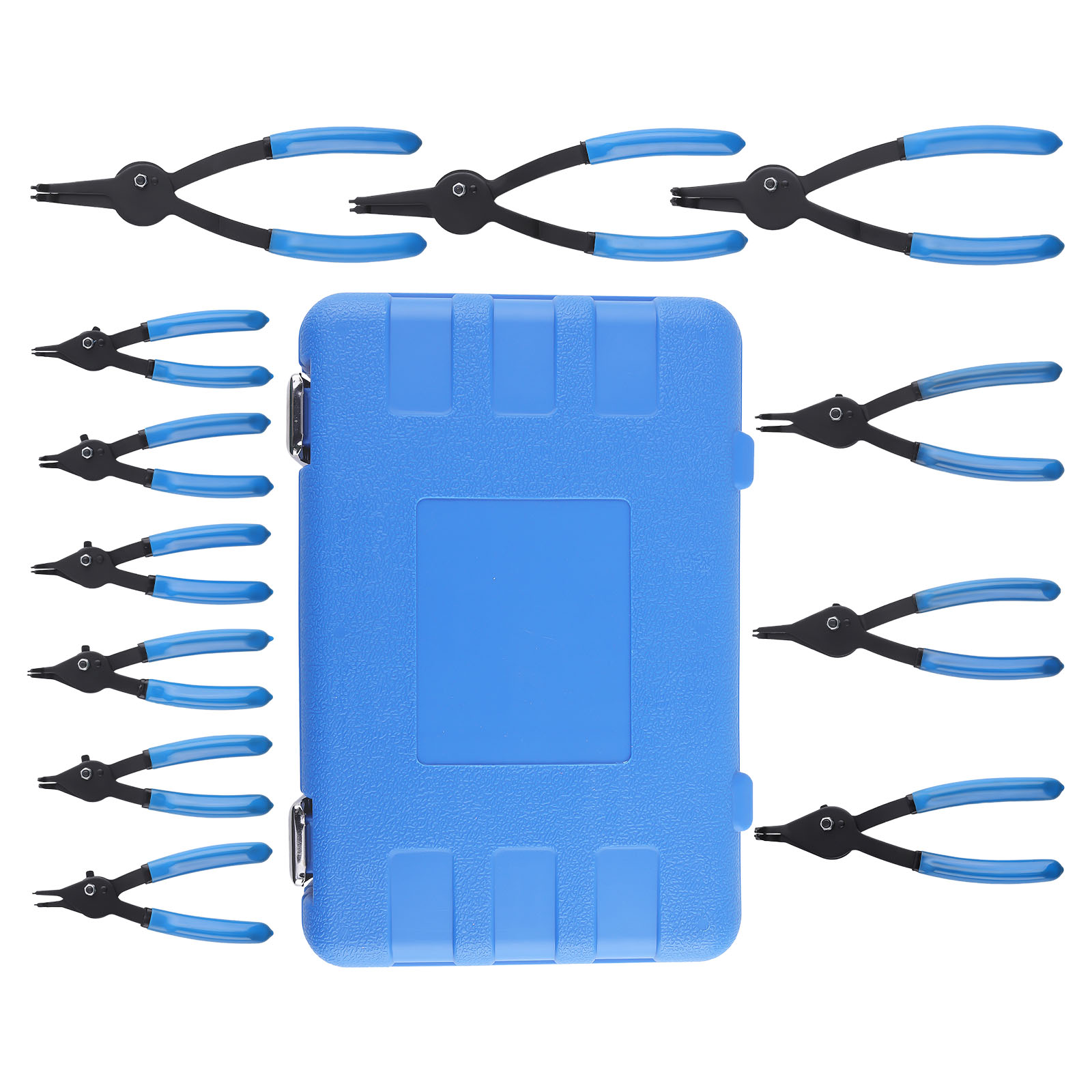

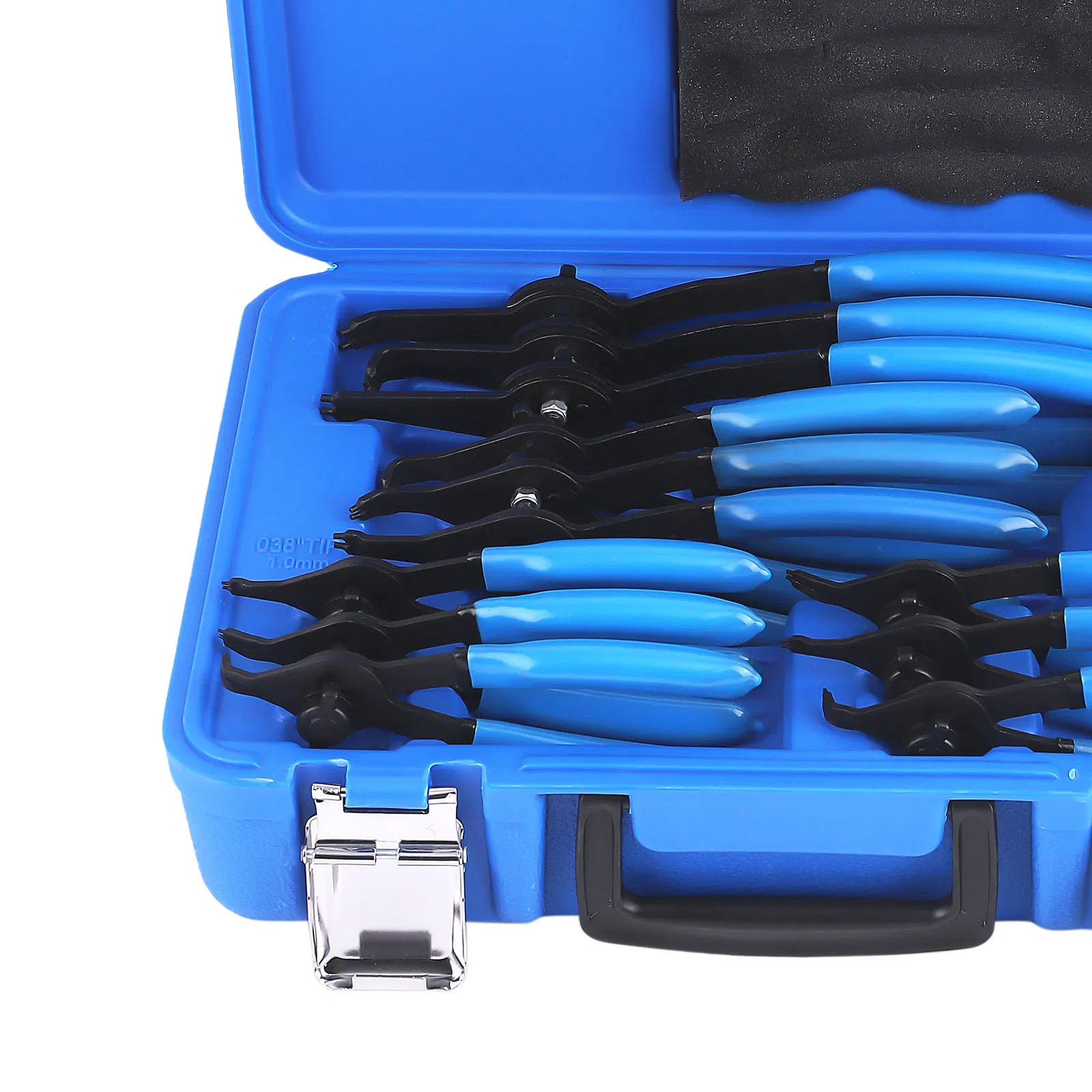
Photos from current listings. Actual item, color, and included accessories may vary.
Snap Ring Plier Set Buying Guide
A snap ring plier set is a specialized hand-tool kit for installing and removing internal and external retaining rings on shafts and in bores. The primary trade-off is between fixed-tip utility kits and convertible ratcheting pliers: fixed-tip sets cover more angles cheaply but risk tip fatigue, while interchangeable-tip or ratcheting designs trade higher cost for repeatable tip alignment and lower ring-slip damage. The decision rule: choose a set with hardened, correctly sized tips for your ring diameter first, then add angle and handle ergonomics only after the tip-to-ring fit is guaranteed.


At a glance
- Category
- Hand Tools
- Data updated
- Nov 20, 2026
Current offers
Highlights
- Tip diameter must match ring hole size within 0.1–0.2 mm; undersized tips slip and deform rings, oversized tips will not seat fully.
- Fixed-tip 0°, 45°, and 90° pliers cover most straight-on and offset access; convertible-tip pliers add reach but introduce tip wobble if the retention screw loosens.
- Hardened chrome-vanadium or chrome-molybdenum tips resist bending better than mild-steel tips; look for through-hardened tips, not case-hardened only.
- Ratcheting or locking pliers reduce hand fatigue on large external rings above roughly 40 mm, but add bulk that blocks tight recesses.
Best use cases
- Best fit: a 12-piece fixed-tip set with 0°, 45°, and 90° pliers for general automotive, appliance, and power-equipment repair where ring sizes range from small shaft clips to medium bore rings.
- Best fit: convertible-tip pliers with a full tip assortment for technicians who face many ring sizes and cannot carry six dedicated pliers; buy only if the tip retention mechanism uses a threaded collet, not a friction fit.
- Wrong fit: a single pair of fixed-tip pliers for both internal and external rings—internal and external pliers have opposite jaw action and cannot substitute without ring damage.
- Wrong fit: long-reach or 90° pliers for deep bore access only; they sacrifice straight-line leverage and are poor primary pliers for flat, open work.
Buying tips
- Match tip diameter to ring hole diameter: a 1.5 mm tip fits roughly 1.5–1.7 mm ring holes; using a 2 mm tip in a 1.5 mm hole will not seat and will round the ring.
- For external rings above 40 mm, choose ratcheting or locking pliers; manual fixed-tip pliers require excessive grip force and can spring the ring.
- Prefer chrome-vanadium (CrV) or chrome-molybdenum (CrMo) steel with black-oxide or manganese-phosphate finish; plain polished mild steel tips bend and rust.
- Convertible sets should include at least 1.5, 1.8, 2.0, 2.3, and 2.7 mm tips; missing intermediate sizes force tip substitution that damages rings.
Specs
| Tip Style | Fixed vs interchangeable convertible |
|---|---|
| Tip Angles | 0°, 45°, 90° straight/offset |
| Jaw Action | Internal squeeze vs external spread |
| Tip Material | Hardened CrV/CrMo vs mild steel |
Related searches
What to check before buying
- Measure the ring hole diameter on the retaining rings you service most often and confirm the set includes a matching tip within 0.2 mm.
- Check whether your rings are internal (bores) or external (shafts); most sets include both, but confirm jaw action matches each type.
- Verify the pliers fit your working clearance: 90° heads need roughly 25–40 mm of side clearance, and straight 0° heads need straight-line access.
- Confirm handle grip material and spring type; double-leaf springs suit repetitive work, while coil springs resist over-extension on large rings.
FAQ
Data sources: eBay / Amazon listings and product attribute feeds Data updated Nov 20, 2026.
Some links on this page are affiliate links. If you buy after clicking one, we may earn a commission at no extra cost to you. This does not change which products appear here or their order. Affiliate disclosure.