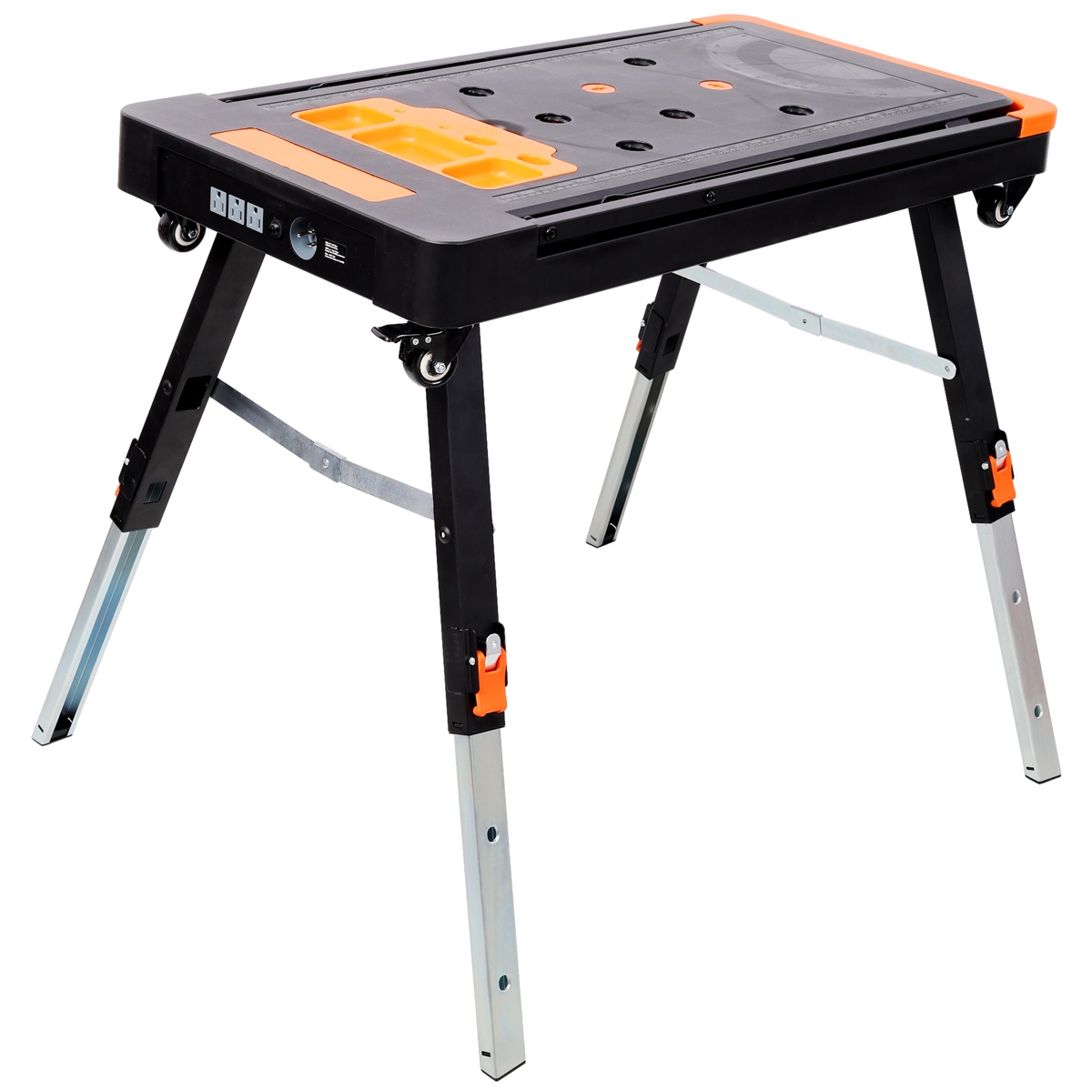

Photos from current listings. Actual item, color, and included accessories may vary.
Heavy Duty Folding Workbench Buying Guide
A heavy-duty folding workbench is a portable or stowable work surface engineered to support 300–1000+ lb loads while collapsing for storage. The key trade-off is between steel frame gauge, leg-lock design, and top thickness versus portability and price. Choose a welded or bolted steel frame with a minimum 16-gauge wall and a 1.5-inch or thicker top for real durability; skip particleboard tops and friction-lock legs for sustained heavy use.


At a glance
- Category
- Workbenches & Shop Equipment
- Data updated
- Nov 20, 2026
Current offers
Highlights
- Steel frame wall thickness of 16-gauge (1.5 mm) or thicker separates heavy-duty from light-duty; thinner 18–20-gauge frames flex under load.
- Leg locking mechanisms—spring-loaded pins or over-center cam locks—determine stability; friction locks and detent pins wear and wobble over time.
- Top material matters: solid wood or 1.5-inch+ MDF core outperforms 0.75-inch particleboard, which sags and crumbles under repeated impact.
- Wheel type and diameter affect portability on shop floors: 3-inch or larger casters roll over cords and debris; 2-inch casters bind on thresholds.
Best use cases
- Best fit: A woodworker needing a temporary assembly table should pick a 48×24-inch welded steel frame with 1.5-inch wood top and 4-inch locking casters; skip folding tables with plastic tops.
- Best fit: A garage mechanic needing a mobile workstation should choose a bench with integrated power strip, 500+ lb capacity, and 3-inch casters; avoid benches with only friction-lock legs.
- Wrong fit: Anyone planning permanent heavy vise work should skip folding benches entirely and bolt a stationary bench to the floor; folding hinges and pins are the weak point under torsional loads.
Buying tips
- Match top thickness to task: 1.5-inch solid wood or 1.75-inch MDF for hammering and vise work; 0.75-inch top is only for light assembly and electronics.
- Verify leg lock type: spring-loaded steel pins or cam-action locks are field-serviceable and resist racking; friction levers and plastic detents fail under 200+ lb side loads.
- Check caster rating: each caster should be rated for at least 25% of the bench's total capacity; 3-inch polyurethane wheels roll best on concrete.
- Confirm folded dimensions against storage space: most 48-inch benches fold to 6–8 inches thick; measure doorways and wall gaps before choosing a 60-inch model.
Specs
| Frame Steel Gauge | 16-ga (1.5 mm) heavy-duty vs 18-ga light |
|---|---|
| Load Capacity | 300–1000 lb evenly distributed |
| Top Thickness | 1.5 in solid wood vs 0.75 in particleboard |
| Caster Size | 3–5 in locking polyurethane vs 2 in nylon |
Related searches
What to check before buying
- Measure your shop floor and doorways: a 48×24-inch bench needs at least 60×36 inches of clear working footprint and a 32-inch door clearance when folded.
- Check floor type: polyurethane casters are safe on epoxy and concrete; nylon casters can flat-spot on hot garage floors.
- Verify electrical needs: if the bench includes a power strip, confirm it has a US-standard 15A plug and a 6-foot cord to reach your wall outlet.
- Confirm companion parts: some folding benches require a separate vise mounting plate or clamp set; budget for these if you plan to mount a vise.
FAQ
Data sources: eBay / Amazon listings and product attribute feeds Data updated Nov 20, 2026.
Some links on this page are affiliate links. If you buy after clicking one, we may earn a commission at no extra cost to you. This does not change which products appear here or their order. Affiliate disclosure.