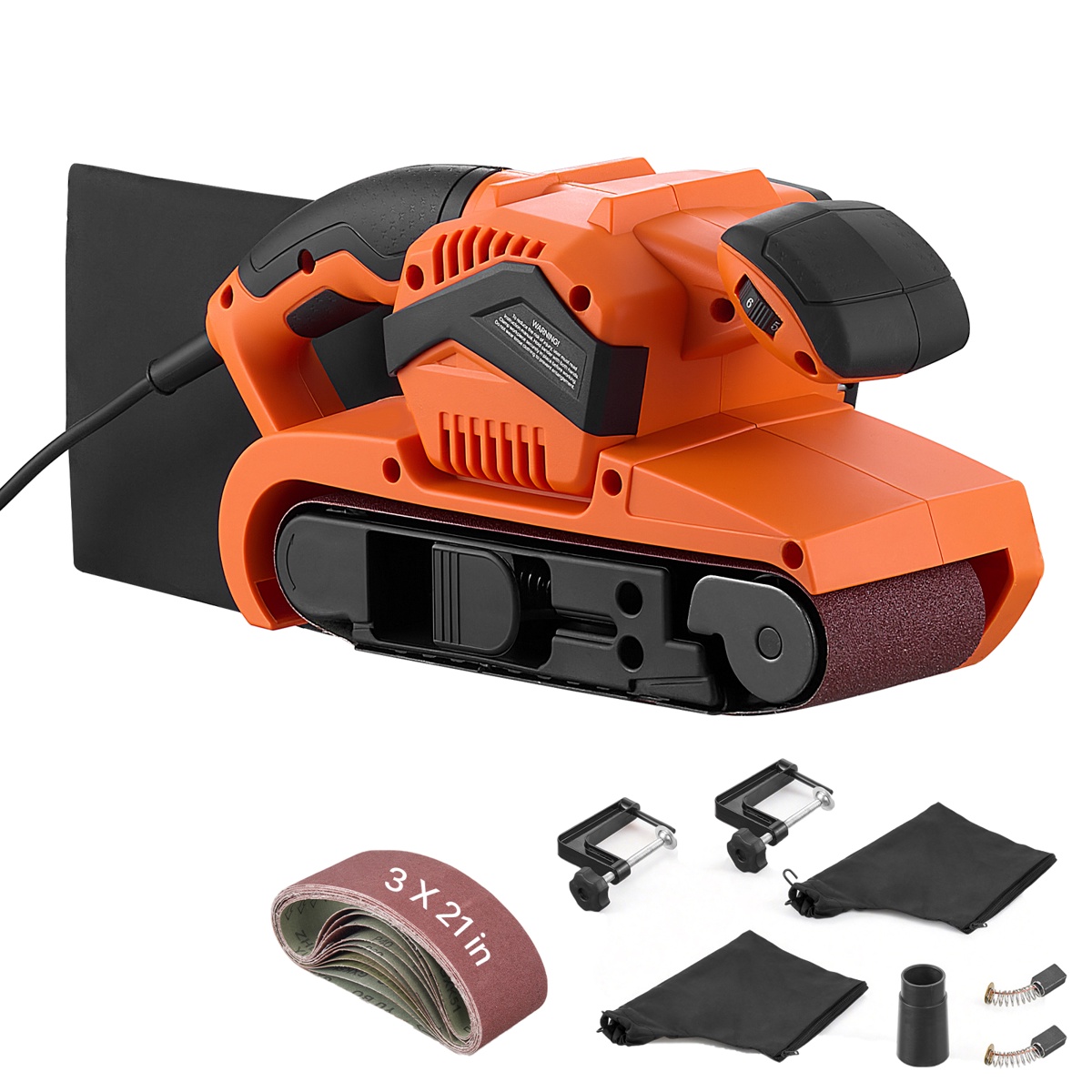

Photos from current listings. Actual item, color, and included accessories may vary.
Belt Sanding Machine Buying Guide
A belt sanding machine removes material fast via a continuous abrasive loop, and the core trade-off is between a lightweight handheld unit and a rigid benchtop frame that keeps the platen flat under load. Buy a machine whose belt tension and platen flatness are engineered for continuous duty, and skip any unit that relies on thin stamped steel or plastic tracking knobs for structural alignment.
At a glance
- Category
- Dust Collection, Sanding & Finishing
- Data updated
- Nov 21, 2026
Current offers
Highlights
- Belt size drives rigidity: 3x21 in and 3x18 in handhelds flex under pressure, while 4x24 in and 4x36 in benchtop units hold a flat platen for true edges.
- Belt speed ranges from 600-1200 FPM on variable-speed handhelds to 1500-1750 FPM on single-speed benchtop motors, with higher speed favoring stock removal over finish.
- Dust collection depends on bag volume and port diameter: 2-bag setups separate coarse chips from fine dust, while a single 1-1/4 in port clogs on resinous woods.
- Motor amperage separates duty classes: 7A class units handle intermittent handheld work, while 8-10A benchtop motors sustain continuous load without thermal shutdown.
Best use cases
- Pick a 3x21 in variable-speed handheld (7A class, 600-1200 FPM) for flattening boards, easing edges, and stripping finish on assembled work; skip it for heavy stock removal on hardwood slabs.
- Choose a 4x24 in or 4x36 in benchtop sander with a cast-iron or heavy steel base for squaring end grain, truing miters, and repeated small parts; skip handhelds for anything needing a fixed 90-degree reference.
- Use a 2-in-1 convertible unit only for occasional hobby work where one tool must cover both roles; skip conversion if you run daily production, because tracking re-alignment after each swap wastes time.
- Skip belt sanders entirely for fine finish work above 180 grit or for contoured surfaces; a random orbital sander or spindle sander delivers the control a linear belt cannot.
Buying tips
- Match belt length to replacement availability: 3x21 in and 4x24 in belts are stocked by every abrasive maker, while odd lengths force custom orders and higher per-belt cost.
- Check platen construction: a graphite-coated or cast platen stays flat and cool, while bare stamped steel wears uneven and transfers heat into the workpiece.
- For benchtop units, confirm the table locks at 90 degrees with a positive stop and that the belt tracking knob is metal, not plastic, to hold adjustment under vibration.
- Size the motor to the belt width: 7A suits 3 in belts, but a 4 in belt needs 8A or more to avoid stalling and burning during continuous edge sanding.
Specs
| Belt Size Class | 3x18 / 3x21 in handheld; 4x24 / 4x36 in benchtop |
|---|---|
| Belt Speed | 600-1200 FPM variable vs 1500-1750 FPM fixed |
| Motor Amperage | 7A handheld; 8-10A benchtop continuous |
| Dust Port | 1-1/4 in to 2-1/4 in; 2-bag preferred |
Related searches
What to check before buying
- Measure your bench or work surface: benchtop belt sanders need 24-36 in of depth and a stable top that accepts the base bolt pattern or clamps.
- Confirm your shop power: most belt sanders draw 7-10A at 120V, so a 15A dedicated circuit is required; a 20A circuit is safer for simultaneous dust collection.
- Verify dust port diameter (commonly 1-1/4 in, 2 in, or 2-1/4 in) against your shop vac hose or cyclone inlet before buying adapters.
- Check belt availability in your grit range locally or from a reliable abrasive supplier; standard 3x21, 4x24, and 4x36 sizes cover coarse through fine grits.
FAQ
Data sources: eBay / Amazon listings and product attribute feeds Data updated Nov 21, 2026.
Some links on this page are affiliate links. If you buy after clicking one, we may earn a commission at no extra cost to you. This does not change which products appear here or their order. Affiliate disclosure.