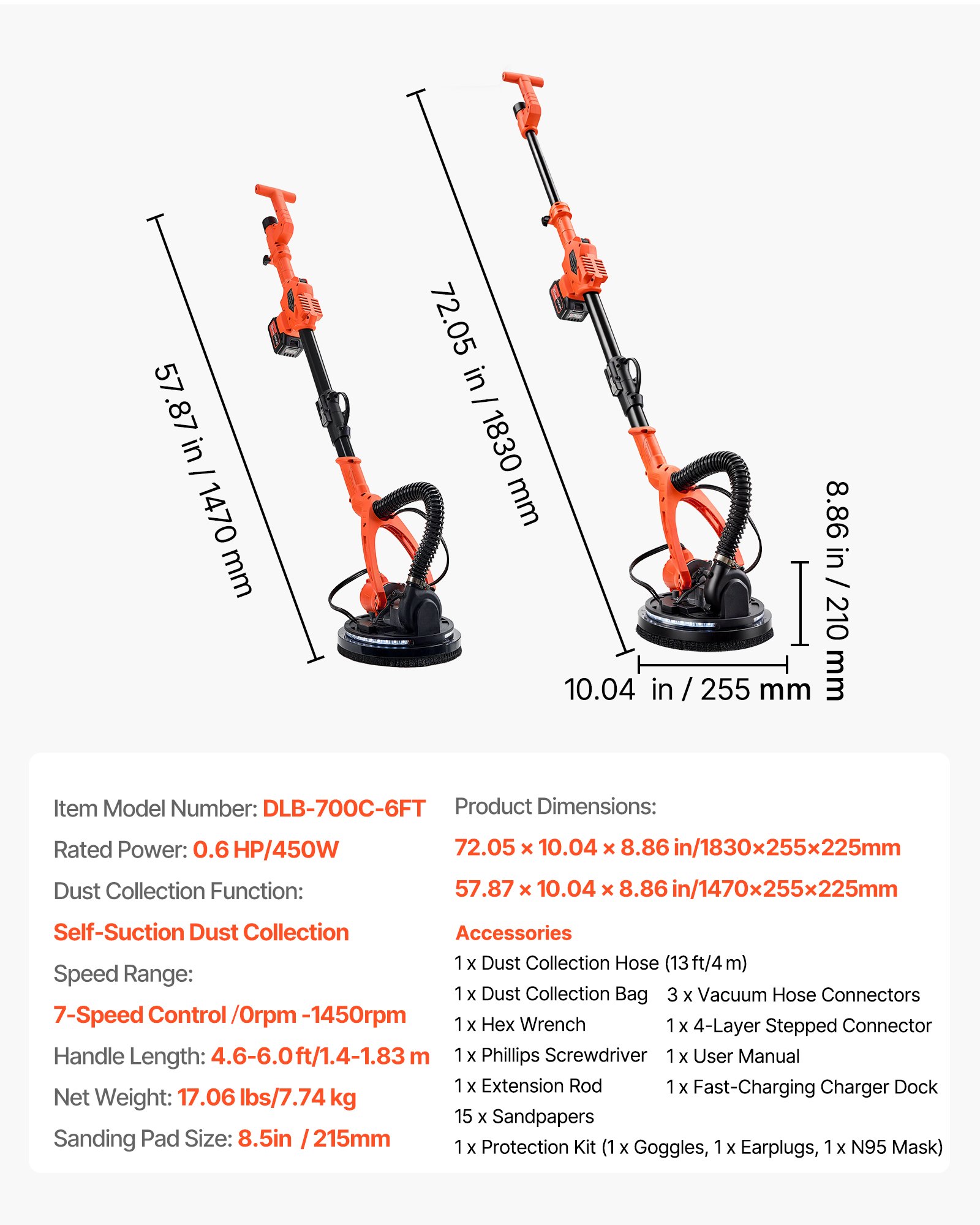

Photos from current listings. Actual item, color, and included accessories may vary.
Cordless Drywall Sander Buying Guide
A cordless drywall sander is a battery-powered rotary tool with an articulating head and dust port for flattening drywall joints and removing texture without a wall outlet. The core trade-off is runtime and head torque versus corded constant power, so buyers must match battery platform and disc diameter to ceiling work. Durable options use brushless motors, rigid telescoping shafts, and sealed dust paths; compromises rely on brushed motors, flex-shaft wobble, and leaky cloth bags.


At a glance
- Category
- Dust Collection, Sanding & Finishing
- Data updated
- Nov 20, 2026
Current offers
Highlights
- Brushless motors deliver 2-3x the runtime of brushed motors at the same battery capacity and maintain RPM under load for consistent scratch patterns.
- Disc diameter determines coverage: 9-inch heads flatten joints fastest but are heavy overhead; 7-inch heads suit detail work and low-dust finishing.
- Effective dust collection requires a sealed port mated to a HEPA vacuum or cyclonic separator; cloth bags on the tool itself leak fine gypsum dust.
- Telescoping handle reach of 4.5-5.5 feet plus an articulating head lets users reach 9-10 foot ceilings without a ladder; flex-shaft extensions add wobble and wear.
Best use cases
- Best fit: 7-inch brushless sander on a 4.0Ah+ battery for room-by-room joint finishing and popcorn ceiling removal in occupied homes with a HEPA vacuum attached.
- Wrong fit: 9-inch brushed sander on a 2.0Ah battery for full-house texture removal—runtime drops under 20 minutes and the head bogs down under pressure.
- Best fit: cordless sander with LED light and articulating head for closet, stairwell, and bulkhead work where cords snag; skip corded models only if you already own the battery platform.
- Wrong fit: buying a cordless sander without a vac hose adapter for fine finishing—gypsum dust overwhelms the onboard bag and settles on cured surfaces.
Buying tips
- Match battery voltage and mount to an existing platform: 18V/20V max batteries from major brands share packs across tools, while 12V models trade power for weight.
- Choose 7-inch discs for 4.5-inch and 5-inch random-orbit sanding compatibility; 9-inch heads need dedicated 9-inch paper and cost more per sheet.
- Require a brushless motor and variable speed of at least 1,000-1,800 RPM for drywall compound; fixed-speed brushed units burn through paper and leave swirl marks.
- Confirm the dust port diameter (typically 1-1/4 to 1-1/2 inches) matches your vacuum hose or a universal adapter before buying.
Specs
| Motor Type | Brushless vs Brushed |
|---|---|
| Disc Diameter | 7 in vs 9 in |
| Battery Platform | 18V/20V max vs 12V |
| Dust Port | 1-1/4 to 1-1/2 in hose |
Related searches
What to check before buying
- Measure ceiling height and wall reach: a 4.5-5.5 ft telescoping handle plus your height must cover the highest joint without a ladder.
- Verify your battery platform voltage and mount style—bare tools need existing packs and chargers, and cross-brand adapters add bulk.
- Check vacuum hose outer diameter against the sander port; a 1-1/4-inch hose fits most compact HEPA vacs, 1-1/2-inch fits standard shop vacs.
- Confirm disc size and backing pad hook-and-loop compatibility so you can buy 7-inch or 9-inch paper in bulk without proprietary refills.
FAQ
Data sources: eBay / Amazon listings and product attribute feeds Data updated Nov 20, 2026.
Some links on this page are affiliate links. If you buy after clicking one, we may earn a commission at no extra cost to you. This does not change which products appear here or their order. Affiliate disclosure.