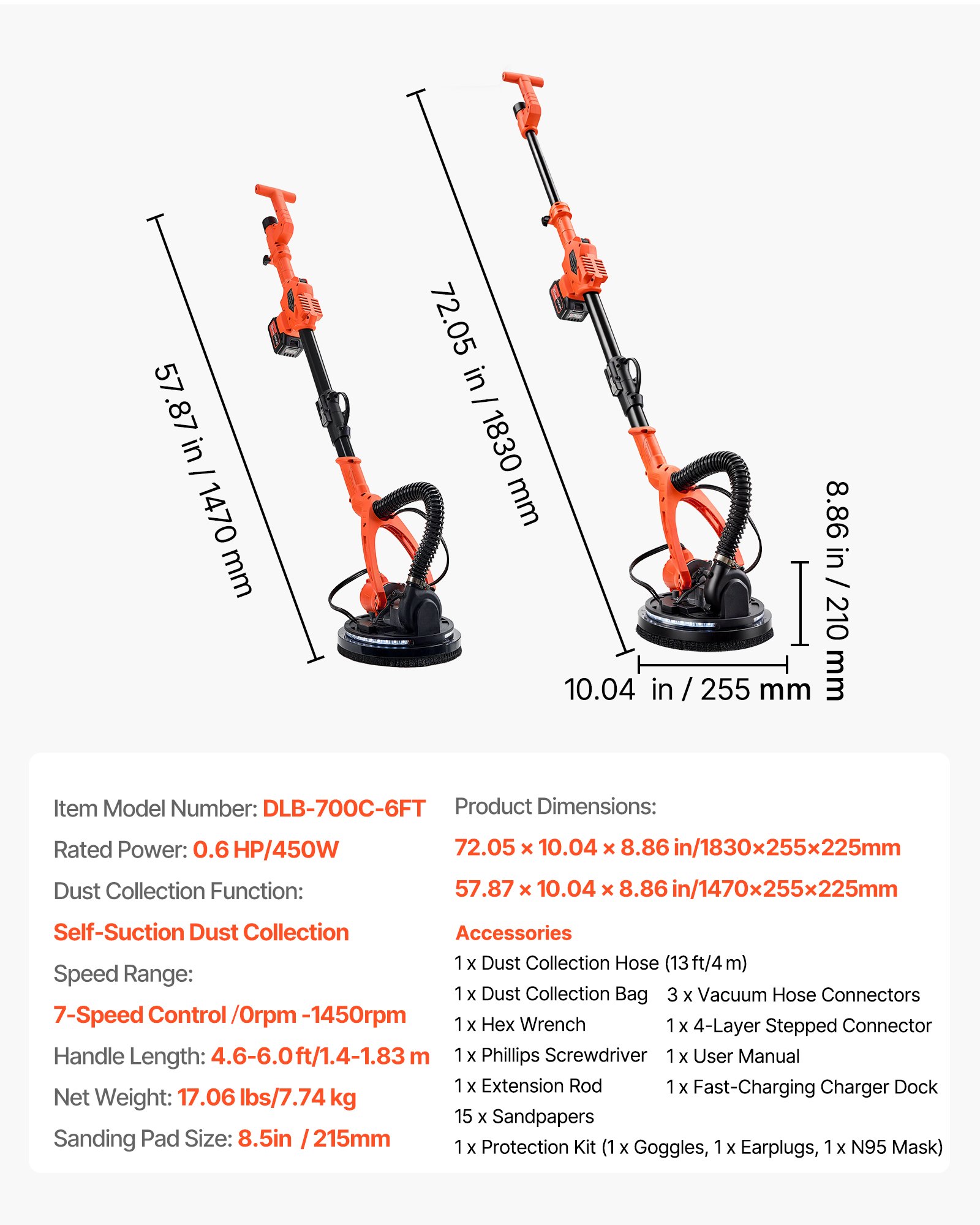

Photos from current listings. Actual item, color, and included accessories may vary.
Electric Sander Buying Guide
Electric sanders span compact palm random-orbit units for finish work, half-sheet straight-line sanders for flattening, and long-reach drywall sanders for walls and ceilings. The decisive trade-off is orbit/action versus power and pad size: random orbital tools blend scratches for finish-ready surfaces, while high-watt fixed-orbit and drywall units remove material fast but demand dust extraction. Buy a brushless random-orbital with a sealed bearing and a real vacuum port for wood; buy a dedicated long-reach drywall sander for walls and ceilings, and skip cordless palm sanders for anything beyond spot work.


At a glance
- Category
- Dust Collection, Sanding & Finishing
- Data updated
- Nov 20, 2026
Current offers
Highlights
- Orbit mechanics define finish quality: random orbital (RO) sanders spin and orbit simultaneously to avoid swirl marks, while dual-action (DA) units switch between fine random orbit and aggressive forced rotation for stock removal.
- Pad diameter governs coverage and control: 5-inch pads are the palm-sander standard for one-handed detailing, 6-inch pads cover about 44% more area and suit flat panels, and half-sheet 1/2 sanders handle edge and corner work.
- Motor class controls load tolerance: brushed 300–400W palm sanders handle light finishing, while 850W-class forced-rotation and 450W drywall units sustain continuous material removal without stalling.
- Dust extraction is a performance spec, not an accessory: an 8-hole or multi-hole pad matched to a vacuum hose keeps abrasive cutting and protects the motor; a cloth bag alone only captures coarse dust.
Best use cases
- Furniture, cabinets, and trim: pick a 5-inch brushless random orbital sander at 3–4 mm orbit with variable speed and a vacuum hose port; skip 6-inch forced-rotation units that gouge narrow stock.
- Walls, ceilings, and popcorn texture: pick a dedicated long-reach drywall sander with a 450W-class motor, 0–1600 RPM variable speed, LED light, and foldable handle; a palm sander cannot reach ceilings safely.
- Flat panels, doors, and table tops: pick a 6-inch random orbital or DA sander in the 350–400W brushless class with a 6–7 speed dial for even coverage and fewer pass marks.
- Spot touch-ups and remote work: cordless 300W-class palm sanders suit light detailing only; skip them for full-room drywall or heavy stock removal where corded power and vacuum extraction are required.
Buying tips
- Match pad size to the work: 5-inch for one-handed detailing and curved profiles, 6-inch for flat panels and faster coverage, 1/2-sheet for edges and corners.
- Choose brushless motors for continuous duty and longer life; brushed motors are acceptable only for occasional light finishing.
- Confirm the orbit diameter: 2.5–3 mm suits finish sanding, 4–5 mm removes stock faster but leaves deeper scratch patterns requiring finer grits.
- For wall work, require a foldable/extendable handle reaching ceiling height, a swivel head, and a vacuum hose connection; 0–1600 RPM is the drywall sanding range.
Specs
| Sander Type | Random orbital / DA / sheet / drywall |
|---|---|
| Pad Size | 5 in / 6 in / 1/2 sheet |
| Motor Class | Brushed 300-400W vs brushless 350-850W |
| Dust Port | Bag / 1-1/4 in or 35 mm vacuum hose |
Related searches
What to check before buying
- Measure the pad and orbit you need against your largest flat surface and tightest corner; a 6-inch pad will not fit cabinet frames where a 5-inch or 1/2-sheet sander will.
- Verify your dust extractor or shop vacuum hose diameter matches the sander port (common 1-1/4 inch and 35 mm fittings); bag-only collection is inadequate for drywall dust.
- For wall and ceiling sanding, confirm the handle extends to your ceiling height and the head swivels; check that the unit's weight is manageable overhead for extended passes.
- Check the plug and voltage standard for your region and confirm the abrasive sheet or disc attachment type (hook-and-loop vs clamp) matches the consumables you can buy locally.
FAQ
Data sources: eBay / Amazon listings and product attribute feeds Data updated Nov 20, 2026.
Some links on this page are affiliate links. If you buy after clicking one, we may earn a commission at no extra cost to you. This does not change which products appear here or their order. Affiliate disclosure.