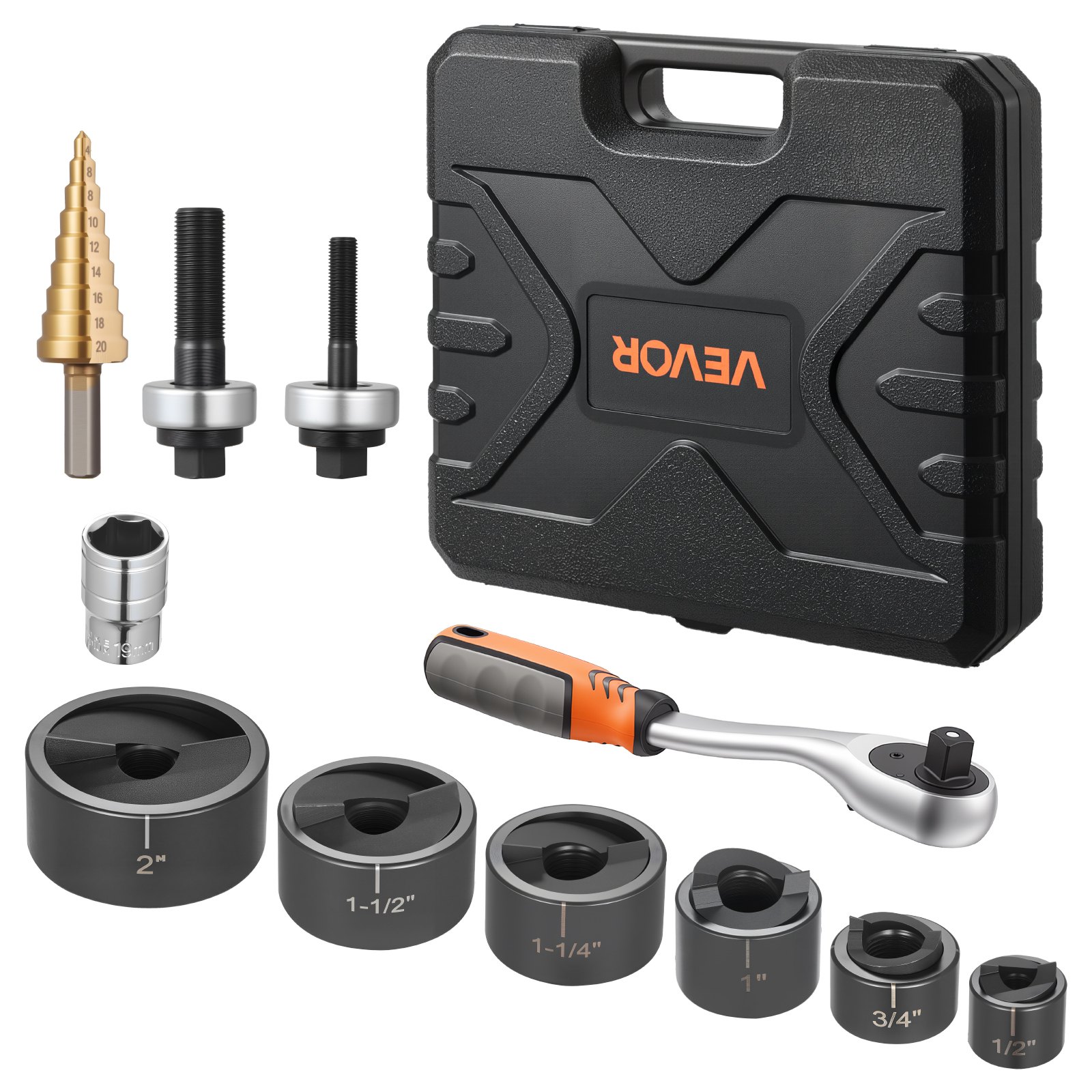

Photos from current listings. Actual item, color, and included accessories may vary.
Hole Punch Buying Guide
A hole punch for electricians is a knockout (KO) punch set that cuts clean, correctly sized conduit and connector holes in electrical enclosures, panels, and boxes. The decisive trade-off is between manual ratchet or hydraulic drivers and the die quality: 40Cr or similar hardened steel dies with precise slug-splitting geometry determine cutter life and hole roundness, while the driver type dictates speed and required clearance. Buy a ratchet or hydraulic set with standard conduit trade-size dies (1/2 in to 2 in) from a known metallurgy grade when you cut mild steel regularly; skip generic carbon-steel dies and undersized mini sets for production work.


At a glance
- Category
- Electrician Hand Tools
- Data updated
- Nov 20, 2026
Current offers
Highlights
- Ratchet KO sets multiply hand force through a pawl mechanism and typically cover 1/2 in to 2 in conduit trade sizes with 6 to 8 dies; hydraulic drivers trade higher upfront cost for one-pull cutting in 10-gauge and thicker steel.
- Die metallurgy is the durability limiter: 40Cr (AISI 5140) hardened dies resist deformation and edge rollover far better than plain carbon steel, and slug-splitting or four-point punch profiles reduce jamming in mild steel.
- Standard KO punches follow the conduit trade-size convention (1/2 in KO cuts a 0.875 in actual hole for 1/2 in conduit), so die sets must match the connector series, not nominal pipe diameter.
- Manual draw-stud and wrench-driven sets are the low-cost entry tier but require high torque and stall on stainless; ratchet and hydraulic drivers are the practical minimum for repeated mild-steel enclosure work.
Best use cases
- Best fit: an electrician punching 1/2 in to 2 in conduit entries in mild-steel enclosures and panels should pick a ratchet KO set with 40Cr dies and a full 6-die range; skip mini 3-die sets that stop at 1-1/4 in.
- Best fit: high-volume panel shops cutting 10-gauge and thicker steel or stainless should choose a hydraulic KO driver with the same die range; a manual ratchet will fatigue operators and distort dies on thick stainless.
- Wrong fit: occasional aluminum, fiberglass, or plastic enclosure work does not justify a hydraulic set; a basic ratchet or wrench-driven 40Cr set covers these softer materials at lower cost.
- Wrong fit: buying a single-size punch for one connector size locks you out of future conduit upgrades; a 1/2 in to 2 in multi-die set is the minimum sensible kit for service electricians.
Buying tips
- Match dies to conduit trade size, not actual hole diameter: a 1/2 in KO die produces roughly a 7/8 in (0.875 in) hole, 3/4 in KO about 1-1/8 in, and 1 in KO about 1-3/8 in, per standard knockout dimensions.
- Confirm driver clearance: ratchet KO tools need about 2 in of free space behind the panel for the draw stud and wrench swing, so check box depth and wall clearance before buying a long-body hydraulic head.
- Prefer 40Cr or equivalent hardened-alloy dies with a black-oxide or coated finish; uncoated carbon-steel dies dull faster and gall when cutting mild steel above 16 gauge.
- Verify the set includes the correct draw stud, spacer, and slug-splitting punch for your driver type; hydraulic and ratchet studs are not interchangeable across brands.
Specs
| Driver Type | Ratchet / Hydraulic / Wrench |
|---|---|
| Die Material | 40Cr hardened alloy vs carbon steel |
| KO Size Range | 1/2 in to 2 in conduit trade sizes |
| Max Mild Steel | 10-16 gauge (driver dependent) |
Related searches
What to check before buying
- Measure the enclosure wall thickness and material: ratchet sets handle mild steel up to roughly 10 gauge, while stainless above 16 gauge generally needs hydraulic assistance.
- Check clearance behind the panel for the draw stud and driver body; deep boxes and closed cabinets can block long hydraulic rams.
- Confirm your connector series uses standard conduit trade sizes (1/2 in to 2 in) so the die set matches the fittings you already stock.
- Verify the kit ships with the matching draw stud, spacer, and carrying case for the driver type you choose; mismatched studs are the most common setup failure.
FAQ
Data sources: eBay / Amazon listings and product attribute feeds Data updated Nov 20, 2026.
Some links on this page are affiliate links. If you buy after clicking one, we may earn a commission at no extra cost to you. This does not change which products appear here or their order. Affiliate disclosure.