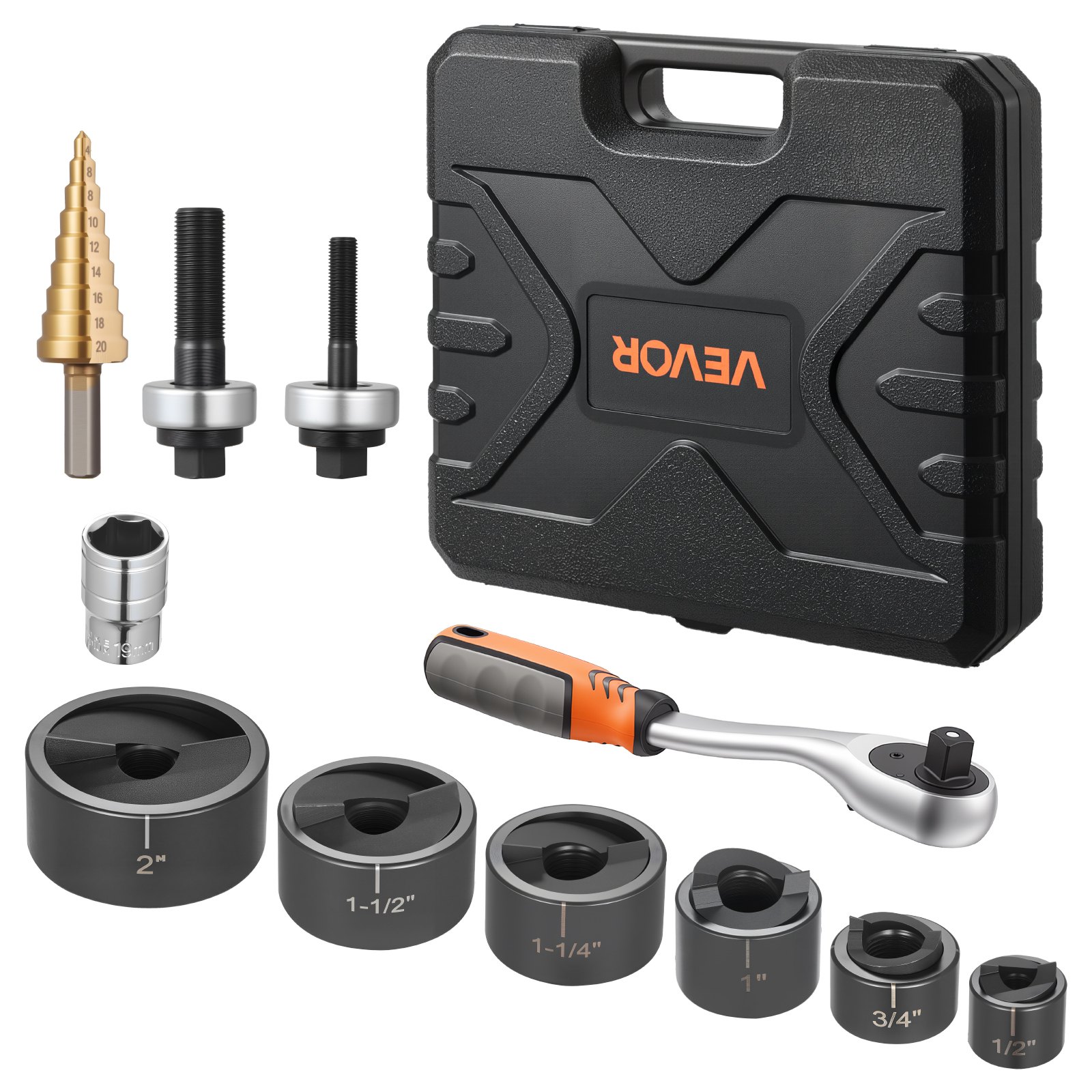

Photos from current listings. Actual item, color, and included accessories may vary.
Knockout Punch Set Buying Guide
A knockout punch set is a hydraulic or ratchet-driven hole-making system that punches clean, burr-free conduit and connector holes through mild steel, aluminum, fiberglass, and plastic electrical enclosures. The core trade-off is driver architecture (manual ratchet vs hydraulic pump) and die steel grade: budget sets use softer dies and thin drivers that deform under load, while professional sets use hardened 40Cr or S7 tool steel dies, thrust bearings, and sealed hydraulic cylinders rated for thousands of cycles. Buy a ratchet set for 1/2 in to 2 in work in thin-gauge enclosures, and step up to a hydraulic driver with hardened dies for 2-1/2 in to 4 in holes or repeated daily punching in 10-gauge and thicker steel.


At a glance
- Category
- Electrician Hand Tools
- Data updated
- Nov 20, 2026
Current offers
Highlights
- Manual ratchet knockout drivers multiply hand force through a geared rack or screw; hydraulic drivers convert pump pressure into 8-12 tons of force, letting one person punch 4 in holes in 10-gauge steel.
- Die and punch steel grade is the durability determinant: 40Cr tool steel holds an edge for hundreds of holes in mild steel, while unhardened carbon-steel dies mushroom and gall within dozens of cycles.
- Standard knockout sizes follow conduit trade sizes: 1/2, 3/4, 1, 1-1/4, 1-1/2, and 2 in covers most branch-circuit enclosures; 2-1/2, 3, 3-1/2, and 4 in are required for feeder and service-entrance work.
- A complete set pairs each punch with a matching die and draw stud; the draw stud thread and length must match the driver (3/4-16 or 5/8-18 are common), and short studs cannot span thick wall enclosures plus the punch stack.
Best use cases
- Best fit: a 1/2 in to 2 in ratchet set with 40Cr dies for residential and light-commercial electricians punching boxes, panels, and enclosures up to 14-gauge steel; skip hydraulic kits unless you routinely exceed 2 in.
- Best fit: a hydraulic knockout set covering 1/2 in to 4 in for industrial and service electricians working 10-gauge and thicker steel, stainless, or repeated daily punching; skip manual ratchet drivers for this duty cycle.
- Wrong fit: buying a single-size punch for a one-off job when a 6-die set costs marginally more and covers future conduit upsizes; also wrong is using standard punches on stainless without a dedicated stainless-rated die and lubricant.
- Wrong fit: expecting a knockout set to cut through concrete, masonry, or wood — it is a sheet-metal and plastic enclosure tool only; use a core drill or hole saw for those substrates.
Buying tips
- Match the die set to your conduit trade sizes, not nominal hole diameter: a 1/2 in knockout produces a 0.875 in (22.2 mm) hole, 3/4 in produces 1.109 in (28.2 mm), and 1 in produces 1.362 in (34.6 mm).
- For mild steel, keep total punched thickness under the driver rating — most ratchet sets are rated to 14-gauge (about 0.075 in) and hydraulic sets to 10-gauge (about 0.135 in); stainless requires roughly half the rated capacity.
- Choose 40Cr or S7 tool-steel dies over unmarked carbon steel; hardened dies resist galling and keep hole edges clean through hundreds of cycles, while soft dies require frequent sharpening or replacement.
- Confirm the draw stud thread matches your driver and that stud length exceeds enclosure wall plus punch-and-die stack; a 3/4-16 stud is standard on many hydraulic drivers and 5/8-18 on compact ratchet models.
Specs
| Driver Type | Manual ratchet vs hydraulic pump |
|---|---|
| Punch Capacity | 14-gauge mild steel (ratchet) / 10-gauge (hydraulic) |
| Die Steel Grade | 40Cr / S7 tool steel vs carbon steel |
| Trade Sizes Included | 1/2 in to 2 in (6-die) / up to 4 in (hydraulic) |
Related searches
What to check before buying
- Measure the thickest enclosure wall you will punch and confirm it falls within the driver's rated capacity for mild steel (14-gauge ratchet, 10-gauge hydraulic) and half that for stainless.
- Verify the die set includes every conduit trade size you install, from 1/2 in through the largest feeder size, and that each punch has a matching die and draw stud.
- Check that the draw stud thread and length fit your existing driver or that the kit includes a compatible ratchet or hydraulic pump and hose.
- Confirm the carrying case holds the full die stack and driver, and that dies are marked with trade size for quick identification on the job.
FAQ
Data sources: eBay / Amazon listings and product attribute feeds Data updated Nov 20, 2026.
Some links on this page are affiliate links. If you buy after clicking one, we may earn a commission at no extra cost to you. This does not change which products appear here or their order. Affiliate disclosure.