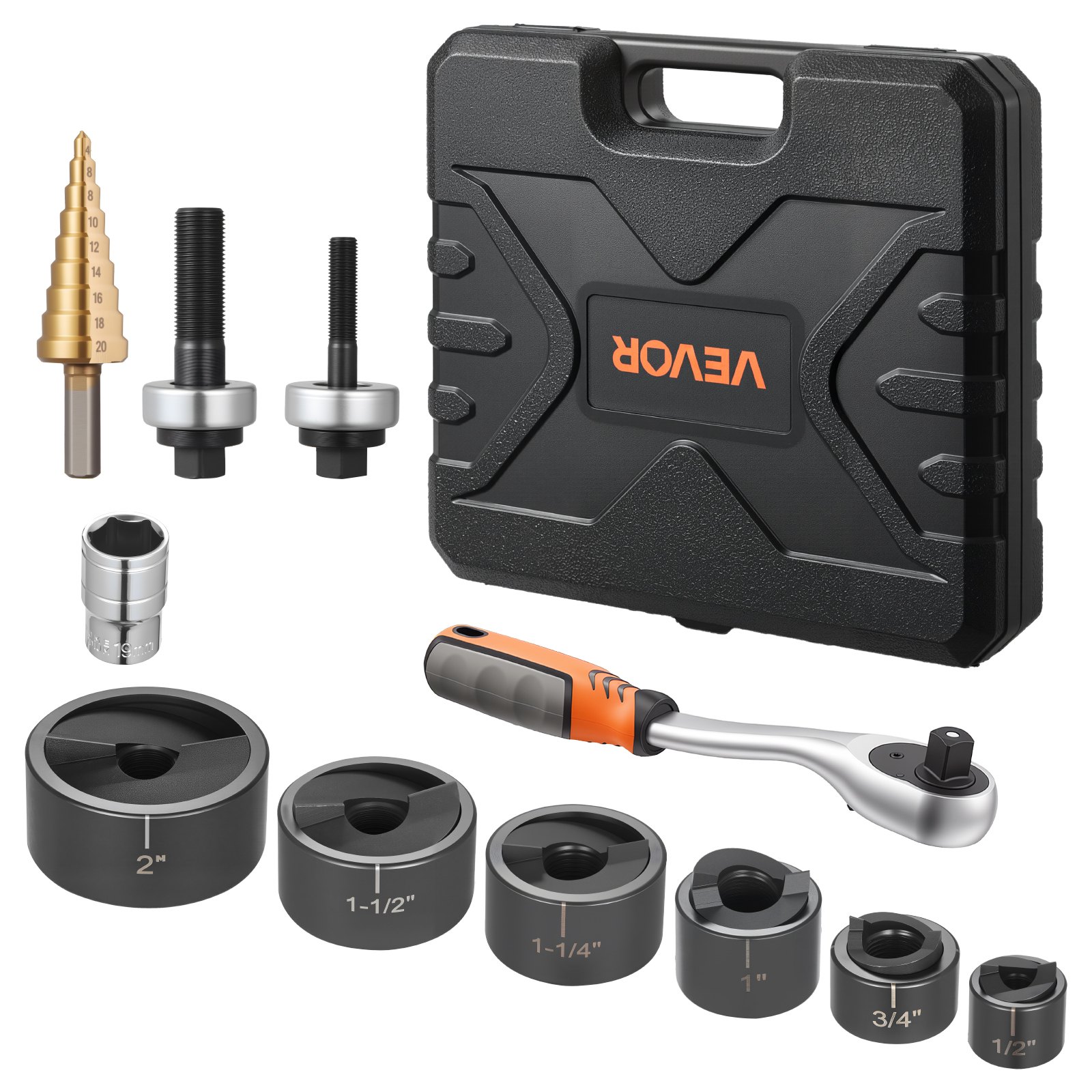

Photos from current listings. Actual item, color, and included accessories may vary.
Knockout Set Buying Guide
A knockout set is a hydraulic or ratchet-driven hole-punching system for cutting clean conduit and connector openings through electrical enclosures, panels, and cabinets. The critical trade-off is between manual ratchet drivers (portable, slower, high force) and hydraulic drivers (fast, low effort, heavier and costlier), with die material and conductor range determining actual cut quality and longevity. Choose a set whose die sizes match your standard trade sizes and whose driver matches your daily volume—one-off 1/2-inch holes can use a compact ratchet, but repeated 1-1/2 to 2-inch work demands hydraulic assistance.


At a glance
- Category
- Electrician Hand Tools
- Data updated
- Nov 20, 2026
Current offers
Highlights
- Manual ratchet knockout sets typically cover 1/2 to 2 in (13–51 mm) conduit trade sizes with 6 dies; hydraulic sets extend to 4 in (102 mm) and reduce handle force by roughly 70%.
- Die and punch metallurgy separate tiers: 40Cr or Cr-V steel punches hold an edge through mild steel and aluminum, while coated or hardened tool-steel dies last longer in stainless and thick gauge.
- Hydraulic drivers are rated by tonnage (commonly 6–15 tons) and stroke; a 10-ton hydraulic head is the practical threshold for 2 in holes in 10-gauge mild steel.
- Standard knockout sets use 3/4 in draw stud and 1-3/8 in thread; verify the driver thread matches the punch set, as mixing 3/4-16 and metric thread sets prevents assembly.
Best use cases
- Best fit for a manual ratchet set: an electrician cutting fewer than 20 holes per day in 1/2 to 1-1/4 in trade sizes through 16–12 gauge mild steel or aluminum enclosures; skip hydraulic if you rarely exceed 1 in.
- Best fit for a hydraulic knockout set: panel-shop or high-volume work punching 1-1/2 to 4 in holes in 10-gauge steel or stainless; choose a 10-ton or higher driver rather than a 6-ton kit.
- Wrong fit: using a standard 40Cr punch set on stainless steel or fiberglass without a hardened or coated die—expect accelerated edge wear and ragged holes; select a set rated for stainless if that is your material.
- Wrong fit: buying a set with only 1/2, 3/4, 1, 1-1/4, 1-1/2, and 2 in dies when your prints call for 2-1/2 to 4 in connectors—order the larger hydraulic die range separately or choose an expandable kit.
Buying tips
- Match die sizes to your connector trade sizes, not pipe OD: a 1/2 in knockout produces a 0.875 in (22.2 mm) hole, 3/4 in gives 1.109 in (28.2 mm), and 1 in gives 1.362 in (34.6 mm)—verify against the connector's locknut diameter.
- Choose a 3/4 in-16 draw stud and 1-3/8 in punch thread standard so replacement dies and drivers from different brands interchange; proprietary thread sets lock you into one ecosystem.
- For mild steel thicker than 10 gauge or any stainless, step up to a hydraulic driver of at least 10 tons and hardened dies; a manual ratchet on 1/4 in steel risks bending the draw stud.
- Confirm the set includes the pilot drill and 7/8 in or 3/4 in hole saw arbor for the draw stud—many budget kits omit the pilot bit, which is required before the punch can be threaded through.
Specs
| Driver Type | Manual ratchet vs hydraulic (6-15 ton) |
|---|---|
| Trade Size Range | 1/2-2 in manual / 1/2-4 in hydraulic |
| Punch Material | 40Cr / Cr-V vs hardened tool steel |
| Thread Standard | 3/4-16 draw stud / 1-3/8 in punch |
Related searches
What to check before buying
- Measure your largest required knockout diameter and the enclosure wall thickness (gauge) before selecting a manual vs hydraulic driver; 2 in holes in 10-gauge steel are the practical manual limit.
- Verify the driver thread (3/4-16 in or metric) matches the punch set and that the draw stud length exceeds the combined punch, die, and enclosure wall thickness.
- Check that the carrying case includes all dies, punches, draw stud, spacer, and pilot drill; a missing spacer prevents cutting thin sheet metal without deformation.
- Confirm the hydraulic driver's tonnage and stroke suit your maximum hole size, and that the set is rated for the material you cut—mild steel, aluminum, fiberglass, or stainless.
FAQ
Data sources: eBay / Amazon listings and product attribute feeds Data updated Nov 20, 2026.
Some links on this page are affiliate links. If you buy after clicking one, we may earn a commission at no extra cost to you. This does not change which products appear here or their order. Affiliate disclosure.