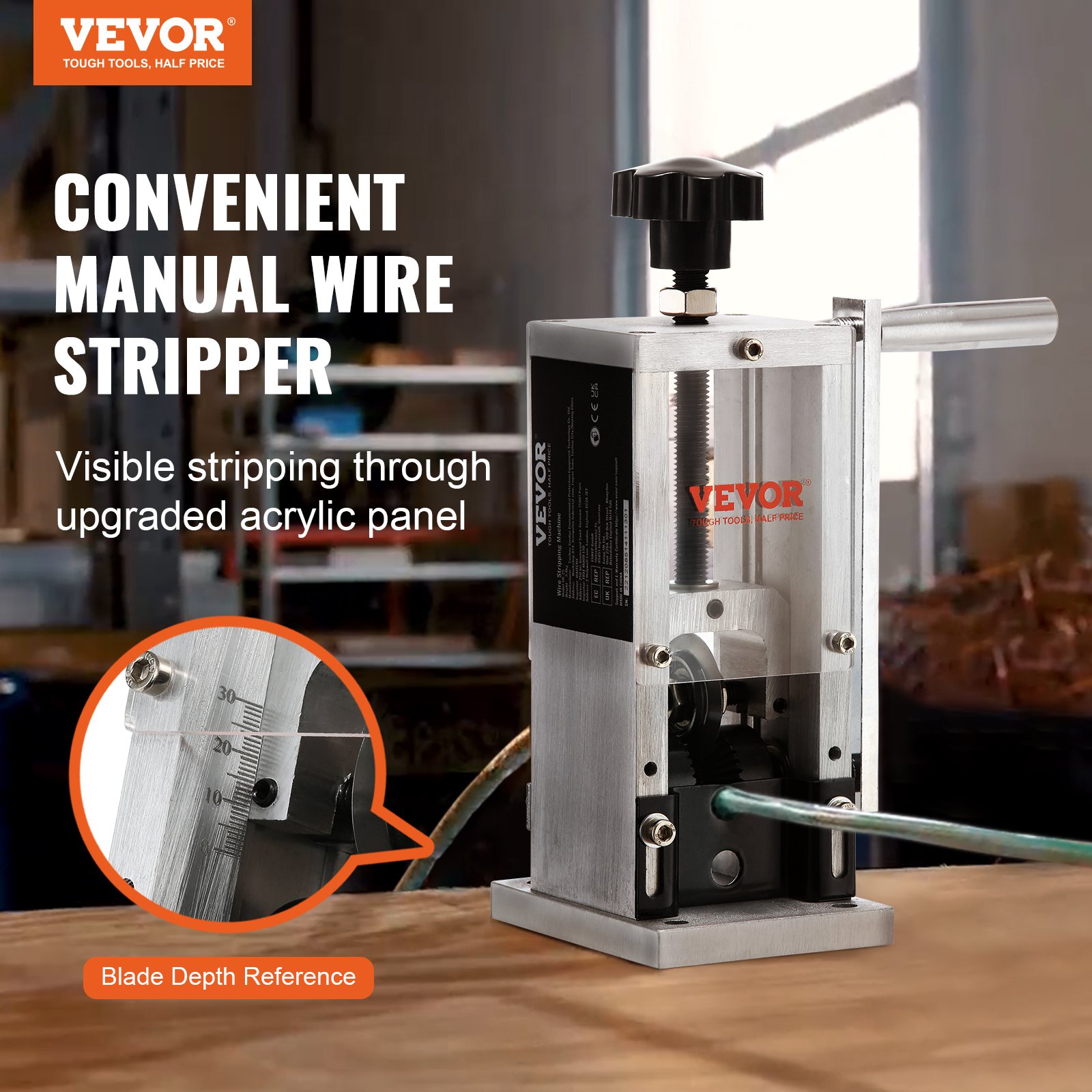

Photos from current listings. Actual item, color, and included accessories may vary.
Manual Wire Stripping Machine Buying Guide
A manual wire stripping machine is a bench-mounted or portable tool that removes insulation from scrap copper or aluminum cable via a hand crank or drill-driven feed, replacing repetitive knife work. The core trade-off is frame rigidity and blade adjustability versus portability: cast-aluminum or steel frames with visible depth references hold tolerance across hundreds of feet, while stamped or plastic-bodied units flex and gouge conductors. Buy a drill-capable unit with a calibrated depth scale if you process more than a few pounds of scrap; skip hand-only, non-adjustable peelers for anything beyond occasional single-gauge work.


At a glance
- Category
- Electrician Hand Tools
- Data updated
- Nov 20, 2026
Current offers
Highlights
- Drive options split into hand-crank only, drill-powered only, and dual-mode units with a hex shank or chuck adapter; dual-mode models are the only ones that scale from small-gauge cleanup to continuous scrap runs.
- Blade adjustment architecture matters more than blade count: a visible depth reference or indexed micrometer-style screw lets you set cut depth per gauge, while slotted set-screw designs drift and shave copper.
- Frame material grades range from stamped steel to cast aluminum to machined billet; cast or billet frames resist feed-axis flex so the blade stays parallel to the conductor at higher feed speeds.
- Portability usually means an aluminum frame with clamp or vise-mount provisions; a unit without a stable mounting point will walk under drill torque and produce inconsistent strip lengths.
Best use cases
- Best fit: scrap recyclers processing mixed 10–2 AWG copper in volume should pick a dual-mode cast-frame stripper with an indexed depth reference and mount it to a bench vise for drill-driven feeding.
- Best fit: occasional household or small-shop users stripping a handful of cables per month should choose a compact hand-crank aluminum-frame unit with a visible depth scale and skip drill adapters they will not use.
- Wrong fit: anyone stripping fine stranded wire below roughly 18 AWG or thin-wall insulation should skip machines entirely and use precision hand strippers, since machine blades crush fine strands and lack gauge-specific nests.
- Wrong fit: job-site electricians needing mid-run stripping on installed cable should not buy a bench peeler; a rotary hand stripper or auto-adjusting plier-style tool is the correct portable configuration.
Buying tips
- Match the feed mechanism to your volume: a drill-driven feed with a chuck adapter processes continuous cable far faster than a hand crank, but only if the frame has a rigid mounting point to resist torque.
- Insist on an indexed or visibly marked depth reference rather than free-floating set screws; a repeatable depth setting is what prevents nicked copper and blade chatter across gauge changes.
- Check the conductor range against your actual scrap mix: most machines are tuned for roughly 1/8 in to 1 in outer diameter, so verify the feed gap and blade travel cover both your smallest and largest cable.
- Prefer cast aluminum or steel frames over stamped or plastic bodies; frame flex is the primary cause of uneven strips, blade wear, and feed jams on continuous use.
Specs
| Drive Type | Hand-crank / drill / dual-mode |
|---|---|
| Frame Material | Cast aluminum / steel / stamped |
| Depth Adjustment | Indexed scale vs set-screw |
| Cable Range | ~1/8 in to 1 in OD |
Related searches
What to check before buying
- Measure your largest and smallest cable outer diameters and confirm the machine's feed gap and blade travel span that full range without shimming.
- Confirm you have a bench vise or clampable edge for mounting; drill-driven units need a fixed base to prevent walk under torque.
- Check your drill's chuck size and whether the unit includes a hex-shank or chuck adapter, and confirm the drill's torque is adequate for continuous feed.
- Verify blade replacement availability and whether the blade is reversible or single-edge, since blade geometry and replacement cost drive long-term running expense.
FAQ
Data sources: eBay / Amazon listings and product attribute feeds Data updated Nov 20, 2026.
Some links on this page are affiliate links. If you buy after clicking one, we may earn a commission at no extra cost to you. This does not change which products appear here or their order. Affiliate disclosure.