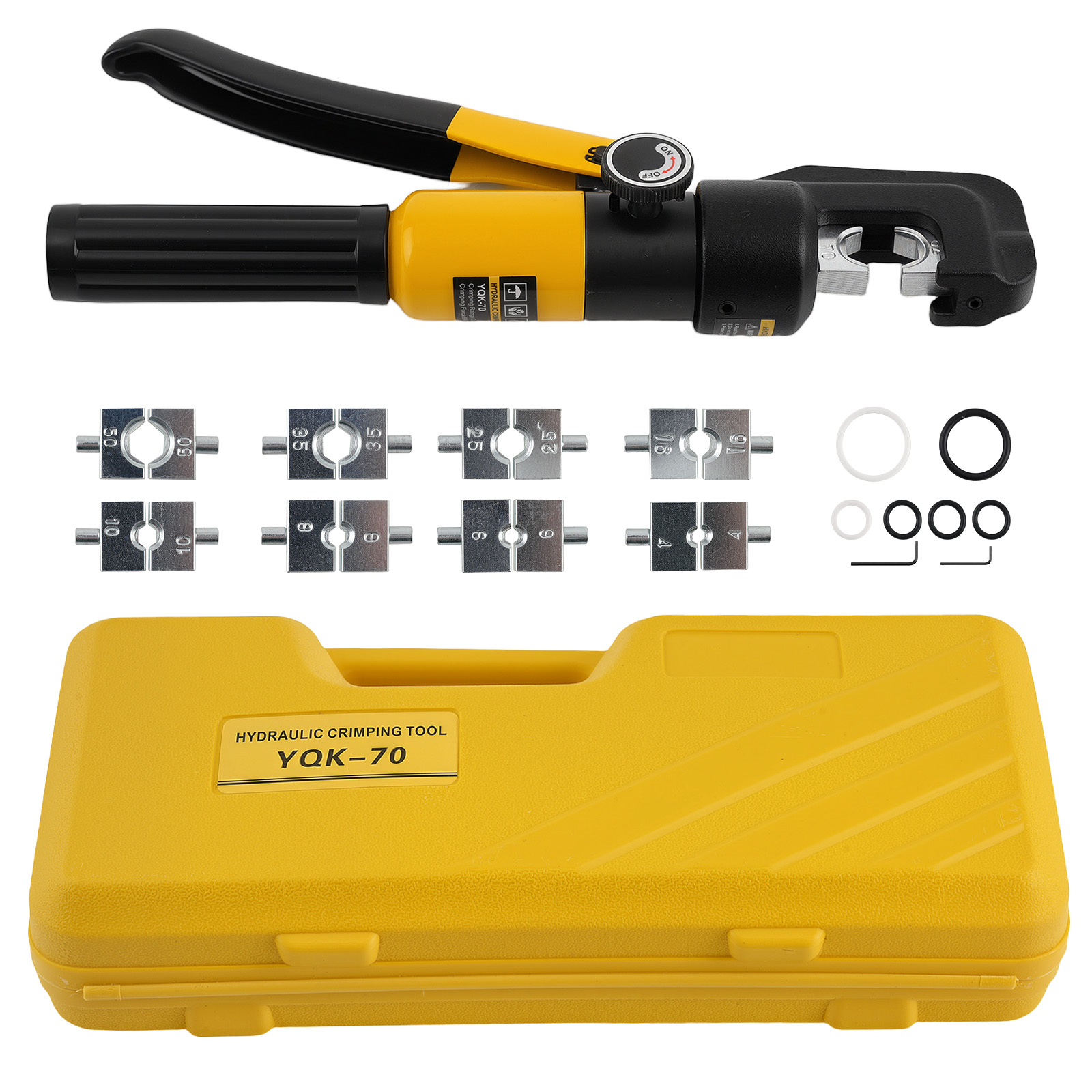

Photos from current listings. Actual item, color, and included accessories may vary.
Professional Wire Crimping Tool Buying Guide
A professional wire crimping tool is a ratcheting or hydraulic press that permanently joins a terminal to conductor using calibrated force, not a plier-style squeeze. The core trade-off is die compatibility and jaw geometry versus raw handle pressure: interchangeable-die frames demand the correct die set for each terminal family, while fixed-die tools only serve one connector standard. The decision rule is simple: buy a tool whose die range and crimp profile match the terminals you actually stock, and skip anything that cannot complete a full cycle before release.


At a glance
- Category
- Electrician Hand Tools
- Data updated
- Nov 20, 2026
Current offers
Highlights
- Ratchet mechanism with full-cycle lockout: the tool will not open until the crimp reaches set force, preventing under-crimped lugs and loose strands.
- Interchangeable die sets cover insulated/uninsulated terminals, ferrules, and tubular lugs; matching die to terminal barrel size governs pull-out strength more than handle length.
- Crimp profile differs by terminal family — hex for tubular lugs and ferrules, double-D or nest-and-indent for insulated terminals — using the wrong profile cuts strands or splits insulation.
- Leverage tiers scale force output: long-handle compound tools suit 8-2 AWG lugs, while hydraulic or bench-mounted presses are required for continuous 2/0 and larger work.
Best use cases
- Panel and control-cabinet wiring with insulated ring/spade terminals: pick a ratcheting tool with a dedicated insulated-terminal die and jaw stop; skip hydraulic presses that crush insulation.
- Battery cable and service-entrance lugs 8 AWG through 2/0: choose a long-handle or hydraulic crimper with hex dies sized to the lug barrel; skip plier-style crimpers entirely.
- Ferrule work on DIN/European terminal blocks: use a square-profile ferrule die with a wire-stop; skip generic indent crimpers that deform the ferrule into an oval.
- Occasional light-gauge repair under 10 AWG: a compact fixed-die ratchet is sufficient; skip multi-die kits only if you never use tubular lugs or ferrules.
Buying tips
- Size the tool to the largest lug barrel, not the wire gauge alone: a 2/0 AWG lug needs a die matched to its barrel OD, typically 0.42-0.47 in, which most 12-2 AWG kits do not provide.
- Confirm die interchangeability before buying: a 9-die kit should include hex dies for 6, 4, 2, 1/0, 2/0 and indent dies for insulated 22-10 AWG; a kit missing the 2/0 hex die cannot terminate the largest lug it advertises.
- Choose ratchet over plier-style for any terminal above 10 AWG: ratchet tools deliver consistent 2-3 ton-class force and full-cycle release, while manual pliers depend on operator grip strength.
- Match crimp profile to terminal standard: hex for European tubular lugs and ferrules, double-D for US insulated terminals; a single-profile tool cannot serve both without deformation.
Specs
| Crimp Mechanism | Ratchet full-cycle vs plier-style |
|---|---|
| Die System | Interchangeable hex/indent dies |
| Wire Range | 22-10 AWG to 8-2/0 AWG |
| Force Tier | Compound lever vs hydraulic press |
Related searches
What to check before buying
- Measure your largest terminal barrel OD and wire gauge; confirm a matching die exists in the kit before purchasing.
- Verify handle length and tool weight suit one-handed bench or overhead work; long compound handles need two hands and clear workspace.
- Check die retention method (screw pin or quick-release) and that spare dies are individually replaceable, not molded into the frame.
- Confirm the tool's rated crimp force and cycle lockout are stated, not implied; a professional tool specifies force in tons or kN.
FAQ
Data sources: eBay / Amazon listings and product attribute feeds Data updated Nov 20, 2026.
Some links on this page are affiliate links. If you buy after clicking one, we may earn a commission at no extra cost to you. This does not change which products appear here or their order. Affiliate disclosure.