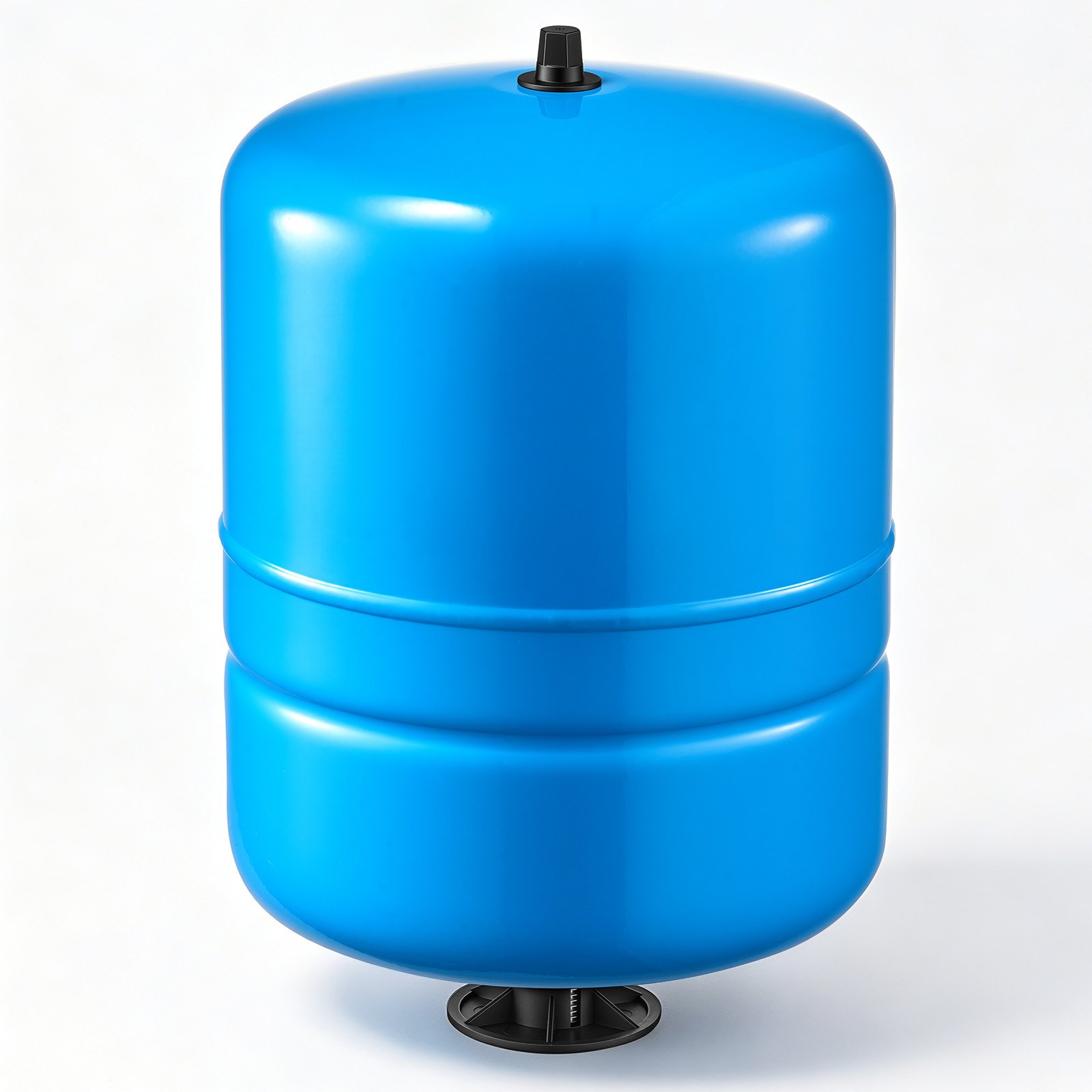

Photos from current listings. Actual item, color, and included accessories may vary.
Expansion Tank Buying Guide
An expansion tank is a sealed steel vessel with an internal bladder that absorbs the volumetric expansion of heated water in a closed plumbing system, preventing pressure spikes and relief-valve discharge. The core trade-off is bladder material and tank construction versus pre-charge accuracy: butyl or EPDM bladders with a welded steel shell and a precise factory air charge last decades, while thin shells and natural-rubber bladders fail early. The decision rule is simple: buy a tank whose acceptance volume exceeds your system's calculated expansion volume at your actual supply pressure, with a replaceable or fully welded bladder design rated for potable water.


At a glance
- Category
- Plumbing Tools
- Data updated
- Nov 20, 2026
Current offers
Highlights
- Bladder vs. diaphragm: a full-replacement bladder keeps air and water fully separated; a fixed diaphragm is cheaper but cannot be serviced and loses pre-charge as the membrane fatigues.
- Carbon steel shell with a welded two-piece construction and epoxy/polypropylene liner resists corrosion; unlined or seamed shells rust through at the water connection in hard or high-oxygen water.
- Pre-charge is factory-set near 40 PSI for typical residential systems; the tank's air charge must match the system's cold fill pressure (often 50-60 PSI on a boiler, 40-60 PSI on potable water).
- Acceptance volume — not nominal tank size — determines capacity: a 2-gallon tank accepts roughly 0.5-0.8 gallons of expansion, so size on acceptance volume at your pressure band.
Best use cases
- Best fit: potable closed systems (tankless water heater retrofits, backflow preventer installations) — choose a stainless or polypropylene-lined bladder tank rated for potable water with a 3/4" NPT connection.
- Best fit: hydronic boiler loops — pick a tank rated for boiler temperatures (typically 240°F) with a 1/2" or 3/4" connection and pre-charge matched to the boiler's cold fill pressure.
- Wrong fit: open-vented gravity systems or systems with a working pressure above the tank's rating — an expansion tank adds no value and can rupture; use a correctly sized feed-and-expansion tank instead.
- Wrong fit: undersized nominal tanks (e.g., a 2-gallon tank on a large tankless system with high incoming pressure) — the bladder bottoms out and the relief valve weeps; upsize to the calculated acceptance volume.
Buying tips
- Size by acceptance volume: for a 50-gallon water heater, thermal expansion from 40°F to 140°F is about 0.6-0.8 gallons; choose a tank whose acceptance volume at your pressure band covers at least that.
- Match pre-charge to cold fill pressure: set the tank's air charge to the system's static fill pressure (commonly 40-60 PSI residential) before installation; a tank pre-charged at 29 PSI on a 60 PSI system loses usable capacity.
- Choose connection and orientation: 3/4" NPT is the residential standard for potable tanks; vertical installation with the connection at the bottom is preferred, but horizontal mounting requires a tank rated for it.
- Specify potable-water certification for drinking-water systems — NSF/ANSI 61 or equivalent — and a butyl or EPDM bladder; boiler-only tanks may use different elastomers not safe for potable water.
Specs
| Tank Type | Bladder vs. diaphragm |
|---|---|
| Nominal Capacity | 2-4.5 gal residential |
| Connection | 3/4" NPT (1/2" boiler) |
| Max Working Pressure | 100-150 PSI |
Related searches
What to check before buying
- Measure the installation space: tanks range from roughly 8 to 20 inches in diameter and 12 to 30 inches tall; confirm clearance for the tank plus a drain pan and service access.
- Check system pressure: confirm the cold fill pressure and relief valve setting so the tank's pre-charge and maximum working pressure (typically 100-150 PSI) are compatible.
- Verify connection thread and pipe size: 3/4" NPT is standard for residential potable tanks; boilers often use 1/2" or 3/4" — have the matching adapter or union on hand.
- Confirm water chemistry and temperature: chlorinated or hard water favors a polypropylene-lined or stainless tank; boiler applications need a tank rated for continuous 240°F service.
FAQ
Data sources: eBay / Amazon listings and product attribute feeds Data updated Nov 20, 2026.
Some links on this page are affiliate links. If you buy after clicking one, we may earn a commission at no extra cost to you. This does not change which products appear here or their order. Affiliate disclosure.