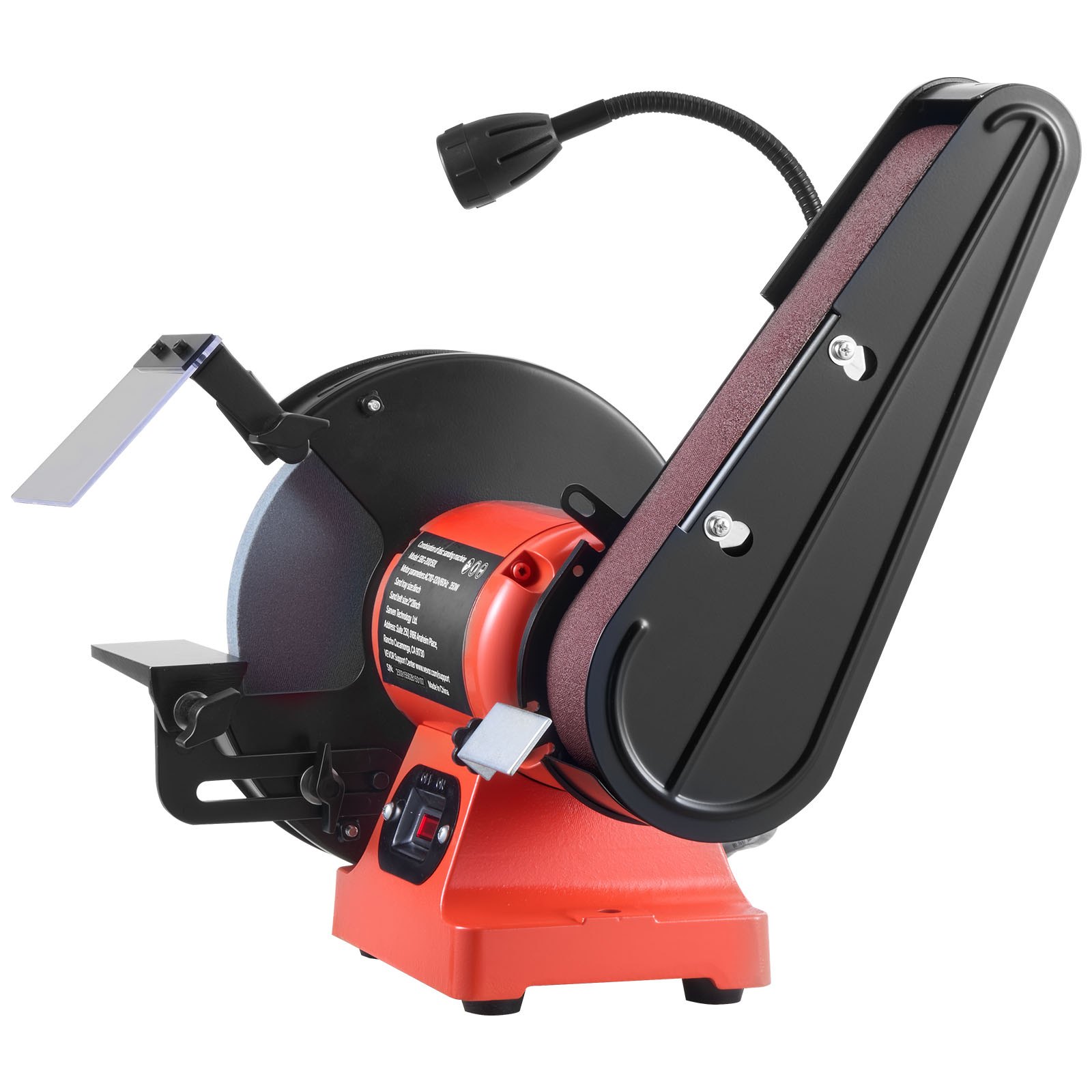

Photos from current listings. Actual item, color, and included accessories may vary.
Bench Grinder With Belt Sander Buying Guide
A bench grinder with belt sander combo pairs a rigid grinding wheel for heavy stock removal and edge shaping with an abrasive belt for flush sanding, deburring, and knife sharpening—all on one motorized pedestal. The primary trade-off is motor power and wheel/belt size versus bench footprint and budget: low-wattage units stall under load, while larger wheels and longer belts run cooler and last longer. The clear decision rule is to buy the largest motor (350W minimum, 500W+ preferred) and longest belt (28" minimum) your bench and circuit can support, skipping any combo with a belt under 2" wide or a wheel under 6".


At a glance
- Category
- Power Tools
- Data updated
- Nov 20, 2026
Current offers
Highlights
- Wheel diameter drives surface speed and grind quality: 6" wheels suit light deburring, 8" wheels run cooler and are the minimum for sustained metalworking.
- Belt length and width determine cooling and finish: 2" x 28" belts are the compact standard, while 2" x 42" or wider 4" belts dissipate heat faster on long passes.
- Motor wattage separates real work from stalling: 350W handles light hobby sharpening, but 500-750W induction motors maintain torque under heavy grinding pressure.
- Belt grit compatibility changes function: 40-80 grit for shaping, 120-240 for sharpening, 400+ for polishing—choose a sander with quick-release tension for fast changes.
Best use cases
- Best fit: home metalworking and knife sharpening—pick an 8" wheel with a 2" x 28" belt and 350W+ motor for deburring, rust removal, and edge maintenance.
- Best fit: woodworking tool maintenance—choose a combo with a finer-grit belt (120+) and a slow-speed or variable-speed motor to avoid burning chisels and plane irons.
- Wrong fit: production fabrication or continuous heavy grinding—skip compact combos and step up to a standalone 8" industrial grinder or a 4" x 36" belt sander with a 1HP+ motor.
- Wrong fit: tight benchtop with no clamping space—avoid 8" wheel combos (they need 20"+ of bench depth and clearance); choose a 6" wheel compact unit instead.
Buying tips
- Match wheel size to motor: an 8" wheel requires at least 350W; underpowered motors bog down and burn the workpiece, so prioritize wattage over wheel size if budget-constrained.
- Select belt dimensions by task: 2" x 28" is the compact standard for sharpening and deburring; 4" x 36" belts remove material faster and run cooler for larger surfacing jobs.
- Check wheel grit and replacement standard: most combos ship with 36- and 60-grit wheels; confirm the arbor size (typically 5/8") so standard replacement wheels fit.
- Prefer cast-iron or heavy-gauge steel bases over stamped sheet metal—vibration damping is the main durability differentiator and directly affects grind finish quality.
Specs
| Wheel Diameter | 6" vs 8" (8" for sustained metalwork) |
|---|---|
| Belt Size | 2" x 28" compact / 4" x 36" heavy |
| Motor Power | 350W min / 500W+ preferred |
| Arbor Size | 5/8" standard wheel arbor |
Related searches
What to check before buying
- Measure bench depth and clearance: an 8" wheel combo needs roughly 20" of depth and 18" of height clearance for wheel guards and belt arm swing.
- Confirm circuit capacity: most 350-750W combos run on standard 120V/15A household circuits; check the nameplate amperage before sharing a circuit with other tools.
- Verify mounting: combos weigh 25-45 lb and vibrate—plan for bolted-down or clamped mounting on a sturdy bench, not a folding table.
- Check belt and wheel availability: confirm standard 2" x 28" belts and 5/8" arbor wheels are locally stocked so you are not locked into proprietary sizes.
FAQ
Data sources: eBay / Amazon listings and product attribute feeds Data updated Nov 20, 2026.
Some links on this page are affiliate links. If you buy after clicking one, we may earn a commission at no extra cost to you. This does not change which products appear here or their order. Affiliate disclosure.