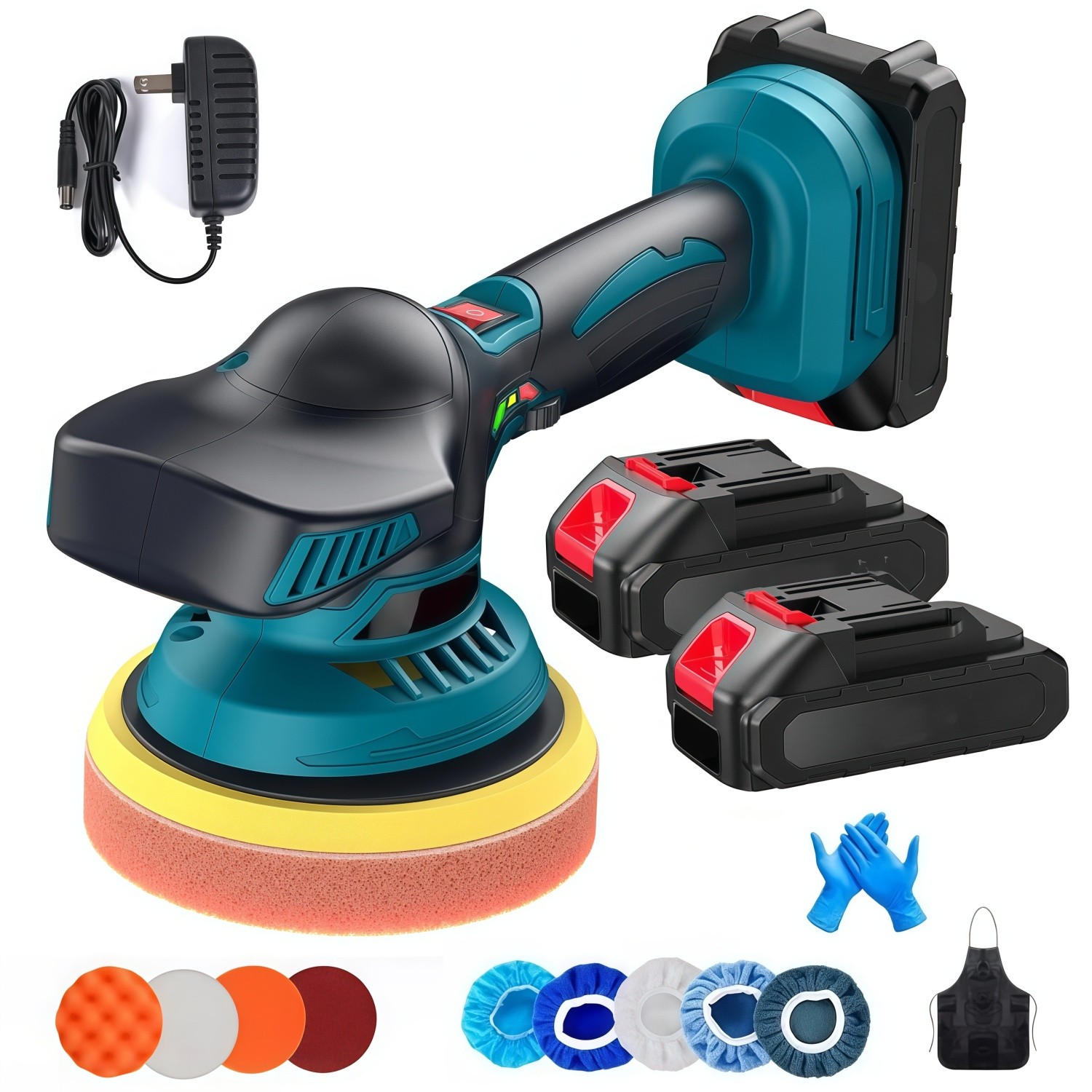

Photos from current listings. Actual item, color, and included accessories may vary.
Cordless Car Buffer Polisher Kit Buying Guide
A cordless car buffer polisher kit pairs a battery-powered dual-action (DA) or rotary head with pads and a charger for swirl-free paint correction away from outlets. The core trade-off is orbit diameter and battery platform versus head weight and pad size: large-throw DA units finish faster but demand more technique, while compact 3-inch rotary tools fit tight panels. Choose a kit with at least two batteries and a variable-speed DA head for safe clearcoat work; skip single-battery, fixed-speed rotary bundles as false economy.


At a glance
- Category
- Power Tools
- Data updated
- Nov 20, 2026
Current offers
Highlights
- Dual-action orbit diameters of 8 mm suit finishing and waxing, while 15–21 mm long-throw heads remove defects faster but require steadier pad control on curved panels.
- 18 V/20 V max battery platforms with 4.0 Ah+ packs sustain pad rotation under load; 2.0 Ah compact packs sag and stall during heavy compounding.
- Backing plates follow standard sizes—3-inch for spot repair, 5-inch for general panels, 6-inch for large flat areas—and hook-and-loop pads must match plate diameter exactly.
- Rotary heads spin at 1,500–3,500 OPM with forced rotation and risk burning edges; DA heads oscillate at 2,500–6,500 OPM and are safer for beginners.
Best use cases
- Best fit: a 5-inch, 15 mm-throw DA kit with two 4.0 Ah batteries for weekly waxing and light swirl removal on a daily driver—this balances speed and safety.
- Wrong fit: a single-battery 6-inch rotary kit for a first-time user—forced rotation on vertical panels risks holograms and burn-through without practice.
- Best fit: a 3-inch compact DA or rotary kit for motorcycle tanks, pillars, and headlight restoration where a 6-inch pad cannot reach.
- Wrong fit: a high-OPM 21 mm long-throw kit for a garage with only 2.0 Ah packs—stalls under pressure and leaves haze on soft paint.
Buying tips
- Match pad size to panel: 5-inch plates cover most hoods and doors; 3-inch plates are mandatory for bumpers, mirrors, and A-pillars on modern cars.
- Require at least two batteries of 4.0 Ah or higher; a single pack means a full charge cycle mid-detail and reduced OPM under compounding load.
- Confirm the kit includes a DA backing plate, not just rotary; DA plates have counterweights matched to orbit diameter, and mismatched plates cause vibration.
- Check charger voltage matches your region—100–120 V for North America, 220–240 V elsewhere—and that the battery platform shares packs across the brand's other tools.
Specs
| Action Type | Dual-action vs forced rotary |
|---|---|
| Orbit Throw | 8 mm / 15 mm / 21 mm |
| Pad/Plate Size | 3 in / 5 in / 6 in hook-and-loop |
| Battery Platform | 18 V / 20 V max, 2.0–5.0 Ah |
Related searches
What to check before buying
- Measure your largest panel and tightest gap: a 6-inch pad needs 8+ inches of flat clearance, so sub-4-inch bumper slats demand a 3-inch kit.
- Verify a grounded 15 A outlet or long extension cord near the car; cordless kits still need a charger and two packs to avoid downtime.
- Confirm pad hook-and-loop diameter matches the backing plate—5-inch plates take 5-inch pads, and 6-inch pads on 5-inch plates wobble.
- Check battery platform compatibility with your existing tools; a kit that shares 18 V packs saves buying spare batteries later.
FAQ
Data sources: eBay / Amazon listings and product attribute feeds Data updated Nov 20, 2026.
Some links on this page are affiliate links. If you buy after clicking one, we may earn a commission at no extra cost to you. This does not change which products appear here or their order. Affiliate disclosure.