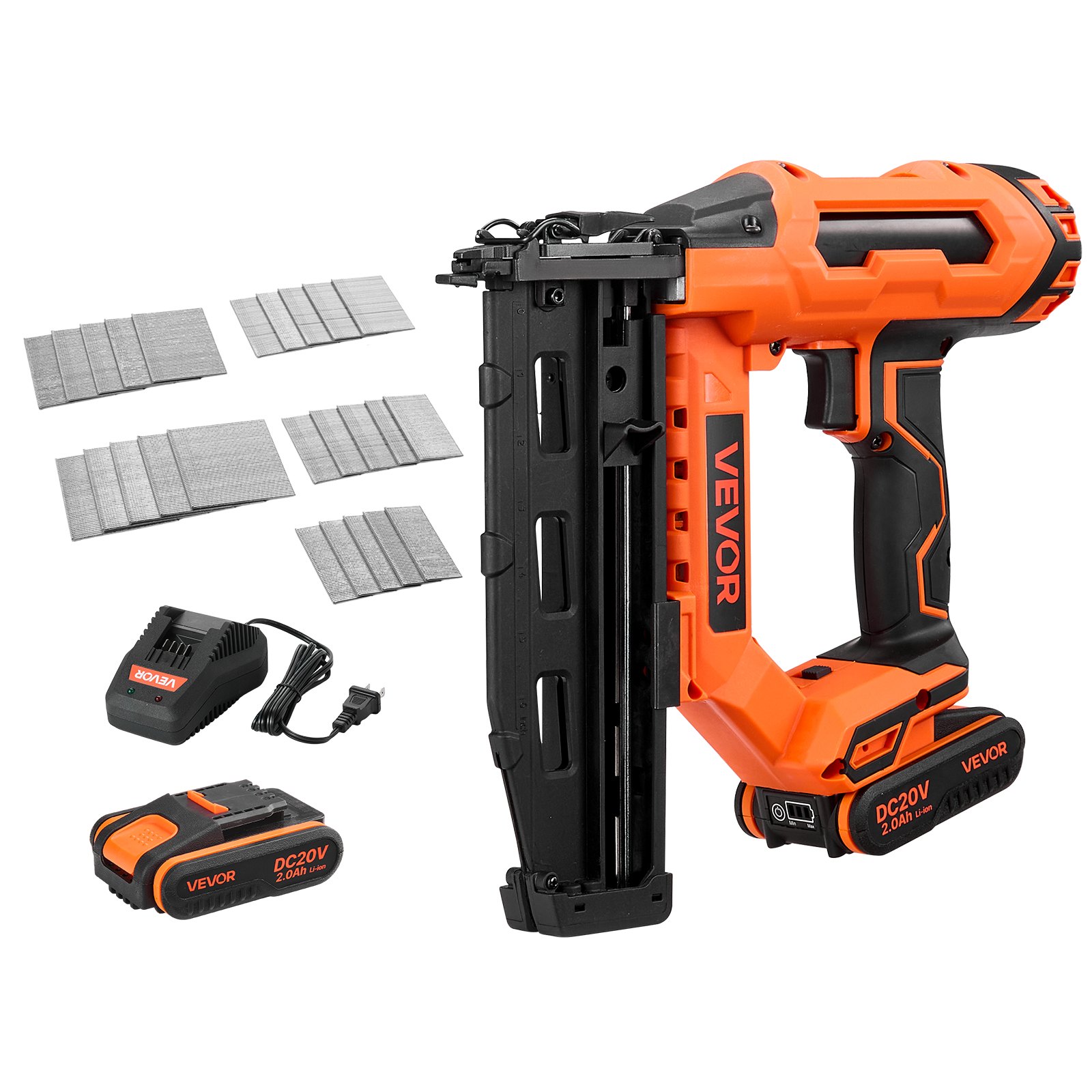

Photos from current listings. Actual item, color, and included accessories may vary.
Cordless Finish Nailer Buying Guide
A cordless finish nailer is a battery-powered trim nailer that drives 15- or 16-gauge fasteners into baseboard, casing, crown, and cabinetry without a compressor hose. The core trade-off is drive mechanism: flywheel/spring ram systems deliver consistent depth and fast cycle rates, while cheaper solenoid or combustion designs lose power as the battery drains. Buy a 16-gauge straight or 15-gauge angled model from a battery platform you already own; skip any no-name brand with proprietary batteries and no replacement-parts supply.


At a glance
- Category
- Power Tools
- Data updated
- Nov 20, 2026
Current offers
Highlights
- 16-gauge straight magazines drive 1-1/4 in to 2-1/2 in nails—the standard for interior trim, shoe mold, and cabinet face frames.
- 15-gauge angled nailers drive 1-1/4 in to 2-1/2 in fasteners at 34° and reach tighter corners; 18-gauge brad nailers top out at 2 in and are for light trim only.
- Flywheel-and-ram drive (e.g., DeWalt DCN660, Milwaukee 2741) holds depth of drive across the battery charge; solenoid designs drop impact force as voltage sags.
- A 2.0Ah 20V pack typically yields 400–800 drives; step to 4.0–5.0Ah only if you are nailing full rooms of casing without a charger nearby.
Best use cases
- Best fit: finish carpenter or remodeler already on a 20V platform—pick the 16-gauge straight nailer for baseboard, casing, and crown; the battery you own cuts total cost.
- Best fit: cabinet installer needing tight-corner access—choose the 15-gauge angled model (34°) over straight; the angled magazine clears inside corners a straight body cannot.
- Wrong fit: homeowner nailing two pieces of shoe mold once a year—rent or buy a pneumatic kit; a cordless finish nailer is overkill and its batteries self-discharge between projects.
- Skip: any 18-gauge brad nailer for structural or exterior trim; 18-gauge fasteners lack the shank diameter and length for 5/4 deck boards or door jambs.
Buying tips
- Match gauge to trim: 16-gauge for 1/2 in to 3/4 in casings and baseboard; 15-gauge angled for heavy crown and stair treads; 18-gauge only for 1/4 in to 1/2 in light stops.
- Measure your thickest trim: nail length must equal trim thickness plus at least 1 in penetration into the stud—2-1/2 in max handles 3/4 in trim over 1-3/4 in embedment.
- Stay on one battery platform: a bare tool body on a platform you own beats a kit with off-brand packs that have no replacement cells in two years.
- Check the nose and magazine: tool-free depth adjustment and a reload indicator save minutes per room; a narrow nosepiece fits between cabinet face frames.
Specs
| Gauge & Collation | 16GA straight / 15GA 34° angled |
|---|---|
| Nail Length Range | 1-1/4 in to 2-1/2 in |
| Drive Mechanism | Flywheel ram vs solenoid |
| Battery Platform | 20V max Li-ion, 2.0–5.0Ah |
Related searches
What to check before buying
- Confirm your trim stack-up: measure casing and baseboard thickness plus substrate depth; ensure required nail length falls within the tool's 1-1/4 in to 2-1/2 in range.
- Verify battery platform compatibility: the tool must accept packs you already own or that are stocked locally; off-brand 20V packs are not cross-compatible.
- Check clearance at the work area: a straight 16-gauge body needs about 3 in behind the nail path; an angled 15-gauge needs less in corners.
- Confirm fastener availability locally: 16-gauge straight and 15-gauge angled nails are stocked at home centers; odd gauges may require online orders.
FAQ
Data sources: eBay / Amazon listings and product attribute feeds Data updated Nov 20, 2026.
Some links on this page are affiliate links. If you buy after clicking one, we may earn a commission at no extra cost to you. This does not change which products appear here or their order. Affiliate disclosure.