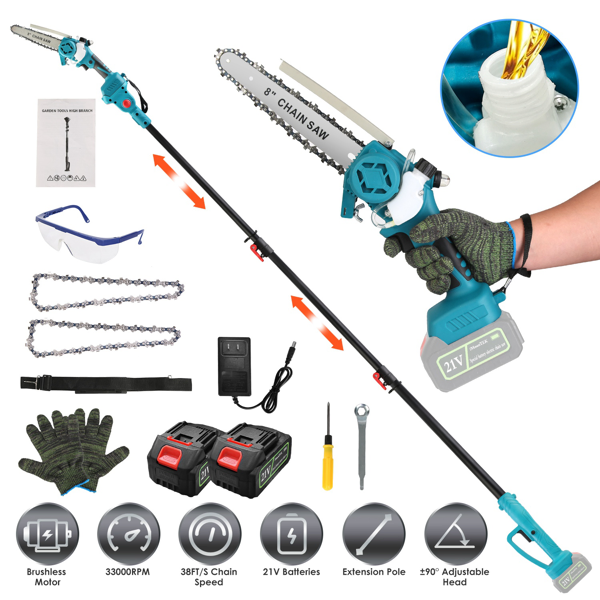

Photos from current listings. Actual item, color, and included accessories may vary.
Cordless Pruning Saw Buying Guide
A cordless pruning saw is a battery-powered cutting tool for limbs and branches, available as a compact handheld chainsaw or a pole-mounted extended-reach model. The core trade-off is between voltage/battery capacity for sustained torque versus bar length and reach for limb diameter—brushless motors and higher voltage (18V–40V+) deliver cooler, longer runtime, while cheap brushed single-battery kits stall under load. The decision rule: buy a brushless model with at least two batteries and a bar matched to your max limb diameter; skip any brushed, single-battery kit with an unspecified bar length.


At a glance
- Category
- Power Tools
- Data updated
- Nov 20, 2026
Current offers
Highlights
- Brushless motors run cooler and deliver 30–50% longer runtime per charge than brushed motors, which wear out faster under sustained pruning loads.
- Bar length (6–8 in handheld, 8–10 in pole) sets max cut diameter; a 6 in bar realistically cuts 4–5 in limbs, an 8 in bar 6–7 in limbs.
- Voltage tier determines torque: 12V suits light 1–2 in cuts, 18–20V handles 4–6 in limbs, 40V+ or 2×20V cross-compatible systems cut 6–8 in hardwoods.
- Auto oil lubrication with a visible tank extends bar and chain life; manual-only or unlisted lubrication accelerates chain stretch and bar wear.
Best use cases
- Best fit: 18V–20V brushless handheld with 6–8 in bar and two 2.0–4.0Ah batteries for yard cleanup, orchard pruning, and cutting limbs up to 5 in.
- Best fit: pole saw with 8–10 in bar and 8–13 ft reach for overhead branches you cannot safely reach from a ladder; pick a telescoping aluminum or fiberglass pole over fixed-length.
- Wrong fit to skip: 12V brushed single-battery kits for anything beyond 2 in limbs—they stall and overheat; also skip 1200W 'brushless' pole/handheld hybrids unless voltage and bar length are explicitly stated.
Buying tips
- Match bar length to limb size: 6 in bar = 4–5 in max cut, 8 in bar = 6–7 in max cut; cutting larger limbs pinches the bar and stalls the motor.
- Choose 18V–20V brushless as the minimum for real pruning; 40V+ only if you regularly cut 6–8 in hardwood or need all-day runtime.
- Require at least two batteries (2.0Ah+ each) so one charges while you cut; single-battery kits die mid-job and often use lower-grade cells.
- Verify auto oil lubrication with a fillable tank and tool-less chain tensioning—these two features separate durable saws from disposable ones.
Specs
| Motor Type | Brushless vs Brushed |
|---|---|
| Voltage Tier | 12V / 18–20V / 40V+ |
| Bar Length | 6–8 in handheld / 8–10 in pole |
| Battery Kit | 2 batteries (2.0Ah+) vs 1 |
Related searches
What to check before buying
- Measure your largest expected limb diameter; add 1–2 in to pick bar length, and confirm the saw's max cut diameter in its specs.
- For pole saws, measure the highest branch height and subtract your safe standing reach; choose reach that covers it without full extension.
- Confirm battery platform compatibility if you already own other tools—18V/20V systems from major brands share packs, off-brands rarely do.
- Check chain gauge/pitch and replacement chain availability; odd sizes make the saw unusable once the original chain dulls.
FAQ
Data sources: eBay / Amazon listings and product attribute feeds Data updated Nov 20, 2026.
Some links on this page are affiliate links. If you buy after clicking one, we may earn a commission at no extra cost to you. This does not change which products appear here or their order. Affiliate disclosure.