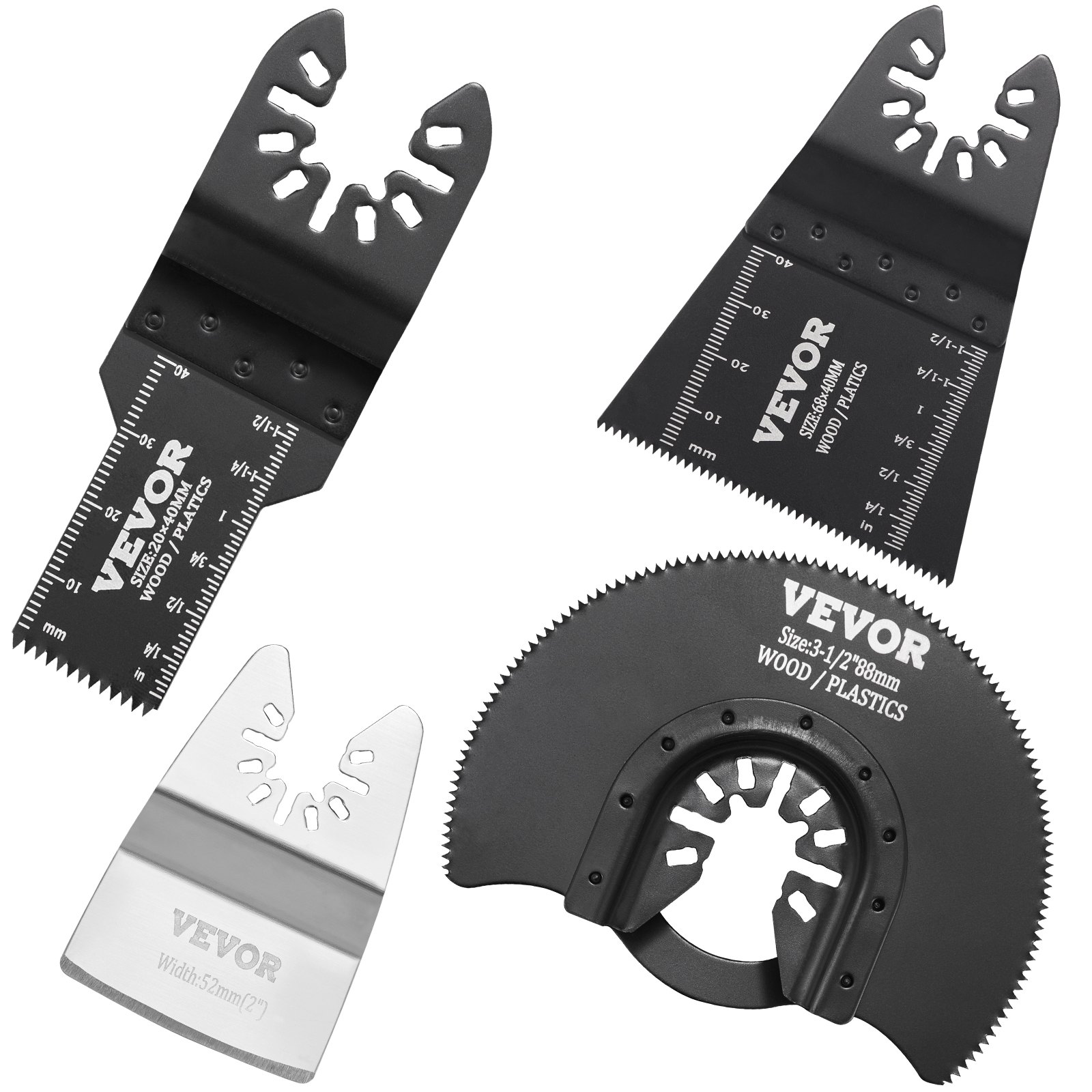

Photos from current listings. Actual item, color, and included accessories may vary.
Multi Tool Blade Buying Guide
Multi-tool blades are oscillating saw accessories defined by their interface (universal vs. Starlock) and tooth geometry, which together determine fit and cut speed. The primary trade-off is between universal arbor compatibility and Starlock's tool-free, slop-free power transfer. Buy universal blades only if your tool lacks Starlock; choose Starlock or StarlockPlus when precision and blade retention matter.
At a glance
- Category
- Power Tools
- Data updated
- Nov 21, 2026
Current offers
Highlights
- OIS universal interface uses a center hole plus 8-pin or 12-pin pattern; Starlock adds a 3D star-shaped collar for tool-free mounting and higher torque transfer.
- Bi-metal blades (HSS teeth on spring-steel body) handle wood with nails and thin metal; carbide-grit blades cut tile, grout, and hardened screws but cut slower in wood.
- Tooth pitch: 14 TPI for clean wood and PVC, 18 TPI for metal, and coarse 6-10 TPI for fast demolition in wood and drywall.
- Blade thickness and kerf: 1.0-1.2 mm blades reduce binding in deep cuts; thin 0.7 mm blades flex and wander in metal.
Best use cases
- Pick a bi-metal 14 TPI plunge-cut blade for flush-cutting door jambs and PVC trim; skip carbide grit, which overheats and dulls on soft plastics.
- Choose a carbide-grit segment blade for removing thinset, grout, and tile; do not use wood-tooth blades, which chip and burn on abrasive mortar.
- For metal pipe and conduit, use a 1.0 mm bi-metal blade at 18 TPI; avoid universal coarse-tooth blades that snag and shatter teeth.
- For deck board and drywall demo, use a wide 2-1/2 inch coarse blade; skip narrow 1-1/4 inch precision blades, which take too long on large cuts.
Buying tips
- Match interface first: Starlock blades fit Starlock, StarlockPlus, and StarlockMax tools; universal OIS blades fit most non-Starlock oscillating tools with an adapter washer.
- Check arbor hole pattern: 1-3/8 inch (35 mm) and 1-3/4 inch (44 mm) center holes with 8-pin or 12-pin rings cover most universal tools; Starlock uses a star collar, not pins.
- Buy bi-metal for mixed wood/metal and carbide grit for abrasive materials; HSS-only blades are for softwood and plastic only and dull quickly on nails.
- Thicker 1.2 mm blades resist bending in prying cuts; thin 0.7 mm blades suit flush cuts but snap under side load.
Specs
| Blade Interface | Universal OIS vs Starlock |
|---|---|
| Tooth Material | Bi-metal / HSS / Carbide grit |
| Tooth Pitch | 6-10 TPI wood; 14 TPI; 18 TPI metal |
| Blade Width | 1-1/4 in to 2-1/2 in |
Related searches
What to check before buying
- Confirm your oscillating tool's interface: Starlock/StarlockPlus/StarlockMax tool-free mount versus universal OIS pin-and-hole arbor.
- Measure the arbor center hole and pin count on your tool; universal blades require matching 8-pin or 12-pin rings or an adapter.
- Check blade width against cut access: 1-1/4 inch blades reach tight corners; 2-1/2 inch blades cut faster but need clearance.
- Verify material rating on the blade: bi-metal for wood with nails and thin metal, carbide grit for tile and grout, HSS for softwood and plastic.
FAQ
Data sources: eBay / Amazon listings and product attribute feeds Data updated Nov 21, 2026.
Some links on this page are affiliate links. If you buy after clicking one, we may earn a commission at no extra cost to you. This does not change which products appear here or their order. Affiliate disclosure.