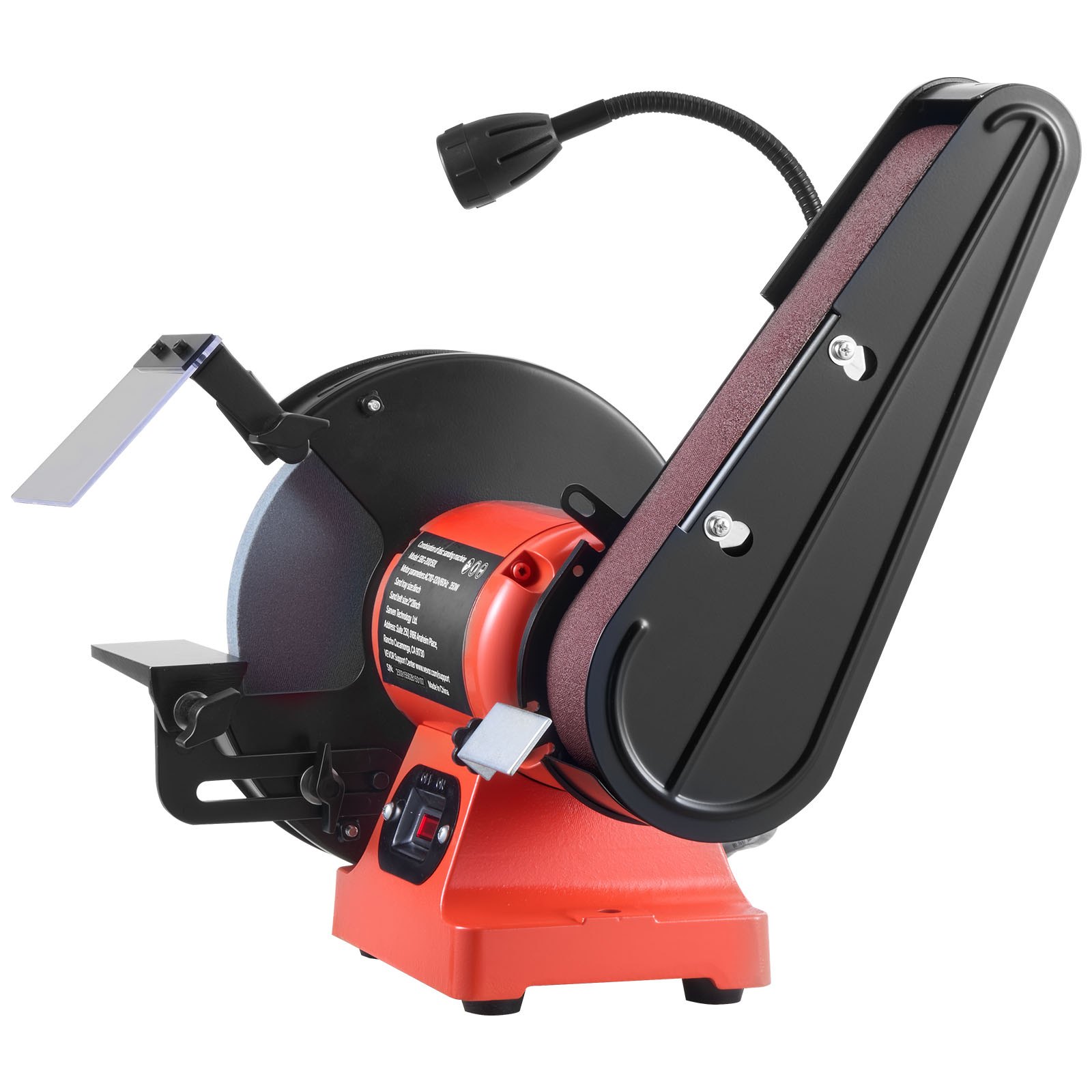

Photos from current listings. Actual item, color, and included accessories may vary.
Sanding Machine Buying Guide
Sanding machines span random-orbit sanders, belt sanders, disc sanders, and combo grinder units, each defined by power delivery and abrasive control. The core trade-off is between motor type and torque (brushed vs brushless, direct-drive vs belt-drive) and dust-extraction capability, which together separate long-life tools from short-cycle compromises. Buy a tool whose motor, platen, and port standard match your material and duty cycle — skip underpowered units that stall under load.


At a glance
- Category
- Power Tools
- Data updated
- Nov 20, 2026
Current offers
Highlights
- Brushless DC motors deliver 2–3× the service life of brushed AC motors and maintain torque under load, critical for continuous stock removal.
- Random-orbit sanders need a 5–6 mm orbit for finish work; belt sanders need 3–5 m/s belt speed for aggressive removal on hardwood.
- Dust ports follow two standards: 35 mm (1-3/8 in) for most random-orbit sanders and 2-1/4 in for benchtop belt/disc units — mismatched ports kill extraction.
- Cast-iron or aluminum platens hold flatness under heat; stamped-steel platens flex and dish, causing uneven sanding on hardwoods.
Best use cases
- Best fit: random-orbit sander (5–6 mm orbit, 150 mm pad) for furniture finishing and paint prep — skip belt sanders here; they gouge across the grain.
- Best fit: 4×36 in belt/disc combo sander for edge truing, knife bevels, and small stock flattening — choose 350 W+ with cast-iron base, skip 150 W hobby units that stall.
- Best fit: 8 in bench grinder + 2×28 in belt sander combo for metalworking and sharpening — select units with sealed bearings and LED work light; skip units lacking eye shields.
- Wrong fit: drywall pole sanders for wood finishing — their circular motion and long reach suit joint compound, not flat-panel stock removal.
Buying tips
- Match orbit to task: 2.5 mm for fine finish, 5 mm for general, 6 mm for aggressive removal — orbit diameter directly sets scratch depth per pass.
- For belt sanders, belt length × width determines platen area: 4×36 in handles stock up to 4 in wide; 2×28 in suits knife and edge work only.
- Check motor wattage against belt width: 350 W drives 2×28 in belts; 750 W+ needed for 4×36 in under continuous load.
- Confirm voltage and plug standard: 120 V 60 Hz for North America, 230 V 50 Hz for EU/UK — combo grinders ship region-specific with no universal input.
Specs
| Motor Type | Brushless DC vs Brushed AC |
|---|---|
| Orbit Diameter | 2.5 / 5 / 6 mm (finish / general / aggressive) |
| Belt Size | 2×28 in / 4×36 in / 6×48 in |
| Dust Port | 35 mm (ROS) / 2-1/4 in (bench) |
Related searches
What to check before buying
- Measure benchtop depth and clearance: 8 in grinder + 2×28 in sander combo needs roughly 24 in front-to-back and 18 in height.
- Verify dust port diameter (35 mm or 2-1/4 in) against your shop vac hose before purchase.
- Check abrasive availability in your region for the belt size (e.g., 2×28 in, 4×36 in) — uncommon sizes limit grit selection.
- Confirm the tool's base is cast iron or heavy aluminum and includes mounting holes for bench bolting to prevent walk.
FAQ
Data sources: eBay / Amazon listings and product attribute feeds Data updated Nov 20, 2026.
Some links on this page are affiliate links. If you buy after clicking one, we may earn a commission at no extra cost to you. This does not change which products appear here or their order. Affiliate disclosure.