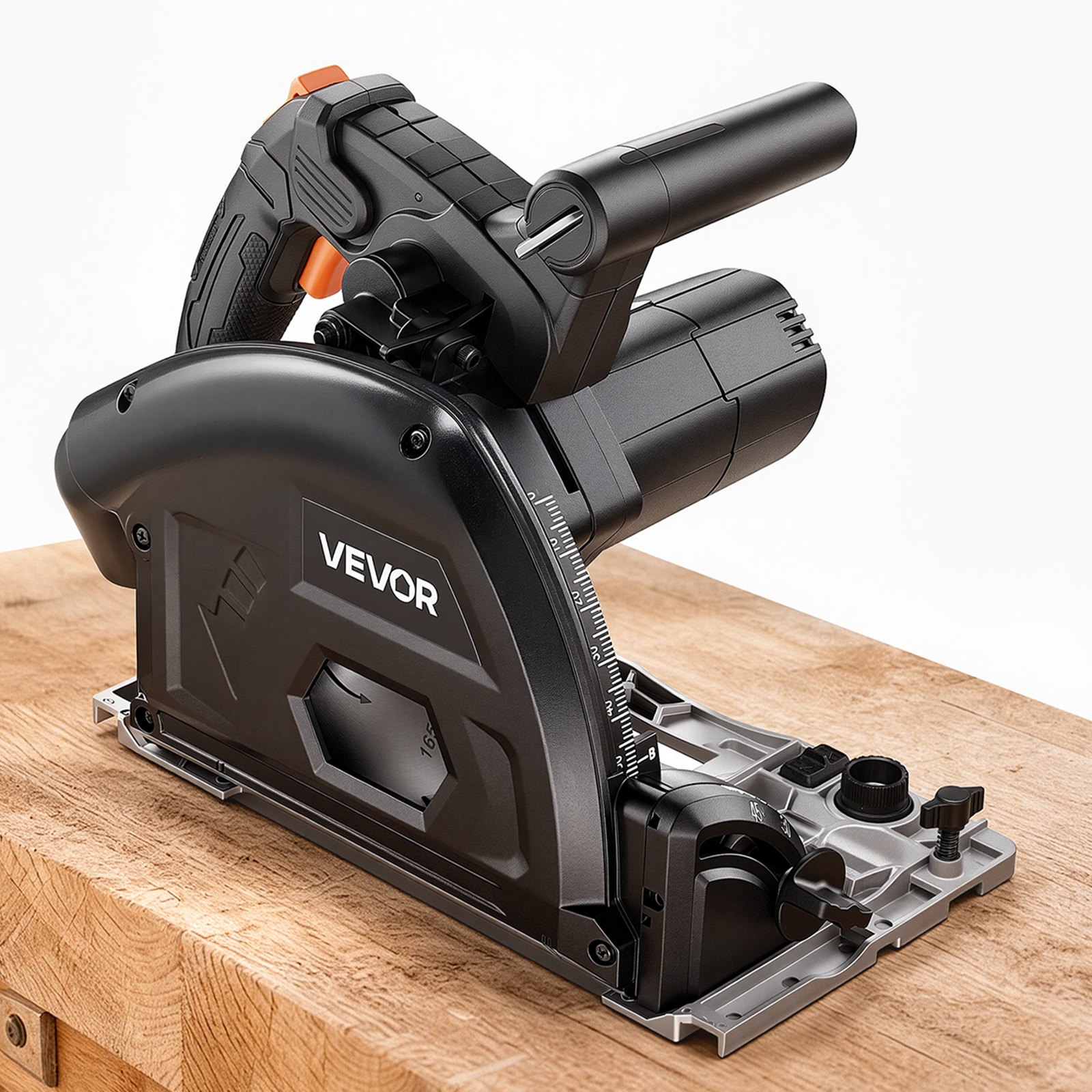

Photos from current listings. Actual item, color, and included accessories may vary.
Circular Saw Rail Buying Guide
A circular saw rail (guide rail) is an extruded aluminum track that constrains a compatible circular saw or plunge saw to a dead-straight cut, replacing a freehand fence. The core trade-off is rail system compatibility and extrusion rigidity: a rail only works with saws whose baseplate groove and offset match the rail's rib, and thin-walled rails flex under load. Buy a rail that explicitly lists your saw model or a universal adapter, and choose a rail with a rib-and-groove profile and at least 1.5 mm wall thickness for durable straight cuts.


At a glance
- Category
- Woodworking Saws & Planers
- Data updated
- Nov 20, 2026
Current offers
Highlights
- Rail cross-section geometry (rib height, groove width, and baseplate offset) is proprietary per brand; a rail from one system will not guide a saw from another without an adapter.
- Extrusion wall thickness and alloy grade (6063-T5 vs generic 6000-series) determine rail stiffness; thinner rails deflect mid-span and produce bowed cuts on long rips.
- Most rails are 1.4 m (55 in) or 1.0 m (39 in) long and can be joined with connector bars; joint alignment quality directly affects straightness across the seam.
- Anti-slip backing strips and splinter guards are consumables: rubberized foam grips the workpiece, while a replaceable splinter strip supports tearout-free cuts on veneered sheet goods.
Best use cases
- Best fit: breaking down 4x8 sheet goods with a plunge saw — pick a 1.4 m rail plus a connector kit for full-length rips; skip short 0.7 m rails that cannot span a full sheet crosscut.
- Best fit: finish carpentry and cabinet installs with a track-compatible circular saw — choose a rail whose baseplate offset matches your exact saw model; skip universal-fit rails if you need repeatable zero-clearance splinter strips.
- Wrong fit: rough framing with a worm-drive saw on dimensional lumber — a guide rail adds setup time and offers no benefit over a speed square; skip rails for repetitive 2x4 crosscuts.
- Best fit: trimming doors and panels on site — a 1.0 m rail with a splinter guard handles 32–36 in door widths; skip 0.7 m rails that force two setups per door edge.
Buying tips
- Match the rail to your saw's baseplate groove and offset: measure the distance from the blade to the baseplate edge; the rail's rib must sit in that groove for the blade to track the splinter strip.
- For full 8 ft rips, buy two 1.4 m rails plus a connector bar set and check that the connector spans the joint with set screws on both sides of the seam.
- Choose rails with replaceable splinter strips and anti-slip foam backing; these are the first wear items and a rail without replacements becomes inaccurate.
- Prefer 6063-T5 aluminum extrusions with wall thickness of 1.5 mm or more; thin-wall rails flex when the saw hangs off the end during a plunge cut.
Specs
| Rail Profile | Rib-and-groove aluminum extrusion |
|---|---|
| Rail Length | 0.7 m / 1.0 m / 1.4 m (2×1.4 m joined) |
| Saw Compatibility | Brand-specific baseplate groove + offset |
| Splinter Guard | Replaceable zero-clearance strip |
Related searches
What to check before buying
- Measure your saw's baseplate: confirm the blade-to-base offset and groove dimensions against the rail's rib profile before ordering.
- Confirm rail length against your workpieces: 1.4 m for 4x8 sheets, 1.0 m for doors and 36 in panels, 0.7 m only for short crosscuts.
- Check that your saw model appears in the rail's compatibility list or that a brand-specific adapter baseplate exists for it.
- Verify the rail ships with or accepts a splinter guard and anti-slip strip, and that replacement strips are sold separately for long-term accuracy.
FAQ
Data sources: eBay / Amazon listings and product attribute feeds Data updated Nov 20, 2026.
Some links on this page are affiliate links. If you buy after clicking one, we may earn a commission at no extra cost to you. This does not change which products appear here or their order. Affiliate disclosure.