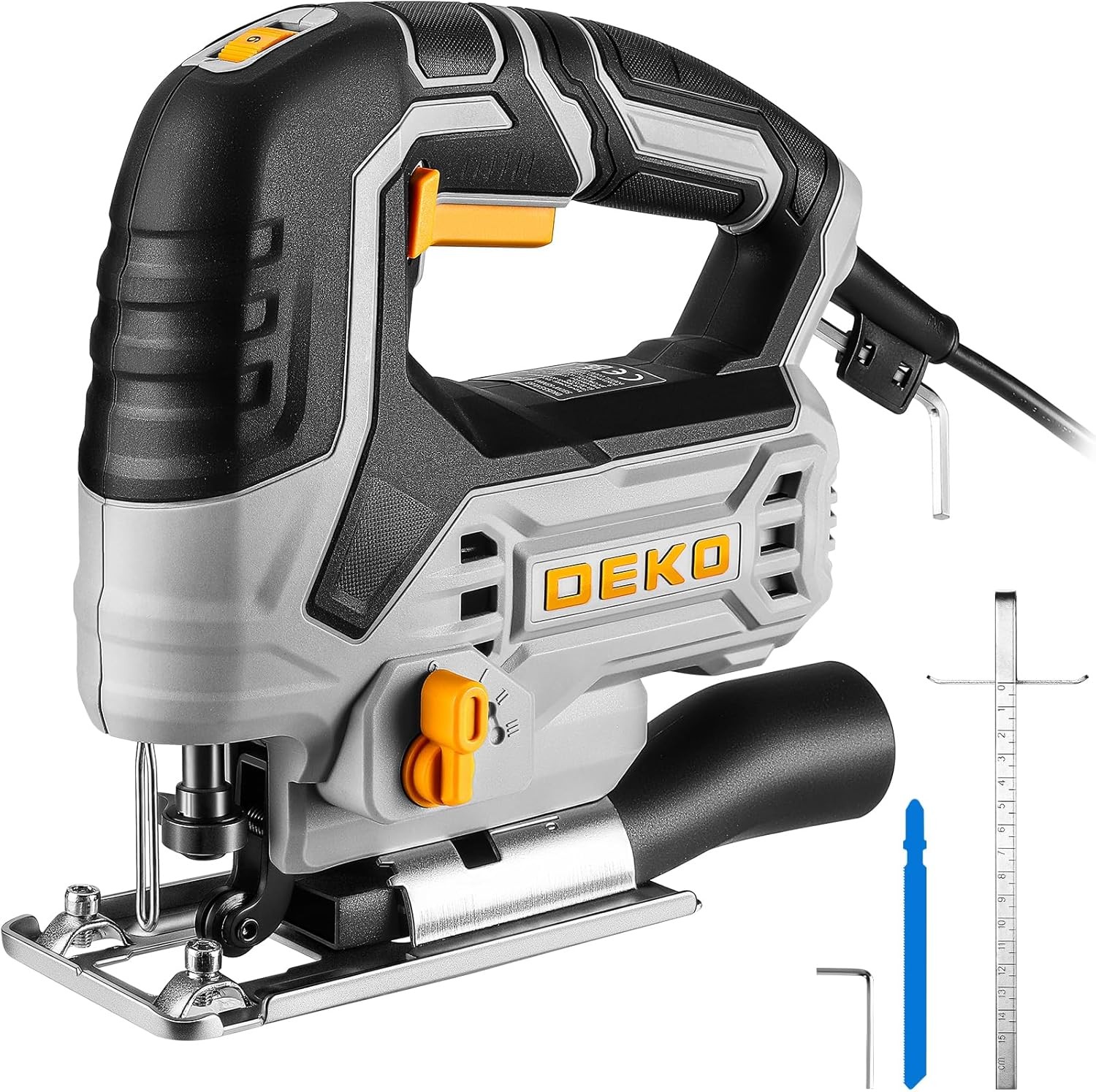

Photos from current listings. Actual item, color, and included accessories may vary.
Electric Jigsaw Buying Guide
An electric jigsaw is a handheld reciprocating saw that cuts curves, straight lines, and cutouts in wood, plastic, and thin metal using a short, fast up-down blade stroke. The core trade-off is between a barrel-grip or top-handle body with a tool-free blade clamp and orbital-action switch (durable, versatile) versus a basic fixed-speed, screw-clamp model that limits control and blade changes. Buy a variable-speed, orbital-action saw with a tool-free T-shank clamp if you cut varied materials; skip any single-speed, keyed-clamp unit unless it is strictly for occasional softwood cuts.


At a glance
- Category
- Woodworking Saws & Planers
- Data updated
- Nov 20, 2026
Current offers
Highlights
- Blade clamp type is the durability bottleneck: tool-free T-shank clamps accept the widest blade range and resist slipping; screw or keyed clamps strip and slow changes.
- Orbital action (usually 3-4 positions) speeds straight cuts in wood by swinging the blade forward on the upstroke; set to 0 for clean curves and metal.
- Stroke length and SPM define cut speed: 3/4 to 1 inch strokes at 500-3,500 SPM cover everything from scrollwork to fast framing cuts.
- Top-handle D-grip bodies suit overhead and plunge cuts; barrel-grip bodies give finer control for curves and are preferred by trim carpenters.
Best use cases
- Best fit: variable-speed, orbital-action top-handle saw (e.g., 6-speed DEKOPRO-class) for general woodworking, countertop cutouts, and PVC—buy this if you need one saw for mixed materials.
- Best fit: barrel-grip jigsaw with low-vibration counterbalance for finish carpentry, curved furniture parts, and laminate; skip top-handle if your work is mostly precision curves.
- Wrong fit: single-speed, non-orbital bargain saw for metal or hardwoods—it overheats blades and chips laminate; step up to a variable-speed model or use a different tool.
- Wrong fit: corded jigsaw for remote framing or overhead ceiling work—choose an 18V/20V cordless model with the same battery platform as your other tools.
Buying tips
- Match blade to material: T-shank high-carbon steel for wood, bi-metal for nail-embedded wood and metal, and carbide-grit for tile and fiberglass—the clamp must accept T-shank.
- Check SPM under load, not no-load: a saw rated 3,000 SPM no-load that bogs to 1,500 in oak is weaker than a 2,500 SPM saw with electronic speed stabilization.
- For cutouts, verify the saw accepts a plunge-cut capability (most orbital saws do) and that the base plate bevels at least 45 degrees for angled cuts.
- Corded saws deliver constant power for sustained shop use; cordless 18V/20V saws trade runtime for portability—pick one battery platform and stay in it.
Specs
| Blade Clamp | Tool-free T-shank vs keyed U-shank |
|---|---|
| Stroke & Speed | 3/4-1 in stroke, 500-3,500 SPM variable |
| Orbital Action | 3-4 position vs fixed straight |
| Power Source | Corded 4-7A vs 18V/20V cordless |
Related searches
What to check before buying
- Measure your workpiece thickness: most jigsaws cut up to 2-3 inches in wood and 3/8 inch in mild steel; deeper cuts need a reciprocating saw.
- Confirm your power source: corded requires a nearby outlet and draws 4-7 amps; cordless needs a battery and charger in a platform you already own.
- Check blade availability locally: T-shank is the dominant standard; U-shank blades are older and limit choices.
- Verify the base plate and blade clamp are tool-free if you change blades often; keyed clamps add minutes per change and strip over time.
FAQ
Data sources: eBay / Amazon listings and product attribute feeds Data updated Nov 20, 2026.
Some links on this page are affiliate links. If you buy after clicking one, we may earn a commission at no extra cost to you. This does not change which products appear here or their order. Affiliate disclosure.