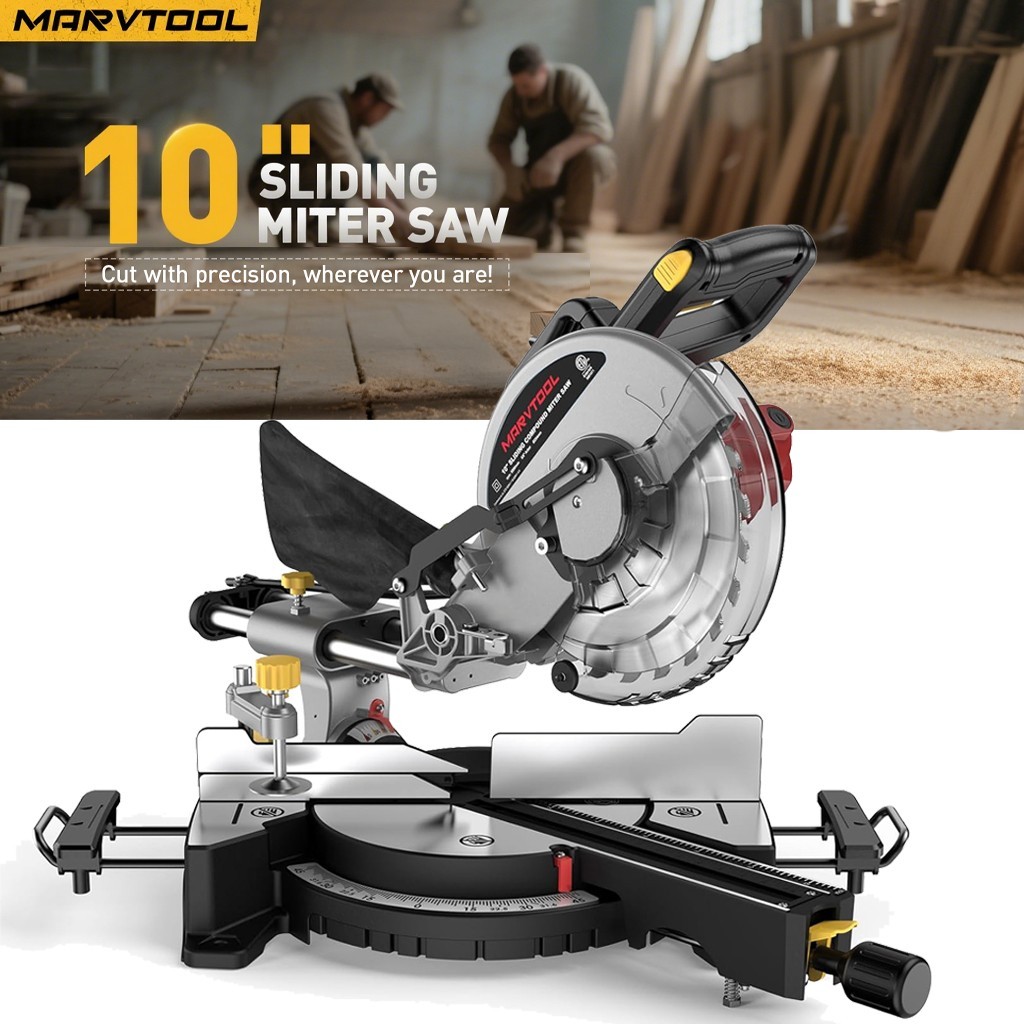

Photos from current listings. Actual item, color, and included accessories may vary.
Marvtool Miter Saw Buying Guide
The Marvtool Miter Saw is a sliding compound miter saw aimed at compact home-workshop and job-site use, where the core trade-offs are motor type, sliding-rail rigidity, and table/fence construction versus a full-size professional unit. The decision rule: buy a sliding compound saw only if its crosscut capacity and bevel/miter range match your widest stock and intended trim angles; otherwise a fixed single-bevel saw saves cost and space without losing capability for 90-degree cuts.


At a glance
- Category
- Woodworking Saws & Planers
- Data updated
- Nov 20, 2026
Current offers
Highlights
- 15 Amp universal (brushed) motor delivers roughly 3,500-4,000 RPM no-load, which is adequate for softwoods and 2x lumber but will bog in dense hardwoods and thick aluminum.
- Sliding compound design adds a horizontal rail stroke that extends crosscut capacity beyond a fixed saw's blade diameter — typically 2x8 or 2x10 at 90 degrees on a 10-inch class saw.
- 10-inch blade (255 mm arbor, usually 5/8 in) yields a maximum crosscut depth around 3-3.5 in at 90 degrees and 2-2.5 in at 45 degrees, so it will not cut a 4x4 in one pass.
- Dual bevel capability (blade tilts left and right) and a miter range of roughly 0-45 degrees each way determine whether you can cut crown molding and compound angles without flipping the workpiece.
Best use cases
- Best fit: trimming, baseboard, and 2x4/2x6 framing on a compact bench or mobile stand — a 10-inch sliding compound saw covers this with margin and stays portable.
- Wrong fit: cutting 4x4 posts, thick hardwood slabs, or large crown profiles in one pass — step up to a 12-inch sliding saw for the extra depth and crosscut capacity.
- Pick a single-bevel fixed saw instead if you only cut 90-degree and simple 45-degree miters — you save weight, cost, and rail flex, and lose nothing for straight cuts.
- Choose dual-bevel over single-bevel only if you regularly cut both left and right compound angles; otherwise a single-bevel saw with a flip of the workpiece is sufficient and cheaper.
Buying tips
- Match blade diameter to your widest stock: a 10-inch saw crosscuts roughly 6 in at 90 degrees, a 12-inch saw roughly 8 in — measure your trim and lumber before choosing.
- Check the sliding rail system: dual horizontal rails with sealed bearings resist flex better than a single-rail or sleeve design, which matters for accurate long crosscuts.
- Verify the miter detents include the common angles (0, 15, 22.5, 31.6, 45 degrees) with a positive stop; a saw with only 0/45 detents makes crown molding and picture frames frustrating.
- Prefer a saw with a cast-aluminum or die-cast table and a tall, adjustable fence over stamped steel — a flexing fence is the most common cause of inaccurate repeated cuts.
Specs
| Blade Size | 10 in (255 mm) / 12 in (305 mm) |
|---|---|
| Motor Type | 15 Amp brushed universal |
| Crosscut Capacity | ~6 in at 90° (10 in class) |
| Bevel Type | Single-bevel vs dual-bevel |
Related searches
What to check before buying
- Measure your bench or stand footprint and the saw's sliding stroke clearance — a sliding compound saw needs roughly 2-3 ft of rear clearance for the rails to travel.
- Check your power source: a 15 Amp saw needs a 15-20 Amp circuit; on a 15 Amp shared circuit, expect breaker trips during heavy cuts.
- Verify the miter table height and fence height suit your typical stock — a tall fence helps with crown molding but can interfere with thick dimensional lumber.
- Confirm the saw's voltage and plug standard match your region (120 V US-style plug vs 230 V) and that a blade guard and riving knife or kerf plate are included.
FAQ
Data sources: eBay / Amazon listings and product attribute feeds Data updated Nov 20, 2026.
Some links on this page are affiliate links. If you buy after clicking one, we may earn a commission at no extra cost to you. This does not change which products appear here or their order. Affiliate disclosure.