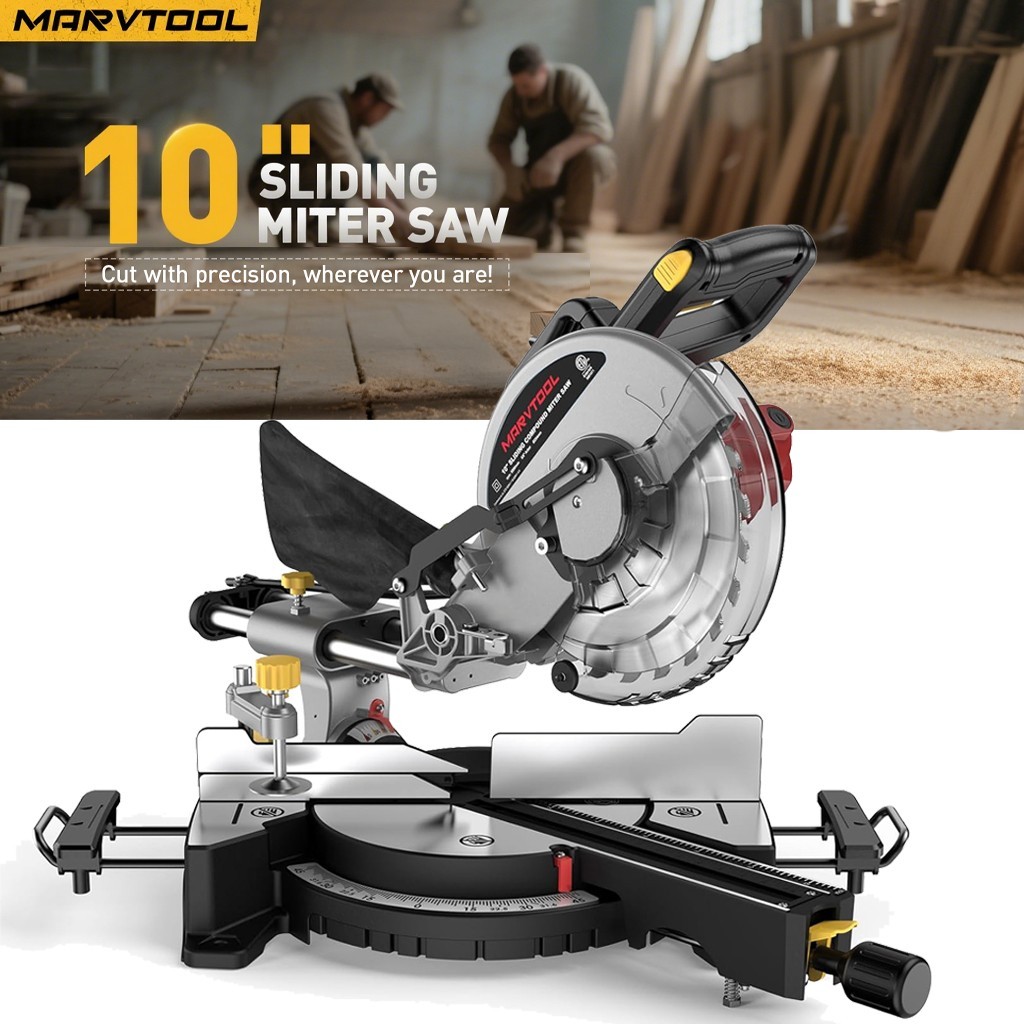

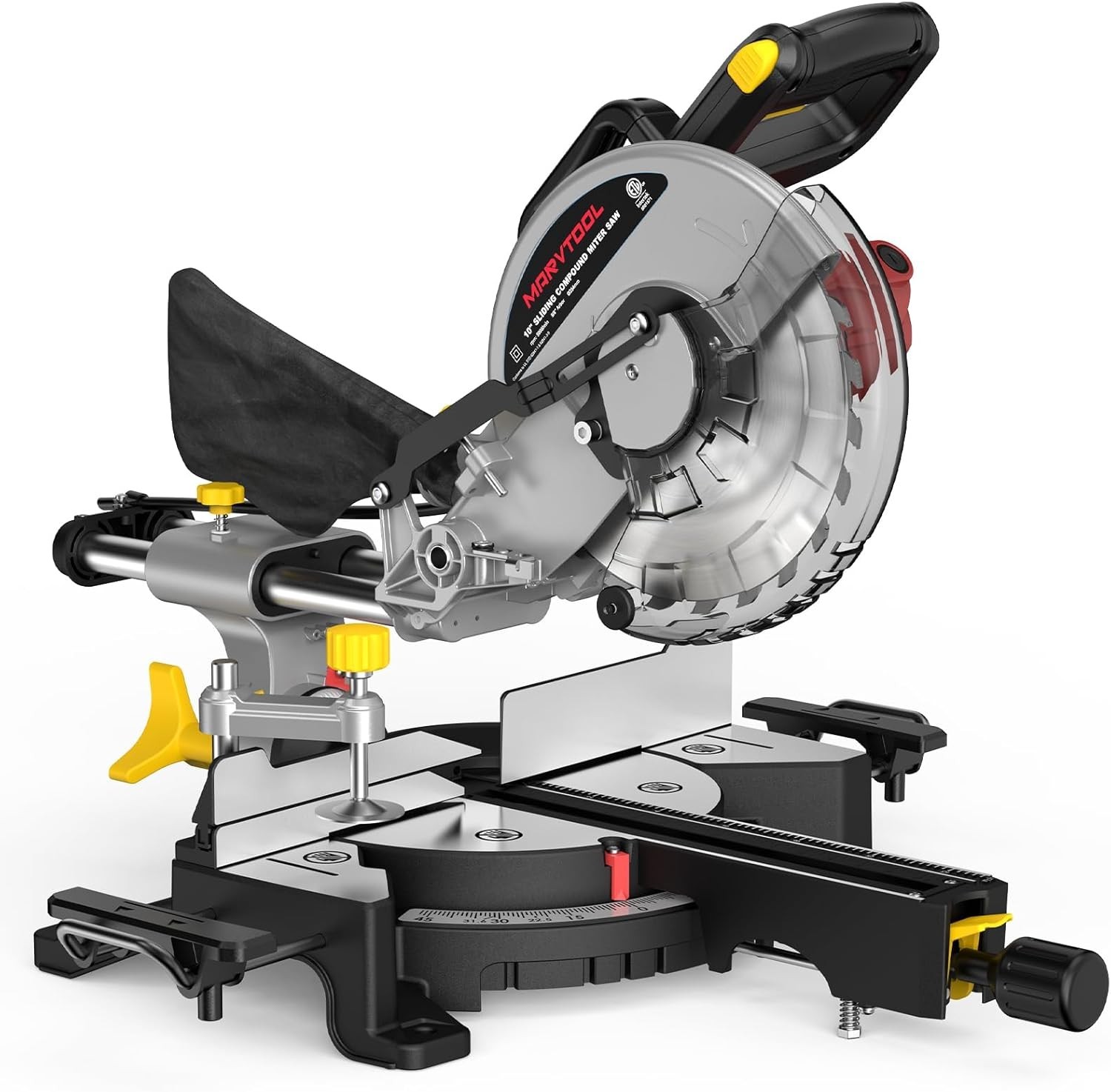
Photos from current listings. Actual item, color, and included accessories may vary.
Miter Saw Buying Guide
A miter saw is a dedicated crosscutting station: the blade swings across a turntable to cut accurate angles, with sliding rails expanding crosscut capacity on wider stock. The core trade-off is between a single-bevel, brushed-motor 10-inch slider and a dual-bevel, belt-driven 12-inch saw with a more rigid fence and detents. Buyers who cut trim, framing, and furniture joinery should prioritize dual-bevel capability and a cast-metal table; buyers doing occasional 2x4 blocking can stay with a compact single-bevel 10-inch unit.


At a glance
- Category
- Woodworking Saws & Planers
- Data updated
- Nov 20, 2026
Current offers
Highlights
- 10-inch blades cut roughly 3.5 inches deep at 90 degrees; 12-inch blades reach about 4 inches, which determines whether you can crosscut 4x4 posts in one pass.
- Sliding rails add crosscut capacity — typically 11 to 14 inches on 10-inch sliders and 14 to 16 inches on 12-inch sliders — so verify the width of your widest stock before choosing.
- Single-bevel saws tilt only left; dual-bevel saws tilt left and right, letting you cut both sides of a compound miter without flipping the workpiece.
- Detent plates with positive stops at 0, 15, 22.5, 31.6, and 45 degrees speed up repeat cuts; cast aluminum or cast iron tables resist deflection better than stamped steel.
Best use cases
- Best fit: 10-inch single-bevel sliding compound saw for trim carpentry, decking, and 2x4 framing where portability and a compact footprint matter more than dual-bevel convenience.
- Best fit: 12-inch dual-bevel sliding saw for furniture, crown molding, and baseboard work where you need 4-inch depth of cut and bevel cuts from both sides.
- Wrong fit: a non-sliding 10-inch chop saw if you regularly crosscut boards wider than 6 inches — the fixed blade guards limit capacity and force awkward flip cuts.
- Skip dual-bevel and laser guides if you only cut 90-degree blocking; a basic single-bevel slider saves weight and cost without losing framing capability.
Buying tips
- Match blade size to depth of cut: 10-inch for 3.5-inch max depth at 90 degrees, 12-inch for 4-inch depth — needed for 4x4 posts and thick stock.
- Check crosscut capacity with the slide extended: 10-inch sliders typically handle 11-12 inches, 12-inch sliders 14-16 inches, so measure your widest board first.
- Choose a 15-amp motor for continuous ripping and dense hardwood; lower-amperage motors bog down in wet pressure-treated lumber and cause burned cuts.
- Look for a cast aluminum table and a fence taller than 4 inches for stable vertical stock; stamped tables flex under load and ruin miter accuracy.
Specs
| Blade Size | 10 in vs 12 in |
|---|---|
| Bevel Type | Single-bevel vs dual-bevel |
| Crosscut Capacity | 11-12 in (10 in) / 14-16 in (12 in) |
| Motor Power | 15 amp standard / 12 amp compact |
Related searches
What to check before buying
- Measure your widest recurring crosscut and confirm the saw's slide-extended capacity exceeds it by at least 1 inch.
- Verify bench or stand depth: 10-inch sliders need roughly 30 inches of front-to-back clearance; 12-inch sliders need about 36 inches.
- Confirm voltage and plug standard match your shop (120V 15-amp grounded outlet for North American models) and that the saw accepts a 5/8-inch arbor blade.
- Check that the saw ships with or accepts a workpiece clamp and extension table if you cut stock longer than 6 feet unsupported.
FAQ
Data sources: eBay / Amazon listings and product attribute feeds Data updated Nov 20, 2026.
Some links on this page are affiliate links. If you buy after clicking one, we may earn a commission at no extra cost to you. This does not change which products appear here or their order. Affiliate disclosure.