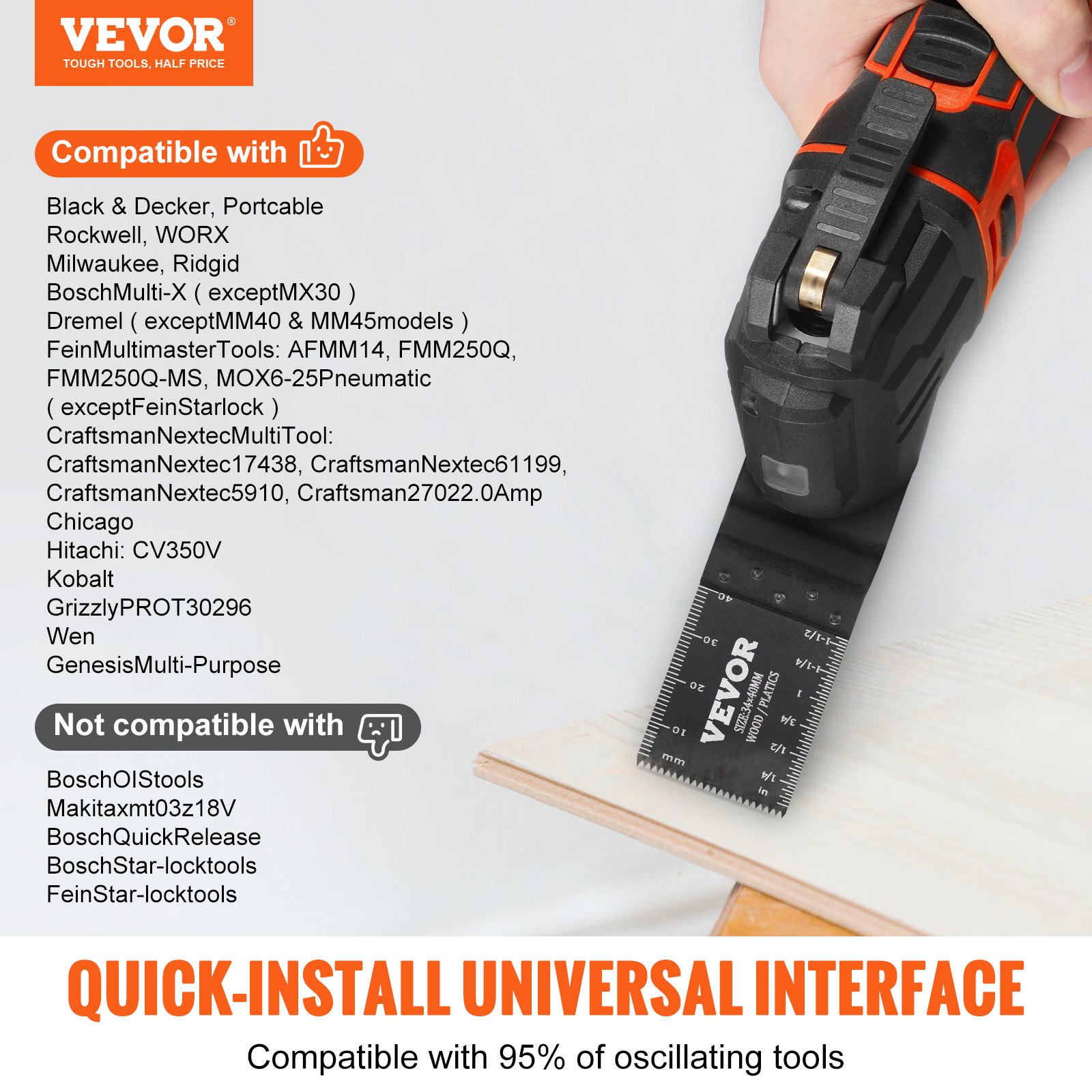

Photos from current listings. Actual item, color, and included accessories may vary.
Oscillating Saw Blade Buying Guide
Oscillating saw blades are the consumable cutting tips that turn your oscillating multi-tool into a flush-cutter, undercut saw, or detail scraper. The key trade-off is between high-speed steel (HSS) for clean wood/plastic cuts and bi-metal or carbide grit for hardened metal, nails, and grout. The decision rule is simple: buy bi-metal or carbide for any metal-cutting task, and reserve cheap HSS or high-carbon steel blades for softwood, drywall, and plastic where shatter risk is low.


At a glance
- Category
- Woodworking Saws & Planers
- Data updated
- Nov 20, 2026
Current offers
Highlights
- Bi-metal blades (HSS teeth electron-beam welded to a spring-steel body) resist tooth snap and heat better than stamped high-carbon steel, making them the minimum grade for nails, screws, and thin sheet metal.
- Carbide-grit blades cut hardened steel, cast iron, fiberglass, and grout but cut slower and wider kerf; use them where bi-metal teeth would dull instantly.
- Universal quick-release (Starlock-style arbor) fits most branded multi-tools, but older pin-style arbors need an adapter washer; verify your tool's interface before buying a bulk pack.
- Tooth pitch matters: fine 18-24 TPI for metal and hardwood, coarse 6-10 TPI for fast softwood and PVC demolition cuts; plunge-cut blades have a rounded tip for blind cuts.
Best use cases
- Pick bi-metal or carbide blades in a bulk pack for remodeling work involving nails, copper pipe, and embedded fasteners; skip plain HSS packs for any metal contact.
- Choose fine-tooth HSS or bi-metal for flush-cutting door jambs, baseboard, and PVC trim where a clean edge matters; skip coarse demolition blades that tear veneer.
- Buy carbide-grit blades for tile grout, fiberglass, and hardened mortar; skip them for wood because they burn and slow-cut.
- For occasional drywall and plastic cutting, a low-cost HSS assortment is adequate; skip premium carbide tiers unless you cut abrasive or hardened material weekly.
Buying tips
- Match arbor interface first: Starlock/quick-release fits most current multi-tools; older Bosch, Dremel, and Fein models may need a pin-adapter, so confirm your tool's mount style before buying a 50-piece pack.
- Buy bi-metal (not high-carbon steel) if any cut may hit a nail or screw—high-carbon teeth chip and shatter, while bi-metal teeth flex and resist snap.
- Choose tooth count by material: 18-24 TPI for metal and hardwoods, 6-10 TPI for fast softwood/PVC cuts; fine pitch gives cleaner edges but slower feed.
- Bulk packs trade unit cost for duplicated sizes; buy a mixed set covering standard 1-1/4 in, 1-3/4 in, and 2-1/2 in widths rather than 50 identical blades unless you standardize on one cut.
Specs
| Blade Material | HCS / Bi-metal / Carbide grit |
|---|---|
| Arbor Interface | Quick-release / Starlock / Pin adapter |
| Tooth Pitch | 6-10 TPI coarse / 18-24 TPI fine |
| Max Cut Depth | Up to 1/8 in sheet metal (bi-metal) |
Related searches
What to check before buying
- Confirm your multi-tool's blade interface (Starlock, quick-release, or pin-style) and whether an adapter is required before ordering.
- Measure the deepest plunge cut you need against blade width—blades wider than the cut opening bind and overheat.
- Check material thickness: standard bi-metal blades handle up to roughly 1/8 in sheet metal; thicker steel needs carbide or a different tool.
- Verify blade length clears your workpiece and that the tool's oscillation angle (typically 3-5 degrees) suits flush-cut vs plunge-cut blades.
FAQ
Data sources: eBay / Amazon listings and product attribute feeds Data updated Nov 20, 2026.
Some links on this page are affiliate links. If you buy after clicking one, we may earn a commission at no extra cost to you. This does not change which products appear here or their order. Affiliate disclosure.