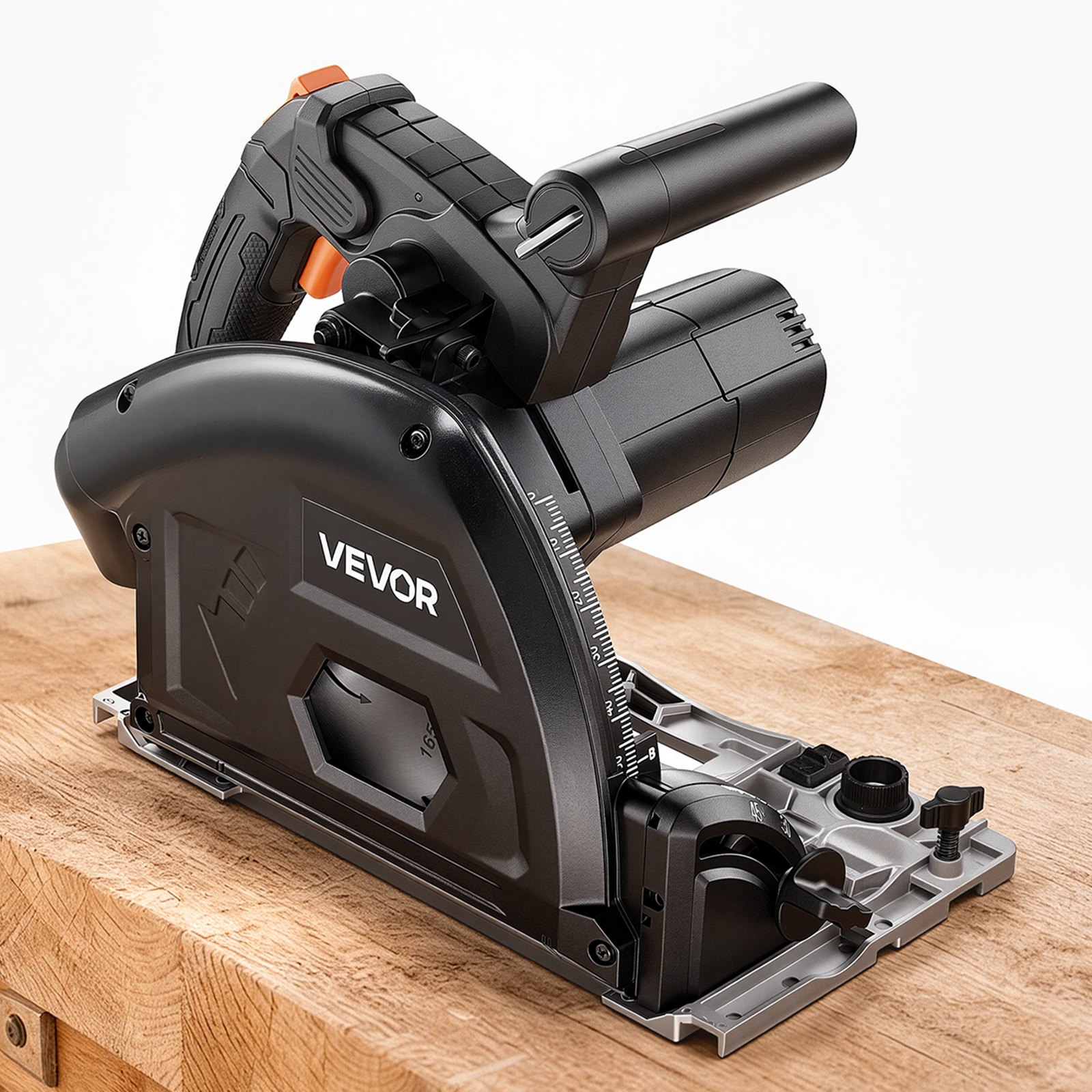

Photos from current listings. Actual item, color, and included accessories may vary.
Plunge Saw With Track Buying Guide
A plunge saw with track is a circular saw that drops vertically into the workpiece and rides a guide rail for splinter-free, dead-straight cuts—replacing a table saw for sheet goods breakdown. The core trade-off is rail system rigidity and saw-to-rail fit versus motor wattage: a sloppy base-to-rail interface ruins cut quality no matter the power. Buy only bundles where the rail is included or the saw is explicitly compatible with a standard rail profile; a bare saw with no rail ecosystem is a compromise.


At a glance
- Category
- Woodworking Saws & Planers
- Data updated
- Nov 20, 2026
Current offers
Highlights
- Rail-guided plunge saws cut 0-45° bevels with 6-1/2 in blades reaching roughly 2.16 in depth at 90°, enough for 1-3/4 in stock and most sheet goods.
- Motor class splits at 1400W/5500 RPM for 6-1/2 in models; larger 8-1/4 in saws run higher wattage for 2-5/8 in depth in thick timber.
- Rail joiners connect two 27.5 in (700mm) rails into a 55 in (1400mm) track; most rails are extruded aluminum with a splinter guard and anti-slip strips.
- Plunge mechanism uses dual spring-loaded columns; a riving knife and blade brake separate safe professional saws from budget units.
Best use cases
- Sheet-goods breakdown (plywood, MDF, melamine): pick the 55 in rail bundle—one continuous track cross-cuts a 48 in panel square; skip bare-saw listings.
- Door and countertop trimming: choose a saw with a 0-45° bevel and at least 2-1/8 in depth; skip 6-1/2 in saws if you routinely cut 2x lumber.
- Trim and cabinet installs on site: get two 27.5 in rails plus joiners for portability; skip the single long rail if transport space is tight.
- Heavy timber or repeated 2x framing: a track saw is the wrong tool—use a circular saw or miter saw; track saws excel at sheet goods and finish cuts.
Buying tips
- Match rail length to your largest cut: a 55 in rail cross-cuts a 48 in sheet; two 27.5 in rails joined equal 55 in but lose rigidity at the seam.
- Confirm the saw base fits the rail profile—most systems are proprietary; a saw without a matching rail or adapter cannot track straight.
- Choose 1400W/5500 RPM for 6-1/2 in blades cutting sheet goods; step up in wattage and blade size for depth over 2-1/4 in.
- Check bevel range and depth at 45°: a saw rated 2.16 in at 90° cuts noticeably less at 45°, so verify the bevel depth spec.
Specs
| Blade Size | 6-1/2 in (165mm) vs 8-1/4 in |
|---|---|
| Max Cut Depth | 2.16 in at 90° / less at 45° |
| Rail Length | 55 in single or 2 x 27.5 in joined |
| Motor / Speed | 1400W, 5500 RPM (6-1/2 in class) |
Related searches
What to check before buying
- Measure your widest sheet cut; buy a rail at least 12 in longer than the cut for entry and exit support.
- Verify your bench or foam-cutting surface is flat and supports the full rail length—sagging rails cause inaccurate cuts.
- Confirm the saw's blade arbor size and that a 48-tooth fine-tooth blade is included for splinter-free sheet goods.
- Check voltage and plug standard for your region (120V North America vs 230V) and that the rail's anti-slip strips are replaceable.
FAQ
Data sources: eBay / Amazon listings and product attribute feeds Data updated Nov 20, 2026.
Some links on this page are affiliate links. If you buy after clicking one, we may earn a commission at no extra cost to you. This does not change which products appear here or their order. Affiliate disclosure.