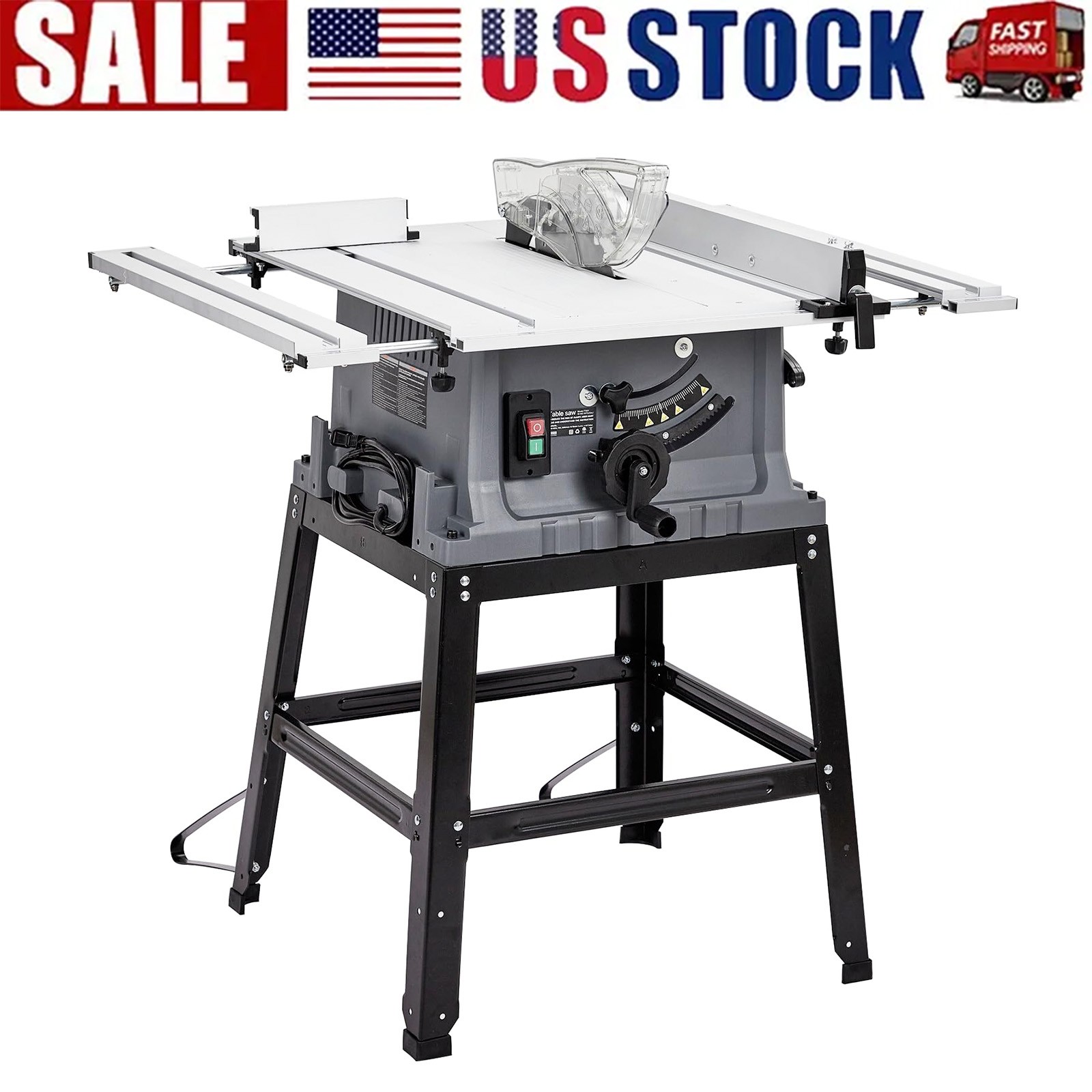

Photos from current listings. Actual item, color, and included accessories may vary.
Portable Table Saw Buying Guide
A portable table saw is a benchtop or job-site saw built around a 10-inch blade that trades cast-iron mass and full rip capacity for transportability and compact footprint. The core trade-off is between a lightweight direct-drive universal motor with a stamped-steel table and a heavier belt-drive induction motor on a precision-machined top: the latter resists bogging in hardwoods and holds fence alignment, while the former wins on portability and cost. The decision rule is simple: buy a belt-drive or brushless saw with a rack-and-pinion fence if you cut hardwood or need repeatable rips; buy a direct-drive benchtop model only for dimensional lumber and occasional sheet-goods breakdown.


At a glance
- Category
- Woodworking Saws & Planers
- Data updated
- Nov 20, 2026
Current offers
Highlights
- 10-inch blade diameter is the segment standard, yielding a 3–3.5 inch depth of cut at 90° and roughly 2–2.5 inches at 45°; 8-inch saws cut shallower and are not a substitute for full-depth ripping.
- Direct-drive universal motors (typically 12–15 amp, 120V) spin at 4,000–5,000 RPM and are light but lose torque under load; belt-drive induction motors run quieter, cooler, and hold RPM in thick hardwood.
- Rack-and-pinion fences lock parallel and stay aligned; a stamped-steel or aluminum fence with a single rear lock is the primary source of inaccurate, non-repeatable rips on budget saws.
- Job-site stands fall into folding scissor-leg and wheeled gravity-rise types; the stand's stability and fence rail rigidity matter more than the saw's motor spec for accurate long rips.
Best use cases
- Best fit: a belt-drive 10-inch saw with rack-and-pinion fence and folding stand for trim carpenters and remodelers who rip hardwood and sheet goods on site — skip direct-drive benchtop units if you cut oak or maple regularly.
- Best fit: a compact 10-inch direct-drive benchtop saw with a lightweight stand for garage woodworkers breaking down plywood and 2x lumber — skip job-site wheeled saws if you never leave the shop.
- Best fit: a saw with a integrated folding stand and large rip capacity (24 inches or more) for deck and fence builders cutting long dimensional lumber — skip 8-inch compact saws and table-top models with sub-20-inch rip capacity.
- Wrong fit: a benchtop saw with a stamped fence and no stand for anyone needing repeatable cabinet-grade rips — upgrade to a rack-and-pinion fence and a stable stand or a contractor-style saw instead.
Buying tips
- Match blade size to depth: a 10-inch saw cuts 3–3.5 inches at 90°, enough for 2x material on edge and 2-inch thick stock; an 8-inch saw tops out near 2.5 inches and cannot rip 4x4 or thick hardwood.
- Check fence type before motor: rack-and-pinion with a front lock and rear glide holds parallel; a single-lock stamped fence drifts and produces tapered rips after a few passes.
- Choose the stand by transport: folding scissor-leg stands set up fast and pack flat for truck beds; wheeled gravity-rise stands roll over rough ground but add weight and cost.
- Verify voltage and plug: portable saws are 120V 15-amp corded tools requiring a 20-amp circuit for full load; a 15-amp household circuit will trip under hard ripping.
Specs
| Blade Size | 10 in standard / 8 in compact |
|---|---|
| Motor Type | Direct-drive universal vs belt-drive |
| Depth of Cut | 3–3.5 in at 90° / 2–2.5 in at 45° |
| Fence Type | Rack-and-pinion vs single-lock stamped |
Related searches
What to check before buying
- Measure your shop or truck bed: a 10-inch benchtop saw with stand occupies roughly 24x24 inches folded and 40x40 inches open — confirm clearance before buying a wheeled job-site model.
- Confirm rip capacity: stock rip capacity ranges from about 16 to 32 inches right of blade; measure your widest sheet-goods cut and pick a saw whose fence rail covers it.
- Check circuit and plug: 120V 15-amp saws need a dedicated 20-amp circuit for continuous ripping; verify the outlet and extension cord gauge (12 AWG minimum) before use.
- Plan blade and accessories: budget for a 10-inch 40-tooth combination blade and a zero-clearance throat plate; the stock ripping blade leaves rough edges on plywood and melamine.
FAQ
Data sources: eBay / Amazon listings and product attribute feeds Data updated Nov 20, 2026.
Some links on this page are affiliate links. If you buy after clicking one, we may earn a commission at no extra cost to you. This does not change which products appear here or their order. Affiliate disclosure.