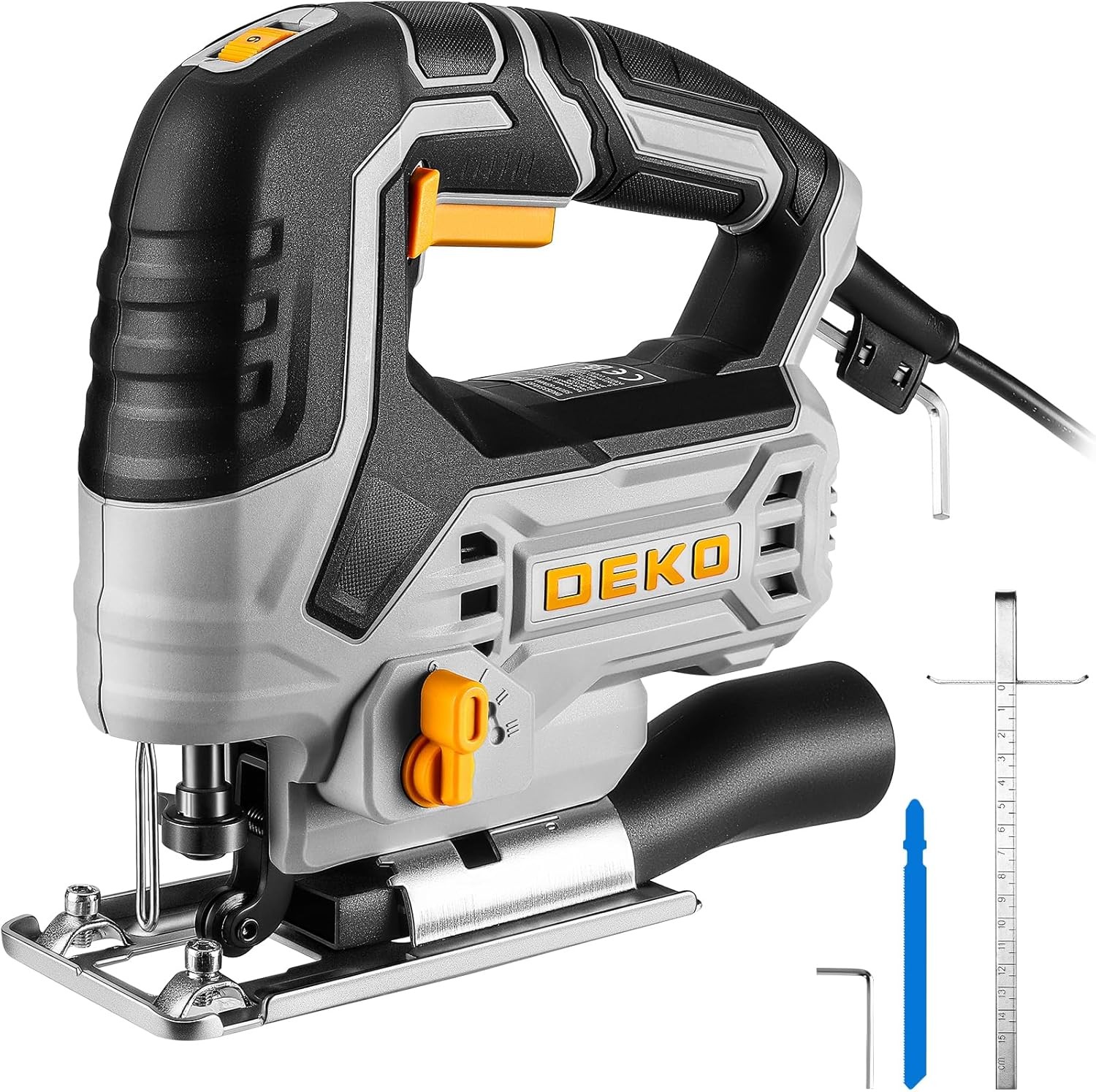

Photos from current listings. Actual item, color, and included accessories may vary.
Power Saw Buying Guide
A power saw is any motor-driven cutting tool—circular, jigsaw, reciprocating, or miter—that replaces hand sawing for speed and repeatability. The core trade-off is motor type and build: brushless motors and cast-aluminum or magnesium bases deliver long-term accuracy, while brushed motors and stamped-steel bases flex under load and wear out faster. Buy brushless with a tool-free blade change and a metal base if you cut weekly; accept brushed motors only for occasional light-duty use.


At a glance
- Category
- Woodworking Saws & Planers
- Data updated
- Nov 20, 2026
Current offers
Highlights
- Motor type: brushless DC delivers 50-60% longer runtime and cooler operation than brushed AC; brushed motors are acceptable only for intermittent DIY use.
- Base material: die-cast magnesium or aluminum resists deflection and keeps 90° cuts true; stamped steel bases flex and lose accuracy under heavy feed pressure.
- Blade change: tool-free keyless chucks on jigsaws and quick-release guards on circular saws cut blade swaps to seconds; keyed arbors require a separate wrench and slow workflow.
- Orbit and speed control: variable-speed triggers (0-3,000 SPM) plus 4-position orbital action on jigsaws let you match aggression to material—straight cuts in thick stock need orbit, splinter-free veneer needs zero orbit.
Best use cases
- Best fit: cutting curves and cutouts in 3/4-inch plywood or countertops—choose a jigsaw with orbital action, tool-free blade change, and a brushed or brushless motor rated for 6+ amps; skip underpowered 2.5-amp mini saws that stall in hardwood.
- Best fit: fast straight crosscuts and rips in dimensional lumber—pick a 7-1/4-inch circular saw with a 15-amp motor and magnesium base; skip 5-1/2-inch trim saws unless you exclusively cut 1x stock.
- Best fit: trim, molding, and framing with repeatable angles—use a 10- or 12-inch sliding compound miter saw with dual bevel; skip non-sliding 7-1/4-inch miter saws if you need to crosscut 2x8 or wider boards.
- Wrong fit: demolition and pruning—reciprocating saws are required for rough cuts in embedded nails or tree limbs; jigsaws and circular saws bind and kick back in those applications.
Buying tips
- Amp rating predicts torque: circular saws need 15 amps for full-depth hardwood cuts; jigsaws need 6+ amps for 2-inch stock. Anything below 10 amps (circular) or 4 amps (jigsaw) is light-duty only.
- Blade arbor sizing: circular saws use 5/8-inch arbor (diamond knockout for 13/16-inch); jigsaws use T-shank (tool-free) or U-shank (bayonet). Confirm your blade stock matches the saw's shank type before buying.
- Corded vs cordless: corded saws deliver constant power and unlimited runtime for shop use; cordless (18V or 20V max) suits remote job sites but adds battery/charger cost and loses power in thick stock.
- Base plate bevel capacity: 45° bevels are standard; 50-56° bevels on premium circular saws allow undercutting and chamfer work. Jigsaw bases that bevel to 45° both ways add versatility for trim.
Specs
| Motor Type | Brushless DC vs Brushed AC |
|---|---|
| Power Source | Corded 120V vs 18V/20V Cordless |
| Blade/Arbor Standard | 7-1/4 in / 5/8 in arbor (circular) |
| Max Cut Depth | 2-3/8 in at 90° (7-1/4 in saw) |
Related searches
What to check before buying
- Measure your thickest regular cut: jigsaws handle up to 2-3/8 inches in wood with a long blade; circular saws at 7-1/4 inches cut 2-3/8 inches at 90° and 1-3/4 inches at 45°. Buy a saw whose max depth exceeds your thickest stock by at least 1/4 inch.
- Confirm power source and circuit: corded saws draw 10-15 amps—ensure your shop circuit is 15-20 amps and use a 12-gauge extension cord under 50 feet to avoid voltage drop.
- Check blade availability locally: T-shank jigsaw blades and 7-1/4-inch circular saw blades are universal; specialty arbor sizes or non-standard blade lengths force online orders and delay projects.
- Verify bevel and shoe adjustability: tool-free bevel levers and positive stops at 0° and 45° speed setup; keyed or detent-only systems require a wrench and slow repeat cuts.
FAQ
Data sources: eBay / Amazon listings and product attribute feeds Data updated Nov 20, 2026.
Some links on this page are affiliate links. If you buy after clicking one, we may earn a commission at no extra cost to you. This does not change which products appear here or their order. Affiliate disclosure.