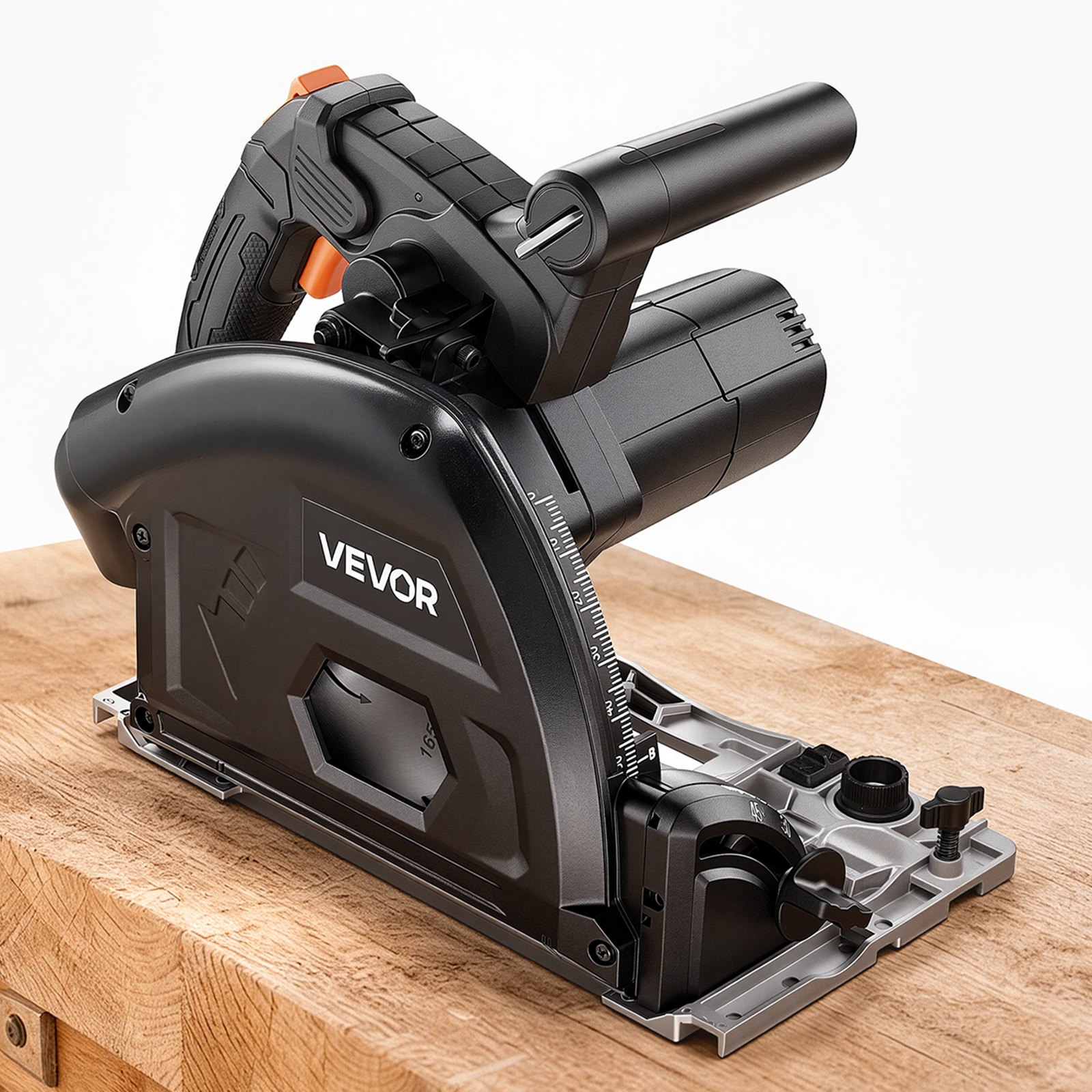

Photos from current listings. Actual item, color, and included accessories may vary.
Track Saw Circular Saw Buying Guide
A track saw circular saw is a plunge-cut circular saw paired with a straight guide rail to deliver dead-straight, splinter-free cuts that rival a table saw on full sheets. The core trade-off is rail compatibility and plunge mechanism precision versus raw wattage—a 1400W saw on an incompatible or flimsy rail will wander, while a lower-power saw on a rigid, anti-slip rail cuts cleanly. The decision rule: buy a saw whose rail system is explicitly named and supported, and treat 'guide rail not included' listings as saw-only purchases that require a separate rail investment.


At a glance
- Category
- Woodworking Saws & Planers
- Data updated
- Nov 20, 2026
Current offers
Highlights
- Plunge mechanism with spring-loaded retraction is what separates a true track saw from a standard circular saw clamped to a straightedge; only plunge saws allow mid-sheet entry and scored cuts.
- Rail compatibility is proprietary: Makita, Festool, Bosch, and DeWalt rails use different rib profiles, so a saw body must match the rail brand or use a known cross-compatible system.
- A 6-1/2-inch blade at 5500 RPM with 2.16-inch depth at 90 degrees cuts standard 1-1/2-inch countertops and 3/4-inch plywood in one pass; depth drops to roughly 1.5 inches at 45 degrees.
- 1400W class motors sustain cuts in hardwood and sheet goods; below 1200W, saws bog down in wet lumber and thick stock, forcing slow feeds that burn edges.
Best use cases
- Best fit: sheet-goods breakdown (plywood, MDF, melamine) on a rigid foam backer—pick a plunge saw with a 55-inch rail and anti-splinter strip to eliminate chip-out on veneered faces.
- Best fit: finish carpentry and cabinet installs—choose a saw with a riving knife and variable depth stop for repeatable 3/4-inch dados and trim cuts along walls.
- Wrong fit: heavy timber framing or wet pressure-treated 4x4s—skip track saws and use a worm-drive circular saw; plunge saws lack the torque and depth for repeated deep rips.
- Wrong fit: budget buyers who assume the rail is included—if the listing says 'guide rail not included,' budget for a separate rail at 55 to 75 inches; a saw without its matching rail cannot track straight.
Buying tips
- Match rail length to your work: a 55-inch rail cross-cuts 4-foot sheet goods; a 75-inch rail rips 8-foot sheets in one pass—two 55-inch rails joined need a connector kit and add flex at the seam.
- Verify blade bore and diameter: 6-1/2-inch blades with 20mm or 5/8-inch arbor are common; a 48-tooth ATB blade suits plywood and melamine, while 24-tooth ripping blades clear chips faster in solid stock.
- Check plunge depth scale calibration: a saw that reads 2.16 inches at 90 degrees should cut 3/4-inch stock with the blade fully retracted past the material—confirm the depth stop locks repeatably, not just rotates.
- Prioritize rail grip and straightness over motor wattage: extruded aluminum rails with dual anti-slip strips and a splinter guard stay true; a 1400W saw on a warped rail produces worse cuts than a 1200W saw on a rigid rail.
Specs
| Blade Size | 6-1/2 in (165mm) common; 7-1/4 in for deeper cuts |
|---|---|
| Cut Depth at 90° | 2.16 in (55mm) typical for 6-1/2 in class |
| Motor Power | 1200-1400W; below 1200W bogs in hardwood |
| Rail System | Proprietary per brand; rail sold separately |
Related searches
What to check before buying
- Measure your sheet goods and workspace: confirm rail length (55 or 75 inches) fits your cut direction and that the rail plus saw overhang clears walls and benches.
- Confirm the saw's rail system is named and sold separately—if the listing omits the rail brand, the saw likely uses a proprietary or unsupported profile.
- Check voltage and plug standard for your region (120V North America vs 230V EU) and confirm the saw ships with the correct plug type.
- Plan for a backer: a rigid foam insulation board or sacrificial plywood sheet under the work prevents tear-out and protects the floor; budget for it alongside the rail.
FAQ
Data sources: eBay / Amazon listings and product attribute feeds Data updated Nov 20, 2026.
Some links on this page are affiliate links. If you buy after clicking one, we may earn a commission at no extra cost to you. This does not change which products appear here or their order. Affiliate disclosure.