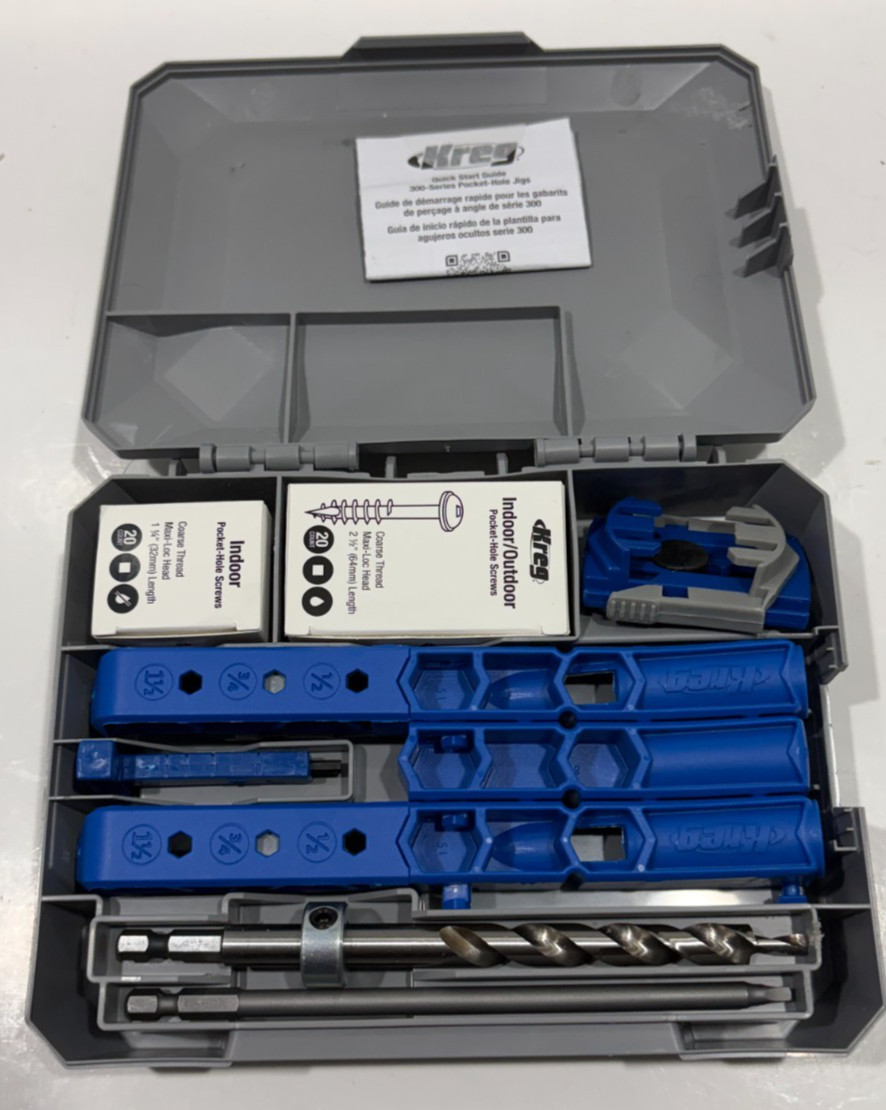

Photos from current listings. Actual item, color, and included accessories may vary.
Kreg Pocket Hole Jig Buying Guide
A Kreg pocket hole jig is a guided drilling system that bores angled pilot holes for hidden screw joinery, and the core trade-off is between fixed single-position blocks and adjustable multi-material carriages. Choose an adjustable, hardened-steel jig with a clamped workpiece and dust collection for furniture-grade repeatability; fixed plastic blocks are only for light repair work.


At a glance
- Category
- Woodworking Clamps, Jigs & Joinery
- Data updated
- Nov 20, 2026
Current offers
Highlights
- Kreg jigs use hardened steel drill guides set at a 15-degree angle; guide wear resistance and drill-bit stop collars determine hole depth accuracy and joint strength.
- The 320-series uses a two-position adjustable guide block on a polymer body, while the 720/720PRO adds a three-position sliding carriage, Kreg Dock compatibility, and integrated material support.
- All Kreg jigs drill 9/16-inch (14 mm) stepped pilot holes for self-tapping washer-head pocket screws; bit stop collar must match screw length (1-1/4-inch screws for 1/2-inch stock, 2-1/2-inch for 1-1/2-inch stock).
- Dust collection on 520/720 models routes chips through a rear port to a shop vac, preventing clogged guides and oversized holes during high-volume drilling.
Best use cases
- Best fit: Kreg 320 kit for apartment/garage woodworkers building face frames, cabinet boxes, and picnic tables in 1/2- to 1-1/2-inch stock; skip if you regularly switch between thin drawer boxes and thick legs without re-clamping.
- Best fit: Kreg 720/720PRO for cabinet shops and remodelers drilling hundreds of holes weekly; the three-position carriage and Dock compatibility justify the size for multi-thickness production runs.
- Wrong fit: a fixed single-hole mini jig for structural butt joints in 2x4 framing or deck ledges—pocket screws are not rated for structural/load-bearing connections; use lag screws or structural connectors instead.
Buying tips
- Match jig capacity to your thickest stock: the 320 handles 1/2 to 1-1/2 inches; the 720 extends to 1-1/2 inches with a wider carriage—thicker material requires the XL or Foreman series.
- Buy the kit with the case and bit/stop-collar set; a bare jig without the correct stop collar and 3/8-inch stepped bit is unusable and separate parts cost more.
- Check drill guide material: hardened steel guides outlast zinc-plated or plastic bushings, which oval out after a few hundred holes and produce loose joints.
- For benchtop use, pick a jig with a rear clamp ledge or Kreg Dock mount; handheld jigs without workholding slide on smooth stock and skew hole angles.
Specs
| Guide Angle | 15-degree hardened steel |
|---|---|
| Stock Capacity | 1/2 to 1-1/2 in (320/720) |
| Pilot Hole Size | 9/16 in (14 mm) stepped |
| Dust Port | Rear port, shop-vac hose |
Related searches
What to check before buying
- Measure your thickest and thinnest workpiece: pocket screws require at least 1/2-inch stock and jig capacity must cover your maximum thickness.
- Confirm you have a 3/8-inch chuck drill and a shop vac with 1-1/4-inch or 2-1/2-inch hose for dust-port models.
- Plan bench space for the jig footprint plus stock overhang—the 320 needs about 12 inches of clearance behind the guide block.
- Verify screw length vs stock thickness: 1-inch screws for 1/2-inch stock, 1-1/4-inch for 3/4-inch, 2-1/2-inch for 1-1/2-inch material.
FAQ
Data sources: eBay / Amazon listings and product attribute feeds Data updated Nov 20, 2026.
Some links on this page are affiliate links. If you buy after clicking one, we may earn a commission at no extra cost to you. This does not change which products appear here or their order. Affiliate disclosure.