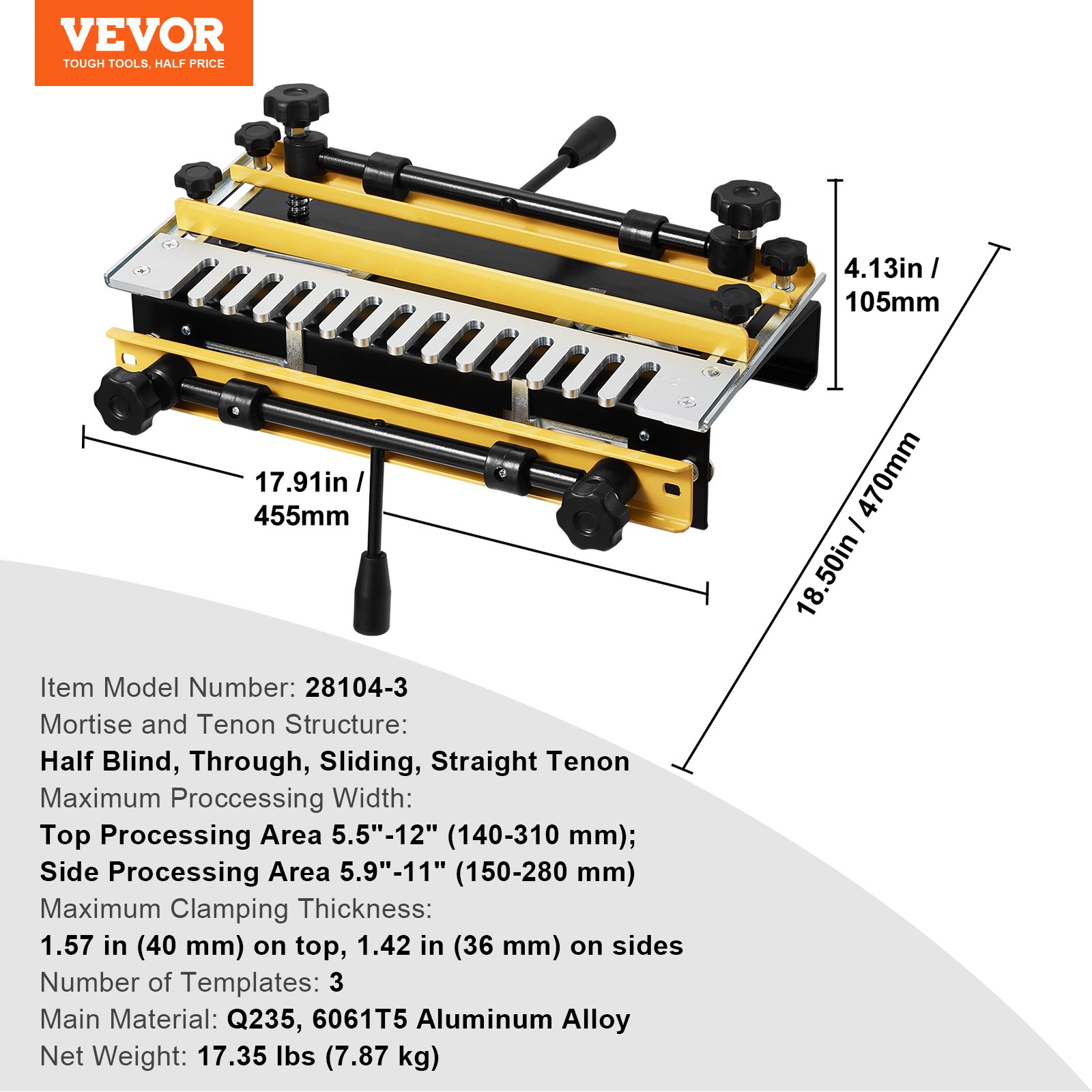

Photos from current listings. Actual item, color, and included accessories may vary.
Woodworking Router Template Buying Guide
A woodworking router template is a guided jig that constrains a router bit to cut repeatable joinery, profiles, or inlays. The core trade-off is between universal adjustable jigs that fit many joints versus fixed-pattern templates that are faster and more accurate but limited to one geometry. Durable options use hardened steel or aluminum guides and thick acrylic or phenolic bases; thin stamped guides and flexible plastic bases flex under load and drift.


At a glance
- Category
- Woodworking Clamps, Jigs & Joinery
- Data updated
- Nov 20, 2026
Current offers
Highlights
- Template guide bushings must match the router base plate; common standards are Porter-Cable-style 1-3/8 in and 1-3/4 in, while European routers often use 30 mm or 40 mm guides.
- Dovetail jigs with steel or aluminum fingers and a rigid backing fence hold bit-to-finger alignment; stamped or plastic fingers deflect and produce loose or gapped tails.
- Template material matters: 1/4 in acrylic or 1/2 in MDF templates resist bit rub; 1/8 in hardboard delaminates and wears at the guide edge.
- Through-dovetail jigs cut both pins and tails with one template setup; half-blind jigs require separate templates and a bearing-guided bit with an offset collar.
Best use cases
- Furniture and cabinet joinery (dovetails, mortise-and-tenon): choose an adjustable dovetail jig with steel fingers and at least three templates plus matched bits, not a single fixed acrylic pattern.
- Curved or inlay routing (arched templates, hinge mortises, inlays): use a pattern template with a guide-bushing offset; skip adjustable dovetail jigs because they only handle straight joinery.
- One-off or small-shop work: a fixed acrylic template and a bearing-guided flush-trim bit is sufficient and cheaper than a multi-template jig; skip it if you need multiple joint geometries and repeatability.
- Production or multi-joint workflows: pick a jig with a rigid fence, adjustable finger spacing, and hardened guides; skip flexible plastic templates that wear and cause cumulative error across dozens of cuts.
Buying tips
- Match your router's guide-bushing diameter to the template's bushing hole; a 1-3/8 in OD bushing with a 1/4 in bit needs a 5/8 in template offset for pattern work.
- Dovetail jig finger pitch determines tail spacing; 7/16 in or 1/2 in pitch suits most drawer and cabinet work, while finer pitch is for small boxes.
- Confirm the jig's max board width: a 12 in capacity covers drawer sides and small cabinet doors; wider panels require a jig rated for 16 in or more or a sliding template.
- For template routing, use a bit with a top-bearing or guide-bushing collar that matches the template thickness; a 1/2 in shank bit reduces deflection versus 1/4 in in hardwoods.
Specs
| Template Material | Steel / Aluminum / Acrylic |
|---|---|
| Bushing Standard | 1-3/8 in / 1-3/4 in / 30 mm |
| Joint Type | Dovetail / Box / Mortise / Pattern |
| Max Board Width | 12 in typical; 16 in+ for panels |
Related searches
What to check before buying
- Measure your router base opening and existing guide bushings; the template or jig must accept your bushing OD and bit shank size.
- Check board thickness and width against the jig's capacity: dovetail jigs commonly clamp 1/2 in to 1 in stock and up to 12 in wide.
- Verify template material and thickness fit your bit bearing or bushing height; a 1/4 in acrylic template needs a bearing or collar that rides its edge.
- Confirm you have the required bits: dovetail jigs typically need a dovetail bit and a straight bit, while pattern templates need a flush-trim or pattern bit with bearing.
FAQ
Data sources: eBay / Amazon listings and product attribute feeds Data updated Nov 20, 2026.
Some links on this page are affiliate links. If you buy after clicking one, we may earn a commission at no extra cost to you. This does not change which products appear here or their order. Affiliate disclosure.