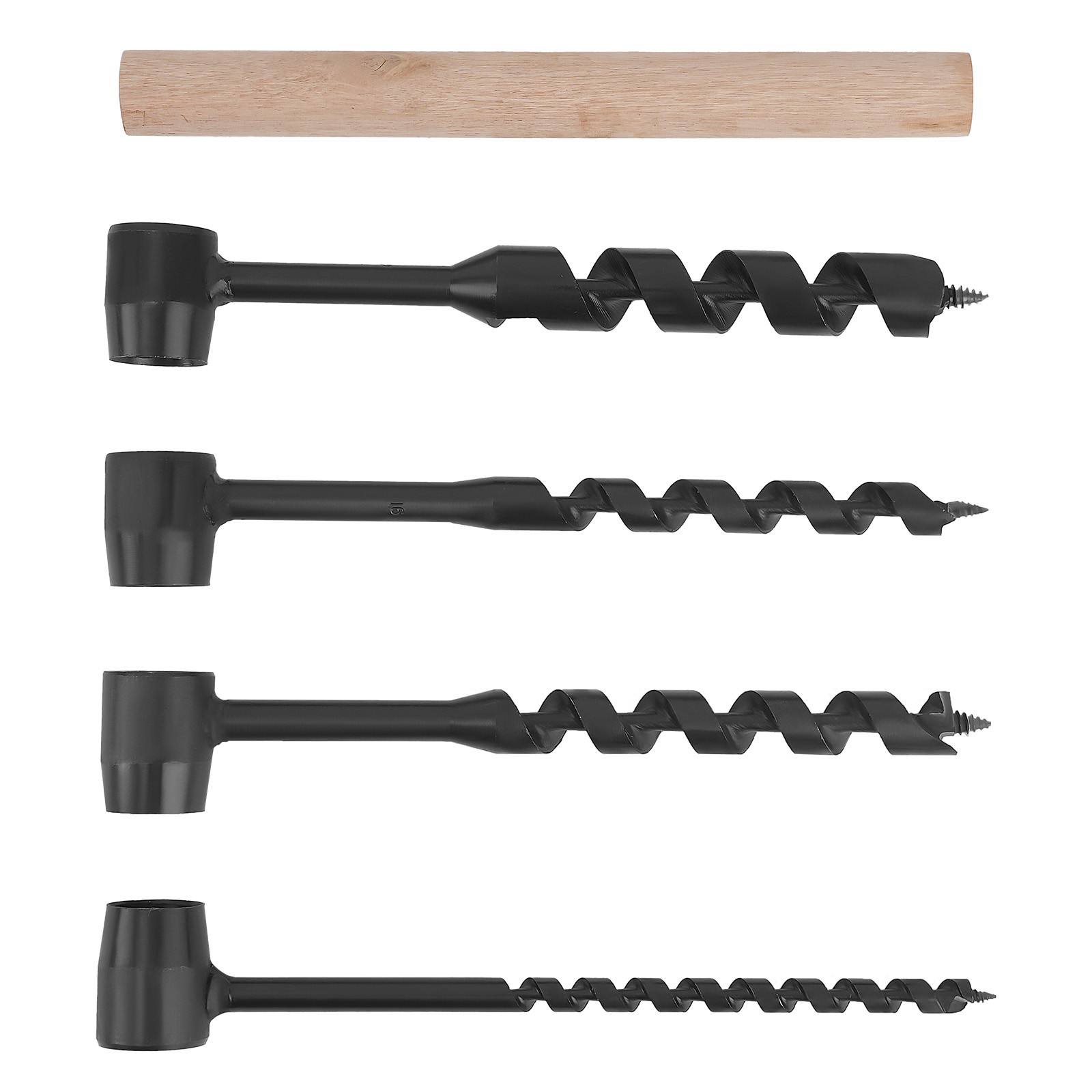

Photos from current listings. Actual item, color, and included accessories may vary.
Hand Wood Auger Buying Guide
A hand wood auger is a manual boring tool that drives a self-feeding screw-point bit through timber without electricity, trading motor power for leverage, control, and portability. The core trade-off is bit steel and shank geometry versus handle torque: a hardened, correctly tapered lead screw and a secure chuck or T-handle determine clean, straight holes and long service life. Buy a traditional T-handle auger with a full-length hex or round shank for deep timber boring; accept a compact bushcraft auger only when pack size matters more than bore diameter and depth.


At a glance
- Category
- Woodworking Hand Tools & Chisels
- Data updated
- Nov 20, 2026
Current offers
Highlights
- Screw-point auger bits self-feed via a tapered lead screw, pulling the cutting lips through grain far faster than a flat spade bit with less wrist torque.
- Bit steel matters: high-carbon steel holds a sharp edge for softwood and green wood, while HSS or cobalt alloys resist heat and abrasion in hardwood and repeated use.
- Shank and chuck interface decides stability: a standard 1/4-inch hex shank fits quick-change handles and braces, while round shanks need a keyed or keyless chuck to avoid slip.
- Handle style sets maximum torque and bore depth: a T-handle gives two-handed leverage for deep holes, a palm or spiral ratchet handle suits shallow, controlled bores and tight spaces.
Best use cases
- Best fit: timber framing, log building, and green-wood carpentry — choose a T-handle auger with a 1/2-inch hex shank and bits from 1/2 to 1-1/2 inch for deep, straight bores.
- Best fit: bushcraft and backcountry kit — pick a compact auger with a folding or detachable handle and 1/4-inch hex shank, accepting smaller maximum bore and shorter reach.
- Wrong fit: production cabinetmaking or repeated large-diameter holes in hardwood — skip hand augers and use a drill press or power auger; manual boring is slow and wrist-heavy above about 1 inch in dense stock.
- Wrong fit: metal, masonry, or plastic — hand wood augers are for wood only; the lead screw and cutting lips will dull or chip on non-wood materials.
Buying tips
- Match bit diameter to the fastener or dowel: a 1/2-inch auger suits 3/8-inch bolts with clearance, while 1-inch bits handle 3/4-inch dowels and pipe; never bore smaller than the hardware shaft.
- Check shank type before buying: 1/4-inch hex fits quick-change handles and impact drivers, round shanks need a chuck, and hex shanks resist slipping under high torque.
- For hardwood, choose HSS or cobalt-tipped bits; high-carbon steel is fine for softwood and green wood but dulls faster in oak, maple, and ash.
- Buy bits in a set with a consistent shank family so one handle or brace drives all sizes, and confirm the lead screw is tapered and sharp — a blunt screw causes wandering and torn entry holes.
Specs
| Drive Type | T-handle / brace / hex-shank handle |
|---|---|
| Shank Standard | 1/4-in hex / 3/8-in round / 1/2-in hex |
| Bit Steel | High-carbon / HSS / cobalt-tipped |
| Typical Bore Range | 1/4-in to 1-1/2-in |
Related searches
What to check before buying
- Measure the timber thickness and required hole depth; confirm the auger bit flute length exceeds that depth by at least 1 inch.
- Check your handle or brace chuck opening against the bit shank: 1/4-inch hex, 3/8-inch round, or 1/2-inch hex are the common standards.
- Verify clearance for the handle swing: a T-handle needs roughly the bit length plus handle radius of unobstructed space around the bore.
- For outdoor or green-wood use, confirm the bit steel and coating resist sap and moisture; uncoated high-carbon steel needs drying and oiling after use.
FAQ
Data sources: eBay / Amazon listings and product attribute feeds Data updated Nov 20, 2026.
Some links on this page are affiliate links. If you buy after clicking one, we may earn a commission at no extra cost to you. This does not change which products appear here or their order. Affiliate disclosure.