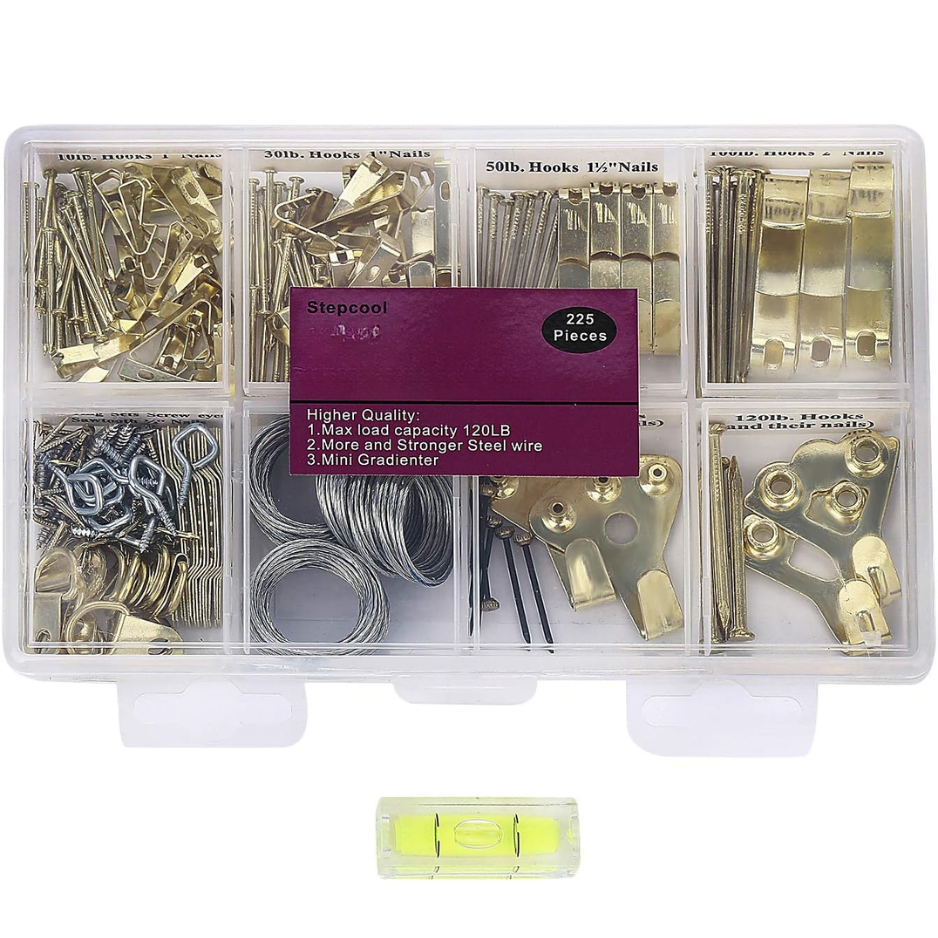

Photos from current listings. Actual item, color, and included accessories may vary.
Hanging Heavy Picture Without Nail Buying Guide
Nail-free heavy-picture hanging relies on adhesive strips, hooks, or toggle-style anchors that transfer load into drywall or plaster without studs. The core trade-off is between chemical adhesive systems (damage-free but load-limited and surface-sensitive) and mechanical anchors (higher capacity but require drilling and patching). Choose adhesive strips for flat, clean, painted drywall under 20 lb per strip pair; choose mechanical toggles or self-drilling anchors for anything above 30 lb or on plaster, tile, or brick.


At a glance
- Category
- Home Repair
- Data updated
- Nov 20, 2026
Current offers
Highlights
- Command-style adhesive strips are rated by pair: large strips typically hold 16-20 lb per pair on smooth painted drywall, with capacity halving on textured or glossy surfaces.
- Self-drilling zinc-plated toggle anchors (e.g., 1/8-inch or 3/16-inch) carry 50-80 lb in 1/2-inch drywall, far exceeding any adhesive strip system.
- Snap-toggle bolts require a 1/2-inch hole and toggle wings that expand behind drywall, distributing load across a 2-3 inch bearing surface to prevent pull-through.
- Picture-hanging wire gauge must match load: 30 lb rated wire is typically 0.06 inch diameter, while 50 lb rated wire steps up to 0.08 inch; undersized wire fails before the anchor does.
Best use cases
- Best fit: renter with smooth painted drywall hanging a 10-15 lb framed print — use two pairs of large adhesive strips rated 16-20 lb per pair, skip drilling entirely.
- Wrong fit: 40 lb mirror on plaster or wallpaper — adhesive strips will bond to the paper and tear it; instead use two 3/16-inch snap toggles into the plaster's gypsum core.
- Best fit: brick or concrete wall — use masonry screws or sleeve anchors with a hammer drill; adhesive strips and drywall toggles have no holding power on masonry.
- Wrong fit: hollow-core door or cabinet panel under 1/2 inch thick — toggle wings need 1/2-inch drywall minimum; use adhesive hooks rated for the door's surface or through-bolt instead.
Buying tips
- Calculate total load: frame + glass + backing + hardware. A 24x36 inch frame with glass can weigh 15-25 lb alone; add 20% safety margin when selecting anchors.
- Match anchor to wall substrate: drywall gets toggles or self-drilling anchors; plaster gets snap toggles with care; brick/concrete gets masonry sleeves; never use adhesive on fresh paint under 7 days cure.
- Use two anchors per heavy frame spaced 1/3 from each edge, not a single center hook — this halves the load per anchor and prevents rotation.
- Wire vs. D-ring: D-rings bolted to the frame back are stronger than screw eyes for frames over 20 lb; wire should be rated at least 1.5x the frame weight.
Specs
| Anchor Type | Adhesive strip / toggle / self-drill |
|---|---|
| Load per Anchor | 16-80 lb (drywall, pair vs single) |
| Wall Substrate | Drywall / plaster / masonry |
| Drill Required | No (adhesive) / Yes (toggle) |
Related searches
What to check before buying
- Weigh the assembled frame (bathroom scale works) and confirm wall substrate: drywall thickness (1/2 inch typical), plaster, or masonry.
- Measure stud locations with a magnetic or electronic stud finder — if a stud aligns within 2 inches of desired hook position, use a wood screw instead of any drywall anchor.
- Verify wall surface condition: no peeling paint, no wallpaper, no tile grout lines where adhesive strips would sit; clean with isopropyl alcohol and let dry fully.
- Confirm anchor hole size matches drill bit (e.g., 1/2-inch toggle requires 1/2-inch bit) and that toggle wings will clear any insulation or blocking behind drywall.
FAQ
Data sources: eBay / Amazon listings and product attribute feeds Data updated Nov 20, 2026.
Some links on this page are affiliate links. If you buy after clicking one, we may earn a commission at no extra cost to you. This does not change which products appear here or their order. Affiliate disclosure.