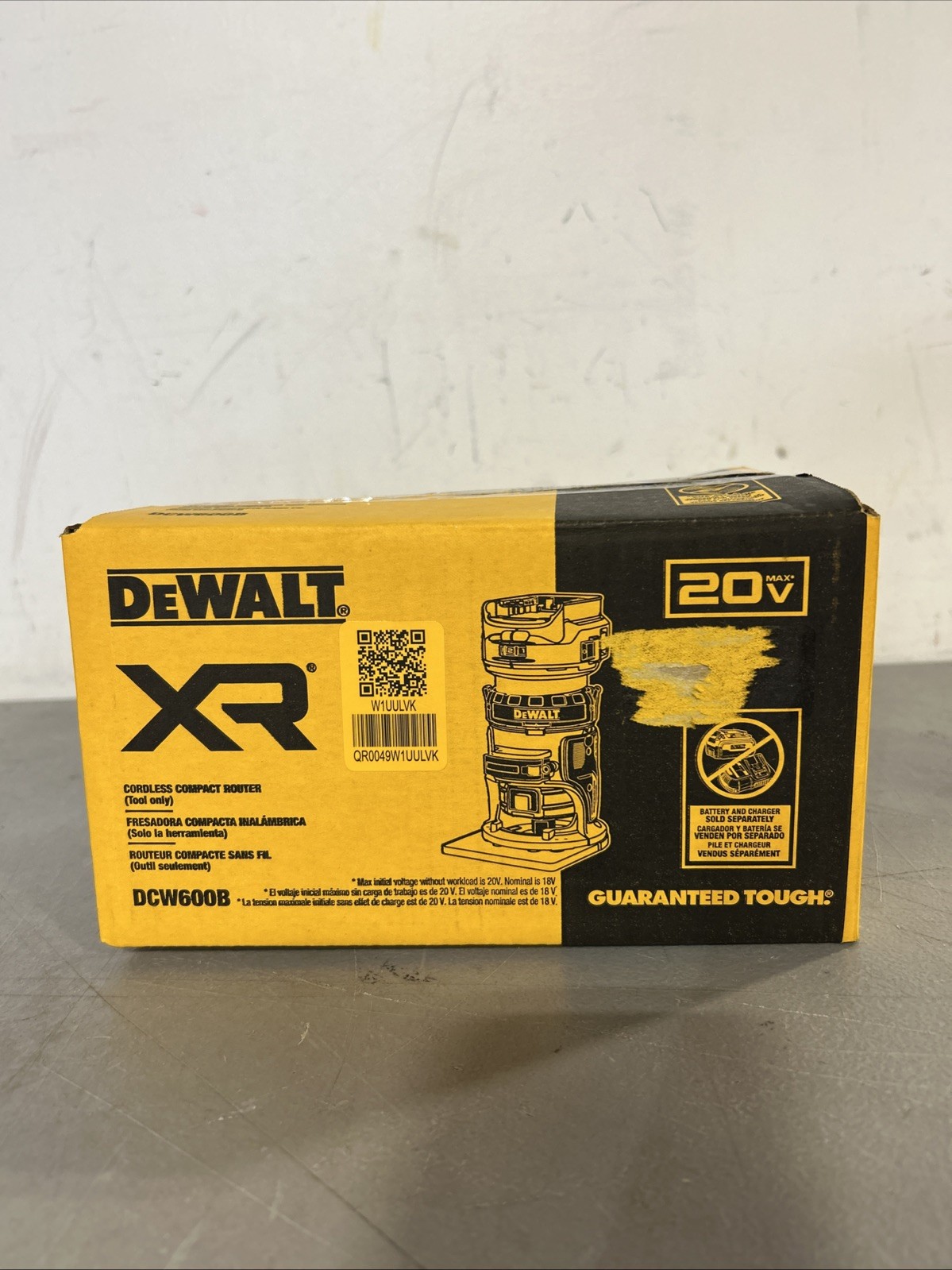

Photos from current listings. Actual item, color, and included accessories may vary.
Dewalt Router Buying Guide
The DeWalt router segment splits into fixed-base corded workhorses and the 20V Max cordless trim line, with the core trade-off being raw continuous power versus jobsite mobility. Buyers should select a corded model for sustained table-mounted routing and the DCW600B-class cordless only for trim and light plunge work where portability outweighs runtime. The decision rule is simple: any router under 1.75 HP or without a standard 1/2-inch collet capacity is a compromise for hardwood profiling.


At a glance
- Category
- Wood Routers & Carving Tools
- Data updated
- Nov 20, 2026
Current offers
Highlights
- Corded DeWalt routers split into 1.75 HP fixed-base (DW616-class) and 2.25 HP plunge/fixed combo (DW618-class) tiers, both using 1/2-inch and 1/4-inch collets.
- The DCW600B cordless router is brushless, 20V Max XR, tool-only, with a 1/4-inch collet and micro-adjust depth ring — it is a trim router, not a table router.
- DeWalt corded motors use replaceable brushes and sealed ball bearings; the brushless cordless platform eliminates brush wear but depends on battery state for RPM stability.
- All DeWalt routers accept standard 1/2-inch or 1/4-inch shank bits; the 2.25 HP models support raised-panel and large-diameter bits that 1.75 HP units cannot spin safely.
Best use cases
- Best fit: cabinet and furniture work with large-diameter bits (raised panels, bullnose) — pick the 2.25 HP DW618-class corded combo and skip any trim router.
- Best fit: jobsite trim, hinge mortises, and edge profiling away from outlets — the DCW600B brushless 20V tool-only is correct, paired with a 5.0Ah XR battery.
- Wrong fit: routing hardwood dados all day in a router table — a 1.75 HP fixed-base or any cordless trim router will bog down; step up to 2.25 HP corded.
- Wrong fit: buying the DCW600B as a first and only router for general shop work — it lacks the power and 1/2-inch collet for panel bits.
Buying tips
- Match collet size to bit shank: 1/2-inch collets are mandatory for bits over 1-inch diameter; 1/4-inch only is a trim-router limitation, not a shop-router spec.
- For table mounting, choose a fixed-base model with a flat top and removable motor; plunge bases add repeatable depth stops but reduce rigidity in a table.
- Cordless runtime scales with battery: a 20V 5.0Ah pack gives roughly 2-3x the cuts of a 2.0Ah pack; tool-only kits require you to budget for XR batteries and a charger.
- Check base opening and sub-base compatibility: aftermarket guide bushings and edge guides need standard 1-3/16-inch or 1-3/8-inch sub-base centers to fit DeWalt bases.
Specs
| Power Source | Corded 1.75-2.25 HP vs 20V cordless |
|---|---|
| Collet Capacity | 1/2-inch + 1/4-inch vs 1/4-inch only |
| Base Type | Fixed / Plunge / Combo / Trim |
| Motor Type | Brushed corded vs Brushless 20V |
Related searches
What to check before buying
- Measure your router table plate opening: standard 3-1/2-inch or 4-1/4-inch plates accept DeWalt fixed bases; verify motor diameter fits the plate bore.
- Confirm your power source: corded routers need a 15A circuit for 2.25 HP models under load; cordless requires 20V Max XR batteries and a charger if buying tool-only.
- Check bit inventory: if you own 1/2-inch shank panel bits, you need a 1/2-inch collet model; 1/4-inch-only trim routers cannot run them safely.
- Plan dust collection: DeWalt fixed bases accept standard 1-1/4-inch or 2-1/2-inch shop-vac hoses via adapter; cordless trim routers have smaller ports needing a reducer.
FAQ
Data sources: eBay / Amazon listings and product attribute feeds Data updated Nov 20, 2026.
Some links on this page are affiliate links. If you buy after clicking one, we may earn a commission at no extra cost to you. This does not change which products appear here or their order. Affiliate disclosure.