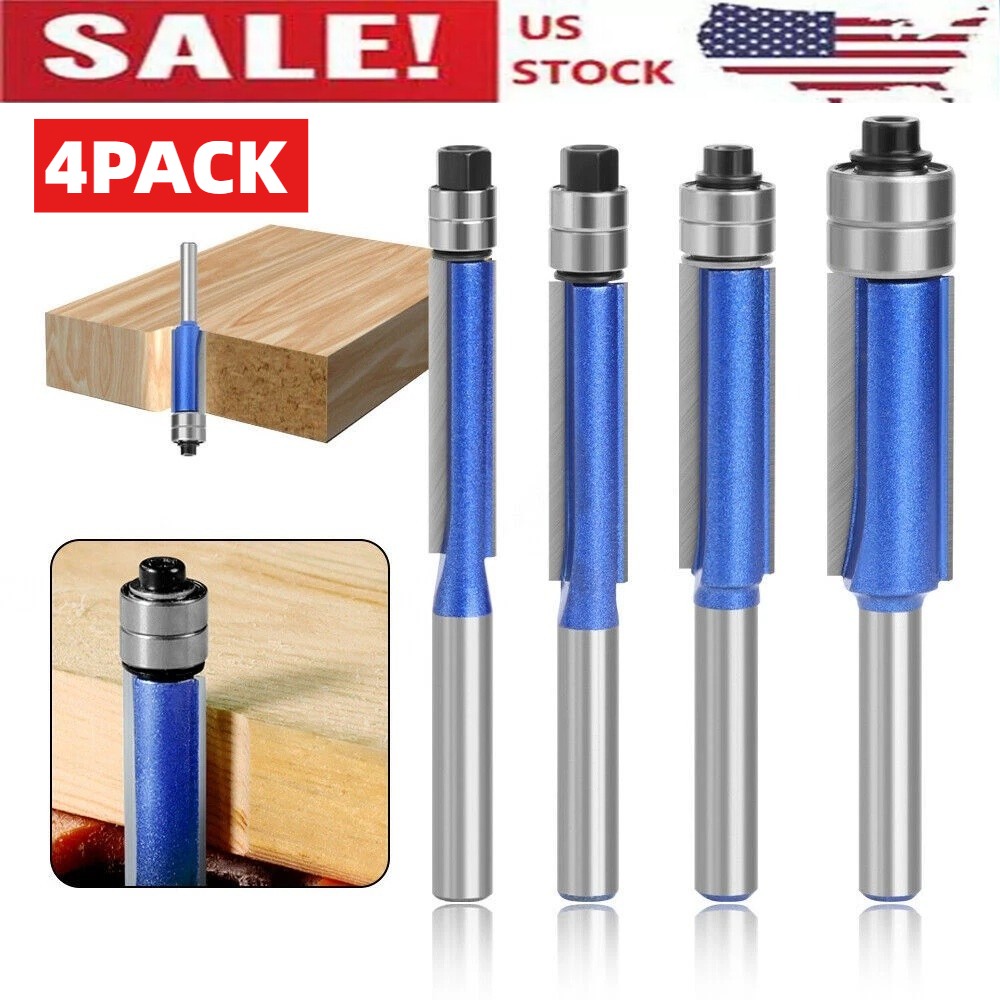

Photos from current listings. Actual item, color, and included accessories may vary.
Bearing Flush Trim Router Bit Buying Guide
A bearing flush trim router bit uses a top-mounted ball-bearing guide to copy a template or pattern onto a workpiece, making it the core tool for template routing, pattern work, and edge trimming. The critical trade-off is bearing quality and cutter geometry: a sealed, hardened bearing and solid carbide spiral or shear-cutting flutes hold tolerance over thousands of linear feet, while loose ABEC-1 bearings and brazed straight flutes burn edges and wander. The decision rule is simple: buy bits with a fully sealed top bearing, 1/2-inch shank above 3/4-inch cutting diameter, and solid carbide cutters for production work; reserve 1/4-inch shank sets for light trim and laminate only.


At a glance
- Category
- Wood Routers & Carving Tools
- Data updated
- Nov 20, 2026
Current offers
Highlights
- Top-bearing flush trim bits guide off the template above the cutter; bottom-bearing versions guide off the workpiece below—choose top-bearing for template-on-top workflows and bottom-bearing for pattern bits following a straight edge.
- Solid carbide spiral flush trim bits shear fibers cleanly and resist burning; straight-flute carbide is cheaper but prone to tearout on cross-grain and plywood, while high-speed steel (HSS) dulls quickly in hardwood.
- Bearing size must match cutter diameter: a 1/2-inch cutter uses a 1/2-inch OD bearing, and swapping to a smaller bearing creates a deliberate offset or rabbet—an intentional feature, not a defect.
- Shank diameter governs stability: 1/4-inch shanks flex and chatter above 3/4-inch cutting diameter, while 1/2-inch shanks are mandatory for large-diameter pattern bits and deep cuts in hardwood.
Best use cases
- Template and pattern routing (guitar bodies, signs, furniture parts): pick a top-bearing solid carbide spiral bit with 1/2-inch shank and a 1/2- to 3/4-inch cutting diameter; skip 1/4-inch shank sets, which chatter and leave scallops.
- Laminate and veneer trimming: use a small-diameter (1/4- to 3/8-inch) top-bearing bit with a 1/4-inch shank and a bearing that rides the substrate; do not use large pattern bits, which chip thin laminate.
- Edge trimming after flush-trimming a glued-up panel: a compression spiral (up-cut below, down-cut above) gives clean top and bottom edges; a straight-flute bit is acceptable for softwood but will tear out on plywood and oak.
Buying tips
- Match bearing OD to cutter diameter exactly (1/2-inch cutter = 1/2-inch bearing); keep spare bearings in 1/8-inch increments to create controlled offsets for inlay and rabbet work.
- Choose solid carbide over brazed carbide for any hardwood or production use—carbide holds an edge through abrasive glue lines and plywood, while HSS is only acceptable for softwood and occasional trim.
- Use 1/2-inch shank for cutting diameters of 3/4-inch and above or depths over 1/2-inch; 1/4-inch shank is safe only for small trim bits under 1/2-inch diameter.
- For plywood and melamine, select a compression or down-cut spiral to prevent top-face tearout; straight-flute bits are for solid softwood and pattern work where direction is controlled.
Specs
| Bearing Position | Top-bearing vs bottom-bearing |
|---|---|
| Cutter Material | Solid carbide vs brazed carbide vs HSS |
| Shank Diameter | 1/4 in vs 1/2 in |
| Flute Geometry | Straight vs spiral vs compression |
Related searches
What to check before buying
- Verify your router collet accepts the shank size—1/4-inch collets cannot hold 1/2-inch shanks, and a 1/2-inch collet with a 1/4-inch bit requires a reducer sleeve that adds runout.
- Confirm the template thickness matches the bearing position: top-bearing bits need the template on top of the workpiece, and the bearing must ride the template edge, not the workpiece.
- Check that the bit's cutting length exceeds your stock thickness plus the template thickness, or the bearing will not contact the template before the cutter bottoms out.
- Ensure the router's minimum speed rating suits the bit diameter—large-diameter pattern bits require reduced RPM (typically 12,000-16,000) to avoid burning and bearing failure.
FAQ
Data sources: eBay / Amazon listings and product attribute feeds Data updated Nov 20, 2026.
Some links on this page are affiliate links. If you buy after clicking one, we may earn a commission at no extra cost to you. This does not change which products appear here or their order. Affiliate disclosure.