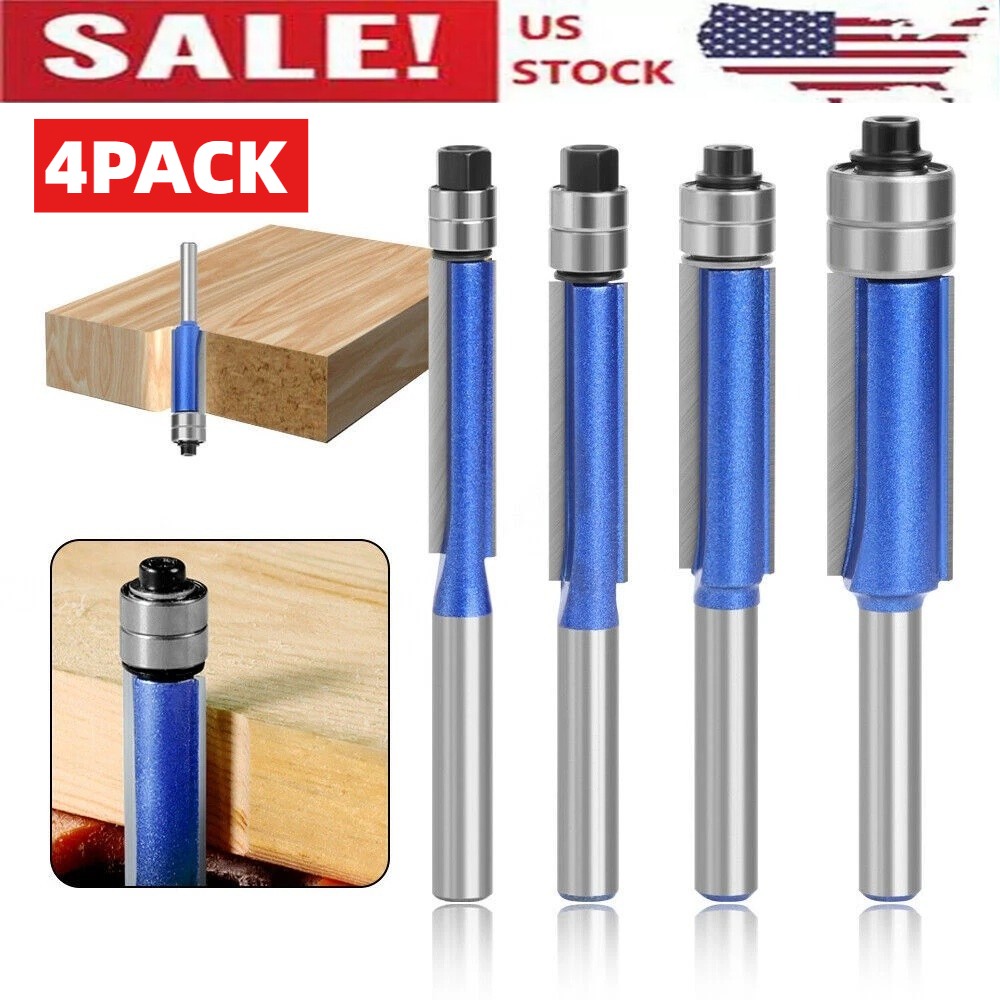

Photos from current listings. Actual item, color, and included accessories may vary.
Bearing Router Bit Buying Guide
Bearing router bits use a top- or bottom-mounted bearing to ride a template, edge, or workpiece for repeatable flush trimming, pattern routing, and edge profiling. The core trade-off is bearing quality and cutter geometry: sealed, hardened bearings with a precise inner race hold tolerance and resist dust, while open or soft bearings wear quickly and cause burning or tear-out. Buy a bit whose bearing inner diameter matches your arbor, whose cutter diameter matches your template offset, and whose carbide grade suits the material—anything less is a short-life compromise.


At a glance
- Category
- Wood Routers & Carving Tools
- Data updated
- Nov 20, 2026
Current offers
Highlights
- Top-bearing vs bottom-bearing: top-bearing bits ride the template above the cutter for pattern routing with the template on top; bottom-bearing bits reference the workpiece edge below for flush trimming against a base template.
- Bearing bore and arbor: 1/4-inch shank bits typically use a 1/4-inch bore bearing; 1/2-inch shank bits use 1/2-inch bore, and correct bore-to-arbor fit prevents bearing wobble and cutter chatter.
- Carbide grade and geometry: micrograin carbide with 2–3 flutes and shear-angle cutting edges resists burning in hardwood; straight-flute bits clear chips faster but leave rougher edges in plywood and melamine.
- Bearing seal and material: sealed, double-shielded steel bearings rated for 10,000+ RPM hold up to router dust; open bearings and plastic-shielded bearings fail early under heat and fine dust.
Best use cases
- Flush trimming laminate or veneer edges: choose a bottom-bearing flush trim bit with a 1/2-inch shank and 1/2-inch cutter diameter for stability; skip 1/4-inch shank bits for heavy trim passes.
- Pattern routing repeated shapes from a template: choose a top-bearing pattern bit with bearing above the cutter and a cutter length matched to template thickness; skip bearing-only guide bits that lack a bottom cutter.
- Edge profiling with a rub collar or fence: choose a bearing bit only when the bearing matches the profile depth; skip bearing bits for freehand edge rounding where a round-over bit with a bearing of the correct radius is required.
Buying tips
- Match shank to router collet: 1/2-inch shank bits flex less and are safer for deep cuts; 1/4-inch shank suits compact routers and light trimming only.
- Match bearing inner diameter to arbor: a 1/4-inch bore bearing will not fit a 1/2-inch arbor; buy bearing kits with matched ID/OD pairs for your bit series.
- Choose cutter diameter for template offset: the bearing OD minus cutter diameter equals the offset; confirm this equals your template guide difference before cutting.
- Select carbide grade by material: C2 micrograin for hardwood and laminate, C3 for softwood and MDF; coated bits resist pitch buildup in resinous woods.
Specs
| Bearing Position | Top-bearing / Bottom-bearing |
|---|---|
| Shank Size | 1/4 in / 1/2 in collet |
| Cutter Material | Micrograin carbide (C2–C3) |
| Bearing Type | Sealed double-shielded steel |
Related searches
What to check before buying
- Router collet size: confirm 1/4-inch or 1/2-inch collet capacity and that the bit shank matches exactly—never use a reducing sleeve in a worn collet.
- Template thickness and bearing position: measure template height so the top or bottom bearing contacts the template face across the full cut depth.
- Router RPM range: verify the bit's maximum RPM rating exceeds your router's no-load speed at the selected setting, especially for large-diameter bits.
- Dust extraction and bearing clearance: ensure the bearing is not blocked by the sub-base or dust shoe and that chips clear the bearing race during operation.
FAQ
Data sources: eBay / Amazon listings and product attribute feeds Data updated Nov 20, 2026.
Some links on this page are affiliate links. If you buy after clicking one, we may earn a commission at no extra cost to you. This does not change which products appear here or their order. Affiliate disclosure.